All species › Falcons › Falcons and caracaras › Peregrine Falcon
Peregrine Falcon | Falco peregrinus
Slechtvalk | Halcón peregrino
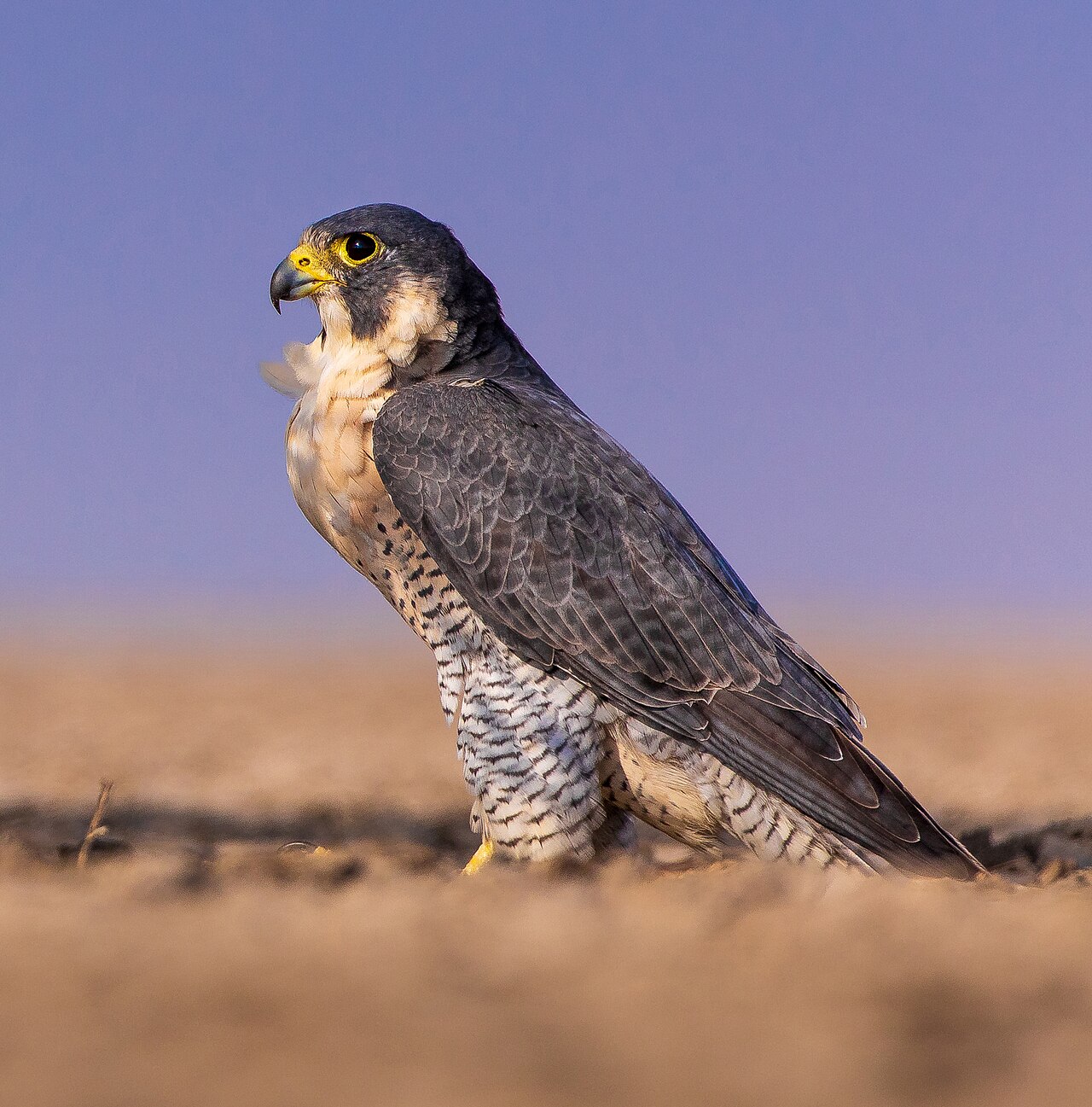
The Peregrine Falcon is the world bird among falcons — it breeds on every continent but Antarctica — and at the same time a scarce species in Australia, common nowhere. It is the fastest bird on earth: in a stoop at prey speeds of well over three hundred kilometres an hour are reached, and that dive from height is the image it is known for.
Voice
At the nest it gives a loud, shrill, rapidly repeated series of sharp cries, hek-ek-ek-ek, deeper in the female than the male, and fiercest when an intruder — a Wedge-tailed Eagle, a raven or a climber — comes too close to the ledge. Between partners a softer, plaintive wee-chup accompanies food passes. Away from breeding it is silent; if you hear it, you are almost always standing by an occupied eyrie.
No freely licensed recording has been found for this species yet; what to listen for is described below.
Identification
A stocky, heavily built falcon of about forty centimetres with a broad chest, long pointed wings and a relatively short tail — in flight an anchor shape with fast, stiff beats alternating with long glides. The upperparts are blue-black to slate, the chin, throat and breast creamy white, and from breast to tail runs fine, dense barring. Decisive is the full black helmet: a broad moustache running down the cheek from the eye and merging with the black cap into one piece. Cere, orbital ring and legs are yellow, the bill yellow with a black tip. Australian birds of the race macropus are smaller and darker than northern forms; juveniles are browner above and streaked rather than barred below.
Confusion species
Among the seven falcons of this region size is the first sort. Australian Hobby (Falco longipennis) is distinctly smaller and lighter, with rufous rather than white underparts, a pale nape collar instead of a closed helmet and a flickering, swift-like beat; the vagrant Eurasian Hobby (Falco subbuteo) is equally small but white with crisp black streaks. Brown Falcon (Falco berigora) is as large or larger, but brown, long-legged, noisy, and flies slowly and rowing with wings in a V. Black Falcon (Falco subniger) is larger, longer-tailed and wholly dark with no white underside. Grey Falcon (Falco hypoleucos) is paler and more thickset, with orange bare parts and black wingtips. New Zealand Falcon (Falco novaeseelandiae) is broader-winged and longer-tailed and occurs only in New Zealand, where the Peregrine is absent — the two can never be seen side by side in the field.
Habitat
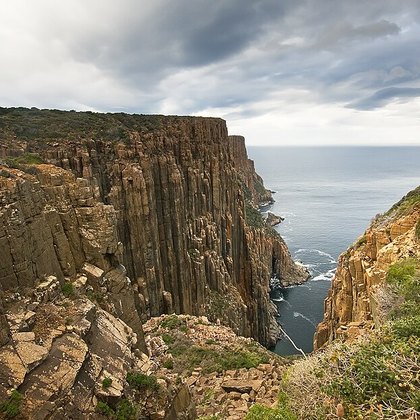
From rainforest to desert and from the coast to the alpine zone, provided there is an elevated nest site. Its core is cliffs: sea cliffs and rock faces on the coast and inland, quarries, and nowadays tall buildings and towers in the large cities. It also breeds in open woodland near water in the abandoned stick nests of other raptors and in hollows of big eucalypts. Hunting is done over open ground: estuaries and tidal flats with waders, lakes with ducks, and over town on pigeons.
Where the bird is most often found, arranged by main group and formation.




Range and movements
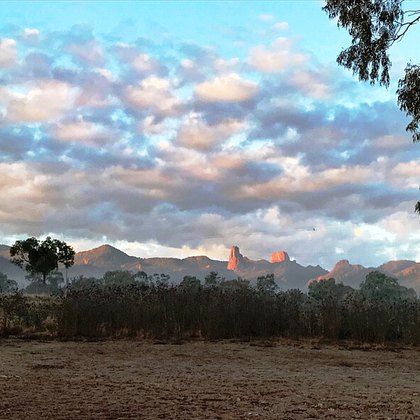
Throughout Australia, from the tropical north coast to Tasmania and from the west coast to the east, but everywhere at low density: this is nowhere a common bird. It is densest in the coastal belt and along the ranges of the Great Dividing Range; in the true interior it follows rock cliffs and gorges. In south-western Australia the smaller, darker form submelanogenys occurs. New Zealand has no breeding Peregrines — the New Zealand Falcon takes its place there — and Norfolk Island also lies outside the breeding range.
- Resident
- dark = core range, pale = thinly spread
Where and when to look
Work a sea cliff or an inland gorge and scan the ledges for a stocky, dark bird perched upright with wingtips reaching the tail tip; white chalk streaks below a ledge betray an occupied site. In town it works the other way round: wait by a tall building until the pigeons go up in panic. If you hear the fast hek-ek-ek, keep your distance — you are then too close to a nest.
Conservation
Least Concern (LC), and in Australia rated secure federally and in almost every state, the exception being South Australia, where it is listed as rare. The species is the textbook case of recovery after a crash: in the mid-twentieth century populations collapsed worldwide through DDT, which thinned eggshells, and after the ban numbers have climbed back in most places. The Australian population was never hit as hard as the North American and European ones. What presses now is disturbance of cliff nests by climbers and drones, illegal taking of young for falconry, and local poisoning through prey.
Scientific name
Falco peregrinus | Tunstall, 1771
Tunstall described the species in 1771 as Falco Peregrinus; the genus has not changed since, so author and year carry no parentheses. Falco is Latin for 'falcon'; peregrinus means 'wandering' or 'foreign' and refers both to the long movements of northern populations and to the falconers' habit of catching young birds on passage rather than taking them from the nest. The type locality is Northamptonshire, England. Australian birds belong to the race macropus, 'large-footed', described by Swainson in 1837.