All species › Owlet-nightjars › Owlet-nightjars › Australian Owlet-Nightjar
Australian Owlet-Nightjar | Aegotheles cristatus
Australische dwergnachtzwaluw | Egotelo australiano
The Australian Owlet-Nightjar is the commonest nocturnal bird on the continent and at the same time the least seen: a small, large-eyed creature that spends the day in a tree hollow and looks out of it head first as dusk comes on. It takes its insects partly in the air and partly on foot on the ground, for which it has relatively long legs.

Voice
The call is a loud grating churr of two or three notes, chirr-chirr-chirr, given from the hollow or on the wing and repeated at intervals for hours through the night. Pairs answer one another, so that the sound comes from two sides of the same patch of trees. Disturbed at the hollow it blows and hisses and claps its bill. The churr is the main character the species offers, because the bird itself usually stays invisible in the dark.
Recording: Romuald Mikusek — CC BY-NC-SA 4.0 · Batehaven, Eurobodalla Shire Council, New South Wales, Australia · xeno-canto
Identification
A small nocturnal bird of twenty-one to twenty-five centimetres with a round head, large dark eyes, a tiny bill ringed with bristles, a long tail and short rounded wings. The plumage comes in two colour forms: grey, much the commoner, and rufous, which occurs mainly in females. The underparts are paler with fine black barring, and two broad black stripes run over the crown from above the eyes and meet on the nape — the best character in either form. The flight is fluttering and low, more like that of a large moth than of a nightjar.
Confusion species
Tawny Frogmouth (Podargus strigoides) is far larger, has a heavy grey bill and an enormous gape, and sits upright against a branch by day instead of in a hollow. Australian Boobook (Ninox boobook) is a true owl with a hooked bill, feathered feet and claws, and a wholly different two-syllable call. Spotted Nightjar (Eurostopodus argus) hunts high and swerving in open air on long pointed wings and rests on bare ground. An owlet-nightjar crossing the headlights at night is often taken for a bat.
Habitat
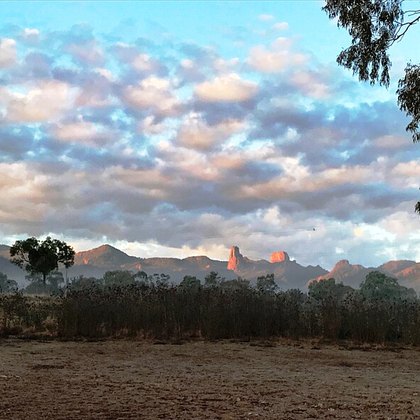
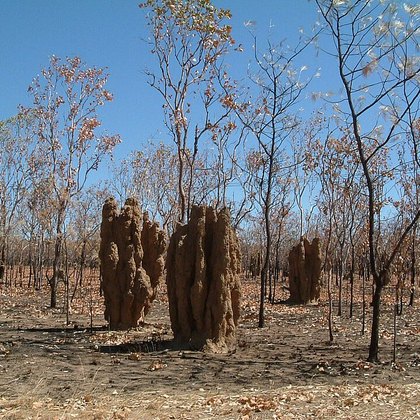
Almost any landscape with trees that carry hollows: dry eucalypt forest and woodland, river red gum along creeks, mallee (low, multi-stemmed eucalypt scrub of dry southern Australia), savanna woodland, casuarina and callitris stands, and beyond that gardens, parks and old street trees. In treeless country it uses crevices in rock and in creek banks, so that it holds on even in gibber country (stony desert with a pavement of polished stones) and sand desert. It avoids closed rainforest and the wettest coastal forests.
Where the bird is most often found, arranged by main group and formation.




Range and movements
Across the whole of mainland Australia and on Tasmania, from the coast into the driest interior, and on into southern New Guinea. It does not migrate and barely wanders: a pair holds the same territory year round and uses a set of regular hollows within it to spend the day in. It does not occur in New Zealand; the guide carries it for the Australian part of the region only.
- Resident
- dark = core range, pale = thinly spread
Where and when to look
Stand at dusk by an old tree rich in hollows and keep an eye on the openings: just before full dark the bird puts its head out and sits there for a minute or two before flying off. By day a pale round face in a crevice sometimes gives it away already. Never knock on the trunk; a disturbed bird leaves the hollow and the chance is gone.
Conservation
Least Concern (LC) and common across the mainland, including in towns and on the edge of cities. The loss of old hollow-bearing trees is the heaviest pressure, since the species both roosts and nests in them and young trees do not supply hollows. Beyond that, feral cats and road deaths on country roads count.
Scientific name
Aegotheles cristatus | (Shaw, 1790)
Shaw described the bird in 1790 as Caprimulgus cristatus, among the nightjars; because it was later moved to another genus, author and year stand in parentheses. The genus Aegotheles was introduced by Vigors and Horsfield in 1827, after Greek aigothelas, 'goat-milker', the old name for the nightjars. cristatus means 'crested', though little of a crest shows in the field. The type locality is New South Wales.