All species › Frogmouths › Frogmouths › Tawny Frogmouth
Tawny Frogmouth | Podargus strigoides
Uilnachtzwaluw | Podargo australiano
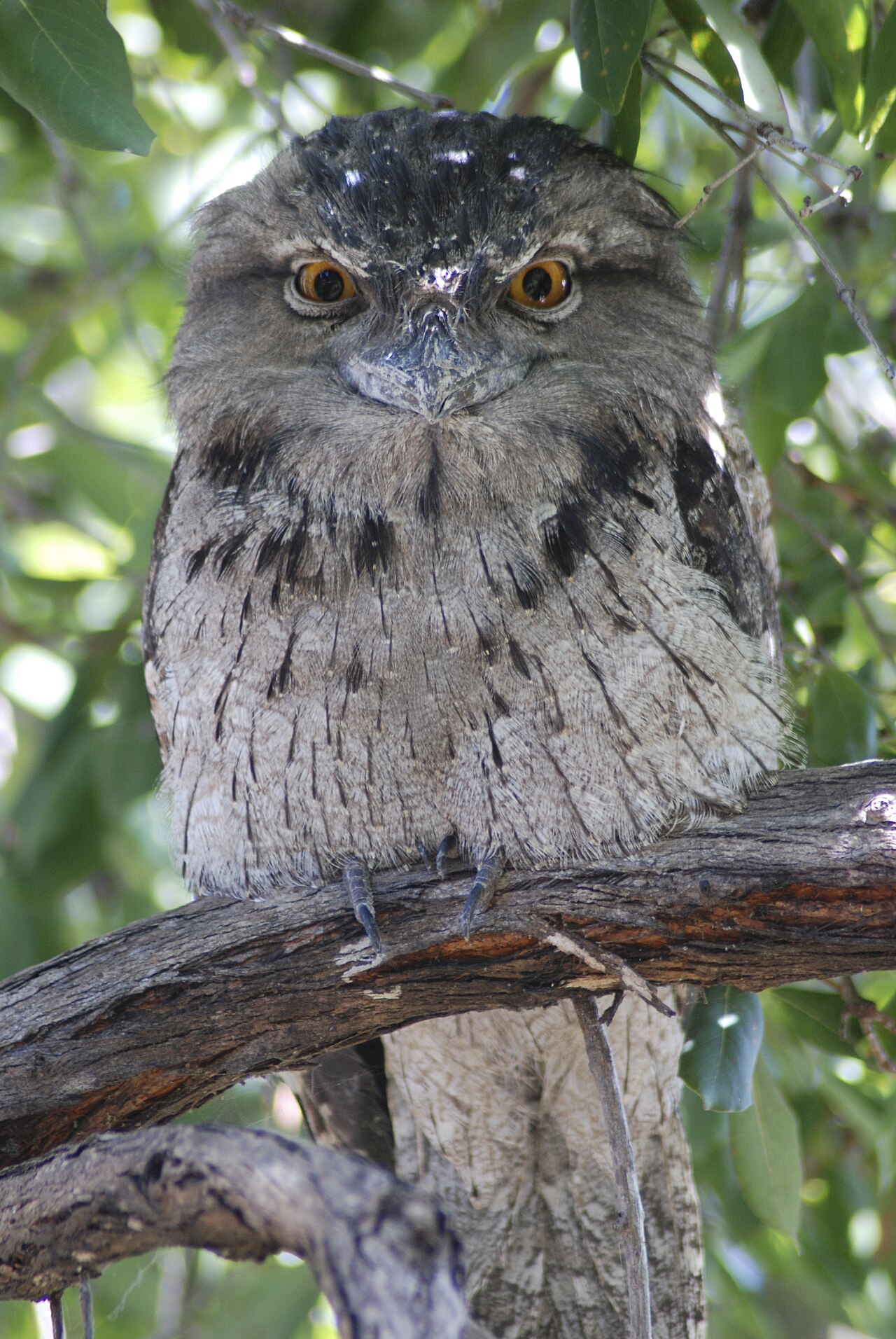
The Tawny Frogmouth is the most seen and least noticed night bird in Australia: by day it sits motionless and angled upward against a branch, and anyone who does not know it is looking at a broken stub. It does not hunt on the wing like a nightjar but drops onto prey on the ground from a low perch.
Voice
The territorial sound is a deep, continuous booming, oom-oom-oom-oom, about eight notes in five seconds, kept up for hours and at distance more felt than heard. Pairs call in turn and lock into each other's rhythm, which makes the sound seem twice as fast. Disturbed, the bird claps its bill and hisses; young beg with a persistent squeaking whistle.
No freely licensed recording has been found for this species yet; what to listen for is described below.
Identification
A grey, silver-marbled bird with black lengthwise streaking, a broad flat head, a yellow iris and a heavy grey bill with an enormous frog-like gape and stiff bristles above it. The plumage comes in three colour morphs, from silver-grey to rufous; rufous birds are usually females. At rest it presses against the branch with bill raised and eyes narrowed to slits, so the outline dissolves into the bark. Flight is silent and low, on short broad wings with a long tail.
Confusion species
Papuan Frogmouth (Podargus papuensis) of the Queensland wet tropics is larger, more rufous and longer-tailed, with a red eye instead of a yellow one. Australian Boobook (Ninox boobook) is a true owl: forward-facing eyes, a short hooked bill and feathered feet with talons, and it takes prey on the wing. Spotted Nightjar (Eurostopodus argus) hunts twisting in open air and rests on the ground, never crosswise on a branch.
Habitat
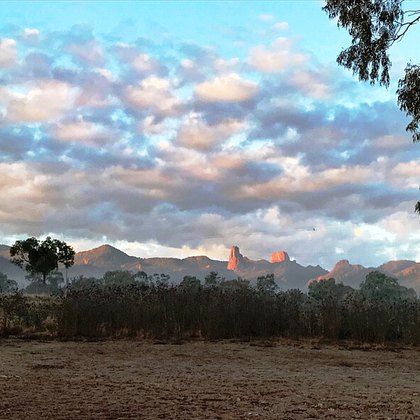
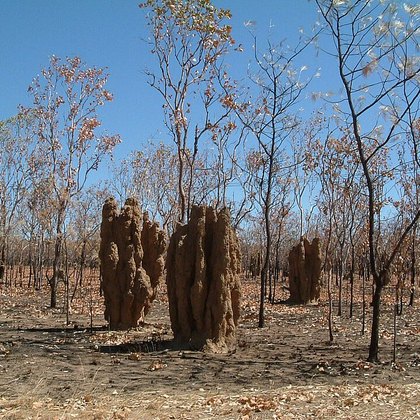
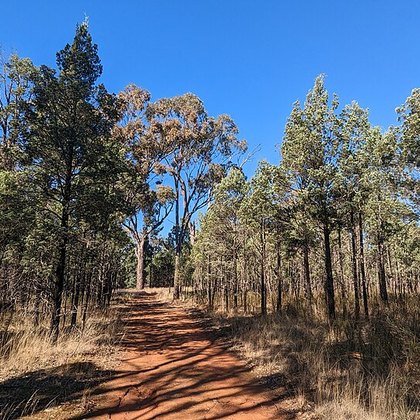
Almost every wooded landscape: dry eucalypt forest and woodland, river red gum along creeks, mallee, savanna woodland, casuarina and callitris belts, and beyond them gardens, parks and street trees into the centre of cities. What it needs is a horizontal branch to spend the day on and open ground or short grass beneath it to hunt from. Closed rainforest, alpine bog and treeless desert are left out.
Where the bird is most often found, arranged by main group and formation.



Range and movements
Across the whole Australian mainland and Tasmania, from the coast into the dry interior, densest in the wooded southeast. It does not migrate and barely wanders: a pair holds the same territory for years and often the same roost. The species is absent from New Zealand; the guide carries it for the Australian part of the region only.
- Resident
- dark = core range, pale = thinly spread
Where and when to look
By day look for white splashes and coughed-up pellets under a thick horizontal branch; that gives away a regular roost the bird returns to year after year. Stand there at dusk and wait for the silhouettes to move. Drive slowly on country roads at night: the bird hunts from posts along the verge and is often hit there.
Conservation
Not threatened (LC) and common across the mainland, including built-up areas. The main losses are collisions with vehicles at dusk and poisoning at one remove, as the bird takes insects and mice exposed to pesticides and rodenticides. In the longer run the loss of old, thick trees with horizontal limbs presses on it, because without those limbs there is neither roost nor nest.
Scientific name
Podargus strigoides | (Latham, 1801)
Latham described the bird in 1801 as Caprimulgus strigoides, among the nightjars; because it was later moved to another genus, author and year stand in parentheses. The genus Podargus was introduced by Vieillot in 1818, after Greek podargos, 'swift-footed' — an odd choice for a bird that hardly walks. strigoides means 'owl-like', from Strix, the genus of the wood owls. The type locality is New Holland, restricted by Mathews to Sydney.