All species › Cranes, rails and allies › Rails, gallinules and coots › Baillon's Crake
Baillon's Crake | Zapornia pusilla
Kleinst waterhoen | Polluela chica
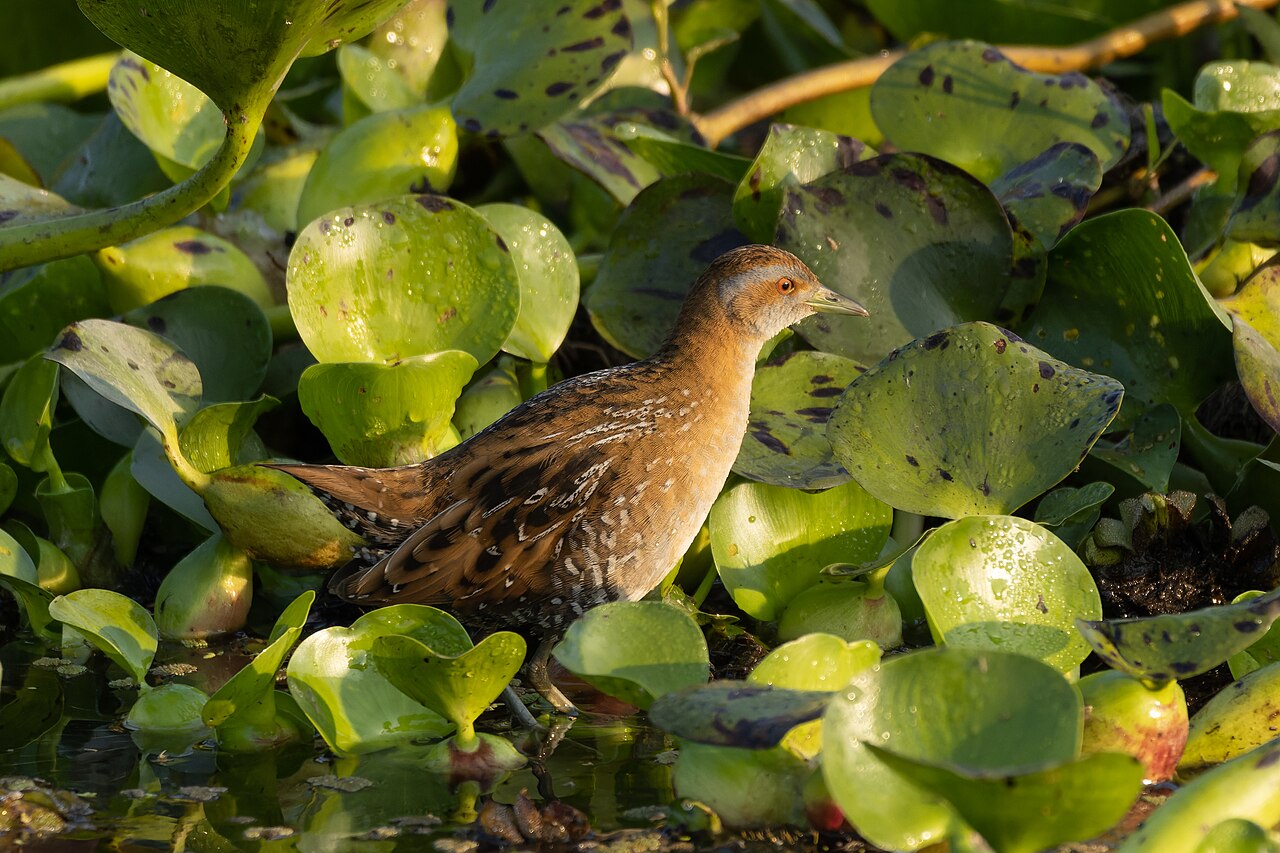
Baillon's Crake is the smallest rail of the region, barely bigger than a sparrow and seldom in view for longer than a second. Warm cinnamon-brown above with black-and-white markings, blue-grey below, with a short green bill, olive-yellow legs and a bright red eye. Most sightings amount to a shadow shooting between two sedge tussocks.
Voice
The characteristic sound is a dry, sustained rattle, krrrrrr, with something of a croaking frog about it, heard mostly at first light, at dusk and through the night. Beyond that come short high ticks and a soft purring between partners. It calls more than it shows, and in most swamps the rattle is the only evidence that it is there.
No freely licensed recording has been found for this species yet; what to listen for is described below.
Identification
Fifteen to eighteen centimetres and thirty to forty grams — the bulk of a sparrow, on long toes. The upperparts are warm cinnamon to rufous-brown with black streaks and white flecks, the head and underparts blue-grey, and the flanks and undertail sharply barred black and white. The bill is short, straight and green, with no red at the base; the legs are olive-yellow to yellow-green and the eye bright red. Females are slightly duller with a white throat; young birds are brown with finely mottled underparts and a brown eye.
Confusion species
Australian Crake (Porzana fluminea) is clearly larger, darker slate-grey on the breast, has white specks on the back, an orange-red patch at the bill base and a broad white border below the black tail. Spotless Crake (Zapornia tabuensis) is the hard one: slightly larger, but above all uniform dark slate-grey with no warm brown at all, an olive-brown mantle without white flecks, and red rather than olive-yellow legs; its undertail is finely barred without a white border. Lewin's Rail (Lewinia pectoralis) is much larger, with a rufous crown and a long pink bill.
Habitat
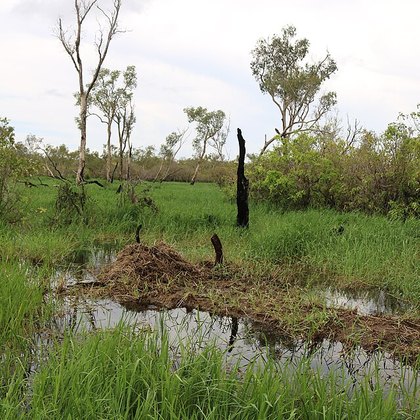
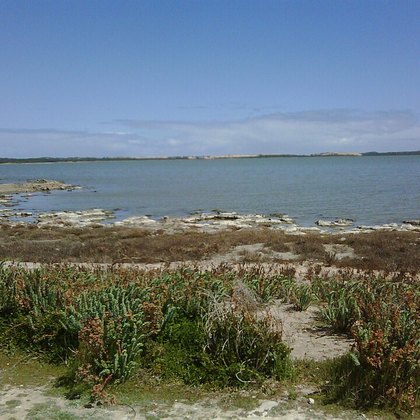
Low, dense marsh vegetation in shallow fresh and brackish water: sedge, rushes, raupo and cumbungi, floating mats and wet tussocky pasture. On the coast also saltmarsh with samphire and the reed fringe of estuaries, and inland the vegetated margins of lakes, pools and settling ponds. It walks over the floating vegetation and the mud beneath it, almost entirely inside cover.
Where the bird is most often found, arranged by main group and formation.


Range and movements
In Australia scattered through the southeast and southwest, with temporary populations inland whenever the swamps fill; in the tropics only locally. In New Zealand, where it is the koitareke or marsh crake, it occurs throughout the country but with its stronghold on the South Island, in sedge and raupo swamp, estuarine reed beds and at times wet pasture or willow woodland. It shifts short distances as the water comes and goes.
- Resident
- Breeding (summer)
- Winter
- dark = core range, pale = thinly spread
Where and when to look
Stand at first light on a bund or a boardwalk above a sedge swamp and listen for the rattle; after that it is a matter of not moving and keeping an eye on the gap between two tussocks. Lookouts and boardwalks over marsh — such as the settling ponds of the big sewage treatment works in Victoria — give the best chance, because they let you look down onto the vegetation.
Conservation
Least Concern (LC) worldwide, with an enormous range from Europe to Japan, Africa and Australasia. Regionally the picture differs sharply: in New Zealand the species counts as declining, chiefly because about ninety per cent of the country's wetlands have been drained, on top of predation by cats, stoats and dogs. In Australia drainage, altered water regimes and the burning of reed fringes cost it ground, though its secretive habits make it nearly impossible to count.
Scientific name
Zapornia pusilla | (Pallas, 1776)
Pallas described the species in 1776 as Rallus pusillus, from a bird taken in Dauria, Transbaikalia; because it later moved to another genus, author and year stand in parentheses. The genus Zapornia was introduced by Leach in 1816 and is a reworking of Porzana. pusilla means 'very small'. Australian birds belong to the subspecies palustris, New Zealand birds to affinis; the English name honours the French naturalist Louis Antoine Francois Baillon.