All species › Cranes, rails and allies › Rails, gallinules and coots › Black-tailed Nativehen
Black-tailed Nativehen | Tribonyx ventralis
Australisch waterhoen | Gallineta patirroja
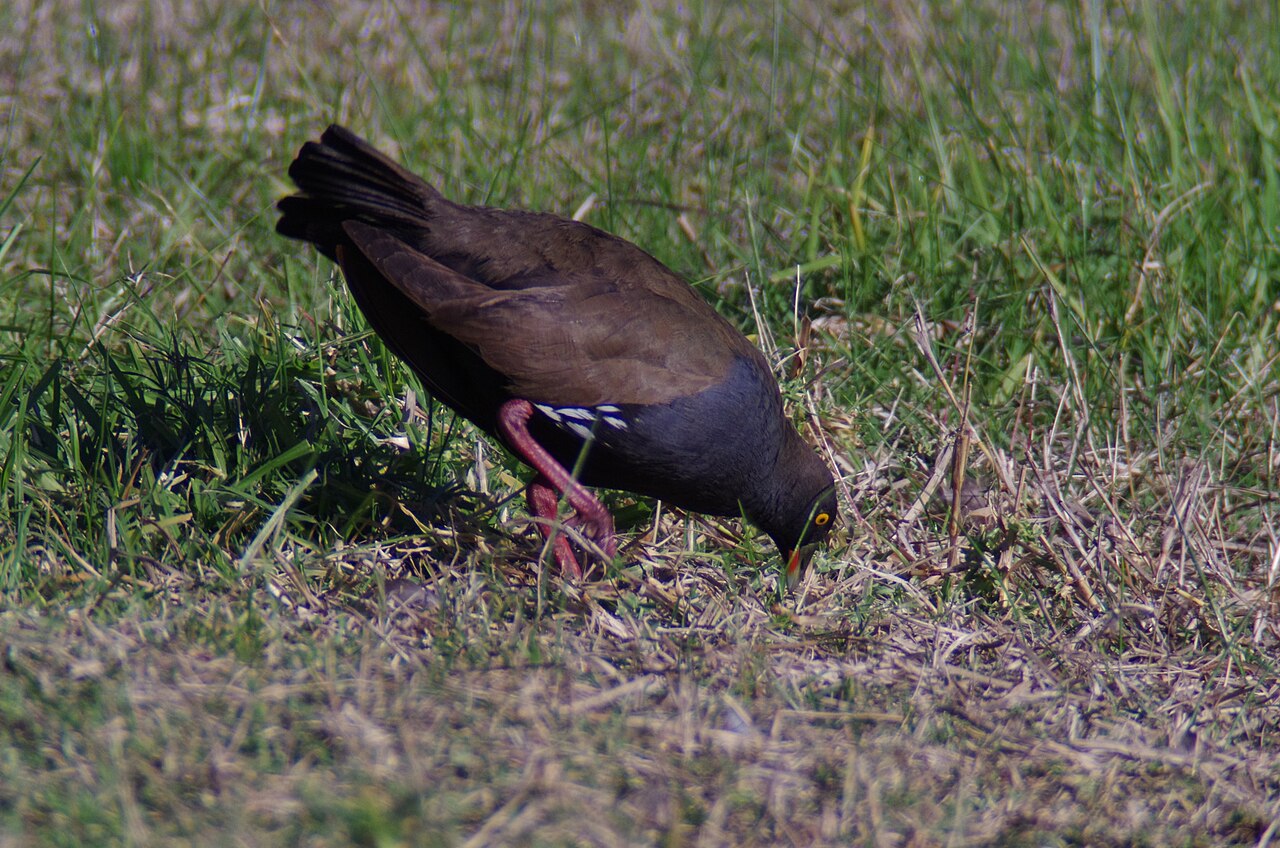
The Black-tailed Nativehen is a dark, fleet-footed rail of the dry inland that runs rather than swims: olive-brown above, slate-grey below, with white streaky spots on the flanks, coral-pink legs and a narrow black tail carried upright and flicked without pause. After big rains it appears in thousands on plains that held none for years.
Voice
A quiet bird: feeding and walking, it is all but silent. The alarm call is a short, sharp kak, and at a disturbance in the flock comes a fast, hard, metallic yap-yap-yap-yap that the whole party takes up. It has no true song.
No freely licensed recording has been found for this species yet; what to listen for is described below.
Identification
A stout rail of thirty to thirty-eight centimetres and about four hundred grams, standing upright like a domestic hen. The upperparts are olive-brown, the underparts slate-grey, and along the flanks run elongated white streaky spots that catch the light. The narrow tail is black, held erect and constantly flicked. Bill and frontal shield are pale green with an orange-red lower mandible, the legs bright coral-pink, the eye clear yellow. Young birds are duller, with dingier legs and a brown eye.
Confusion species
Tasmanian Nativehen (Tribonyx mortierii) is larger and heavier, has grey-green rather than coral-pink legs and cannot fly; it occurs on Tasmania alone, where Black-tailed Nativehen turns up only as a vagrant — so range almost always settles the question. Dusky Moorhen (Gallinula tenebrosa) is darker, far more often on the water, and has a red frontal shield with a yellow bill tip and white undertail. Eurasian Coot (Fulica atra) is black with a white shield and nearly always swimming.
Habitat
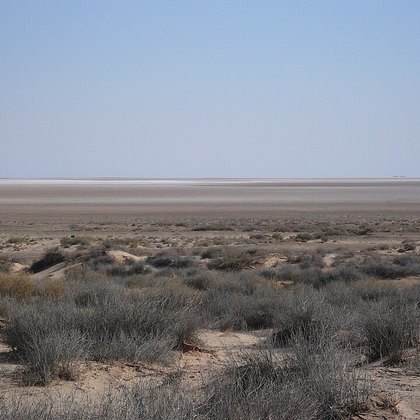
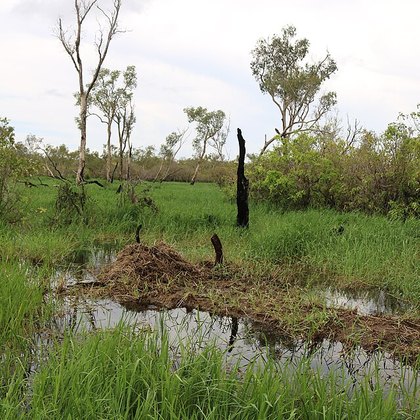
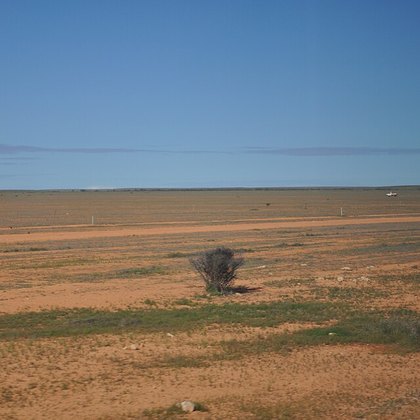
Temporary and permanent wetlands in low-rainfall country, fresh or brackish: lignum swamps, claypans, ephemeral lakes, farm dams and the banks of creeks. It nests in dense tussock, lignum or rushes close to water, but feeds on open ground well away from the edge — on bare plains, saltbush and bluebush country and grazed pasture. It runs, then stops abruptly, flushing insects as it goes.
Where the bird is most often found, arranged by main group and formation.

Range and movements
Widespread across mainland Australia, with settled strongholds around reliable water in the Murray-Darling basin, the Cooper Creek system and along the Western Australian coast. On Tasmania it is a vagrant. In New Zealand it has been recorded at least nine times, most recently in November 2024 in the Eglinton Valley, Fiordland. In the years between it can vanish entirely from large parts of its range.
- Resident
- dark = core range, pale = thinly spread
Where and when to look
Do not look for it in the reeds but on the open flat beside them: in drought it stands in small parties around the last dam or waterhole, and in the years after heavy rain it walks the desert plain in hundreds or thousands. Drive the inland roads past storage dams and floodplains and watch for the black, upright tail — that gives it away from the car.
Conservation
Least Concern (LC), with a range of millions of square kilometres and a way of life that buffers it against drought: it breeds explosively as soon as rain falls and shifts thousands of kilometres to wherever water is standing. Major irruptions came in 2010–2012 and in 2017. Where farmers read those numbers as a plague, local control may follow, but at species level that counts for little against the bird's capacity to start again after every downpour.
Scientific name
Tribonyx ventralis | (Gould, 1837)
Gould described the species in 1837 as Gallinula ventralis; because it later moved to Tribonyx, author and year stand in parentheses. Tribonyx is formed from Greek tribo, 'to wear away', and onyx, 'claw', for the worn claws of these walking rails. ventralis means 'of the belly', for the slate-grey underparts. The type locality is the Swan River in Western Australia.