All species › Passerines › Thornbills, scrubwrens, gerygones and allies › Banded Whiteface
Banded Whiteface | Aphelocephala nigricincta
Gebandeerde witgezicht | Cariblanco bandeado
The Banded Whiteface is the whiteface of the red interior: nine to ten centimetres, a white face crossed by a dark band through the eye, and a crisp black band straight across the white breast. It hops in pairs or small parties over bare ground among mulga, saltbush and spinifex, and in the heat of the middle of the day it is all but impossible to find.
No freely licensed photograph of a living wild bird of this species exists. Do you have one that meets the rules? Send it in.
Voice
A thin high chirping and a fast stuttering twitter, audible surprisingly far across open plain simply because nothing else is sounding. Sharp short alarm notes follow when a party flies up to the nearest bush. The repertoire is modest and few recordings exist; on voice alone the three whitefaces cannot be told apart with confidence.
No freely licensed recording has been found for this species yet; what to listen for is described below.
Identification
Nine to ten centimetres, about eleven grams. The face is white, bounded by a dark band running across the eye. The upperparts are greyish brown, the upper breast pale blue-grey, and below that a broad, crisp black band crosses otherwise white underparts. A rufous patch marks each flank. Bill and legs are dark, the eye white. Sexes are alike; young birds are duller and lack the breast band.
Confusion species
Southern Whiteface (Aphelocephala leucopsis) overlaps across much of the interior: it is bulkier, lacks the black breast band altogether, and has olive-buff to cinnamon flanks rather than a crisp rufous patch. Chestnut-breasted Whiteface (A. pectoralis) wears a rufous rather than black band in the same place and occurs only in the gibber country of South Australia. Note that young Banded Whitefaces have yet to gain the band and were once taken for A. pectoralis; the confusion was only settled in 1921 by catching young birds. The thornbills of the same country, such as Chestnut-rumped Thornbill (Acanthiza uropygialis), have a thin pointed bill instead of the short finch-like bill of the whitefaces.
Habitat
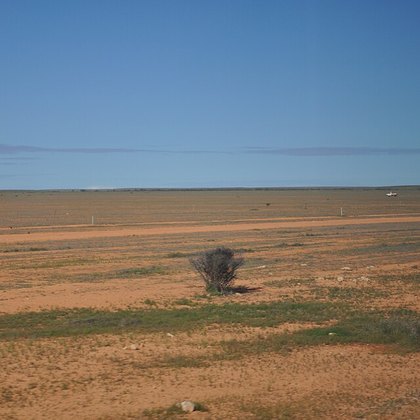
The arid interior: mulga and other acacia scrub, saltbush and bluebush plains, spinifex on red sand, sandhills and stony gibber. It needs open ground to hop over and shrubs to dive into, and avoids both closed woodland and wholly bare salt pans.
Where the bird is most often found, arranged by main group and formation.




Range and movements
Endemic to the drier parts of Australia, from southwestern Queensland and northwestern New South Wales through central Australia west to Mount Magnet in Western Australia. The species is resident and does not migrate, though it shifts locally with the rain. The range covers over one and a half million square kilometres.
- Resident
- Winter
- dark = core range, pale = thinly spread
Where and when to look
Drive a stretch of gravel road through mulga or saltbush early in the morning and watch for small birds hopping over the ground ahead of the car. Then put the glass on the breast: a crisp black band across it belongs to this species. A bird without a band is either a juvenile or a Southern Whiteface. In cold winter weather it gets going late in the morning, because it lets its body temperature drop overnight and has to warm up first.
Conservation
Least Concern (LC). The species lives in thinly settled country that has hardly been brought under cultivation, and numbers are stable. Overgrazing by stock, rabbits and camels can strip the shrub and herb layer locally, and that is the main long-term threat; there is no sign of a national decline.
Scientific name
Aphelocephala nigricincta | (North, 1895)
Alfred John North described the species in 1895 as Xerophila nigricincta; the type locality is Missionary Plain in central Australia. The move to another genus puts author and year in parentheses. The genus Aphelocephala is from Greek apheles, 'simple, plain', and kephale, 'head': the bird with the smooth plain head. The epithet is Latin, from niger, 'black', and cinctus, 'girdled': the black-banded one.