All species › Passerines › Thornbills, scrubwrens, gerygones and allies › Chestnut-breasted Whiteface
Chestnut-breasted Whiteface | Aphelocephala pectoralis
Kastanjeborstwitgezicht | Cariblanco pecho castaño
The Chestnut-breasted Whiteface is the rarest and least known of the three whitefaces: eleven centimetres, with a rufous band across the white breast instead of a black one. Its entire range lies in the stony gibber plains of inland South Australia, a strip running from Marla south to Lyndhurst at the northern end of the Flinders Ranges, and the bird occurs nowhere else on earth.
Voice
A loud, medium-pitched trill of repeated syllables, and alongside it a soft twittering as a party feeds over the ground. While foraging the birds are notably quiet and shy. Few recordings of the species exist, and what there is remains too sparse to use voice as a reliable mark against the other whitefaces.
No freely licensed recording has been found for this species yet; what to listen for is described below.
Identification
About eleven centimetres, nine to ten grams. The face is white, the crown mottled grey-brown, the upperparts plain grey-brown. A broad rufous to chestnut band runs across the white breast; that is the mark on which the species stands or falls. The undertail feathers are black with white tips. The bill is short and finch-like, as in all whitefaces.
Confusion species
Banded Whiteface (Aphelocephala nigricincta) is the only real confusion species and shares the same arid country: it carries a crisp black rather than rufous band in exactly the same place, and rufous on the flanks rather than on the breast. Southern Whiteface (A. leucopsis) has no breast band at all. It matters to set juveniles aside: young A. nigricincta have yet to gain the black band and were repeatedly taken for this species in the nineteenth century, to the point where the validity of A. pectoralis was doubted; the matter was only put right in 1921.
Habitat
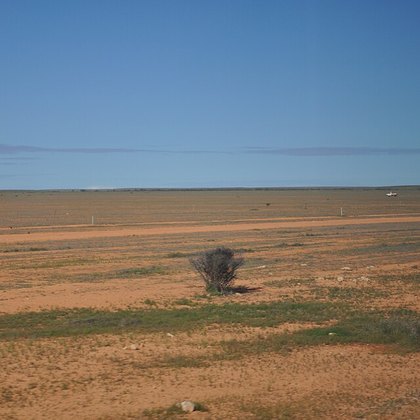
Gibber plains and stony hills in the arid and semi-arid zone, carrying a low cover of chenopod shrubs: bluebush and saltbush on bare, pebble-strewn ground. The nest is built in low bluebush. The species is thus tied closely to a single landscape type, and that is why its range stays so small.
Where the bird is most often found, arranged by main group and formation.


Range and movements
Endemic to inland South Australia, in a strip from Marla in the north south to Lyndhurst at the northern end of the Flinders Ranges. Records from the Northern Territory have never been confirmed. It is one of the Australian birds with the smallest range, and within that strip it is patchily distributed besides.
- Resident
- dark = core range, pale = thinly spread
Where and when to look
This is a species you have to go to the gibber for; chance encounters are rare. Drive slowly along bluebush on pebble plains, watch for silent parties feeding over the stones, and check the breast: rufous, not black. In a party containing young birds, do not settle for a missing black band — that is exactly the trap nineteenth-century collectors fell into.
Conservation
Near Threatened (NT) on the Red List: the population probably exceeds a thousand mature birds spread over several subpopulations, but the range is small and the species is nowhere numerous. Overgrazing by stock and rabbits degrades the chenopod layer it depends on, and opal mining destroys its habitat locally. Because so little fieldwork has been done, the trend is poorly known.
Scientific name
Aphelocephala pectoralis | (Gould, 1871)
John Gould described the species in 1871 as Xerophila pectoralis, from a specimen collected by Frank Gibson; the type locality is Port Augusta, South Australia. The genus Aphelocephala is from Greek apheles, 'simple, plain', and kephale, 'head'. Latin pectoralis means 'of the breast' and points to the chestnut band. The species was long held to be doubtful, until in 1921 the confusion with young Banded Whitefaces was shown to be a misunderstanding.