All species › Passerines › Thornbills, scrubwrens, gerygones and allies › Rufous Fieldwren
Rufous Fieldwren | Calamanthus campestris
Rosse struiksluiper | Sedosito rufo
The Rufous Fieldwren is the fieldwren of the dry country: a small, streaked bird with a cocked tail that runs mouse-like over bare ground between saltbush and samphire and gives itself away only when a singing male climbs to the top of a low shrub in spring. It is spread across almost all of southern Australia in a series of separated subpopulations, each with its own shade of brown — and it is precisely those colour differences that have kept taxonomists busy for a century.
Voice
Song is the only thing that reliably betrays this species. Both sexes sing, in the breeding season from the top of a low shrub, a cheerful, clear and melodious phrase usually rendered as whirr-whirr-chick-chick-whirr-ree-ree: a whirring start, a few sharp ticks and a falling close. Alarm is a sharp chrr-r-r or a rattling han-han-han, usually from cover, after which the bird is gone.
No freely licensed recording has been found for this species yet; what to listen for is described below.
Identification
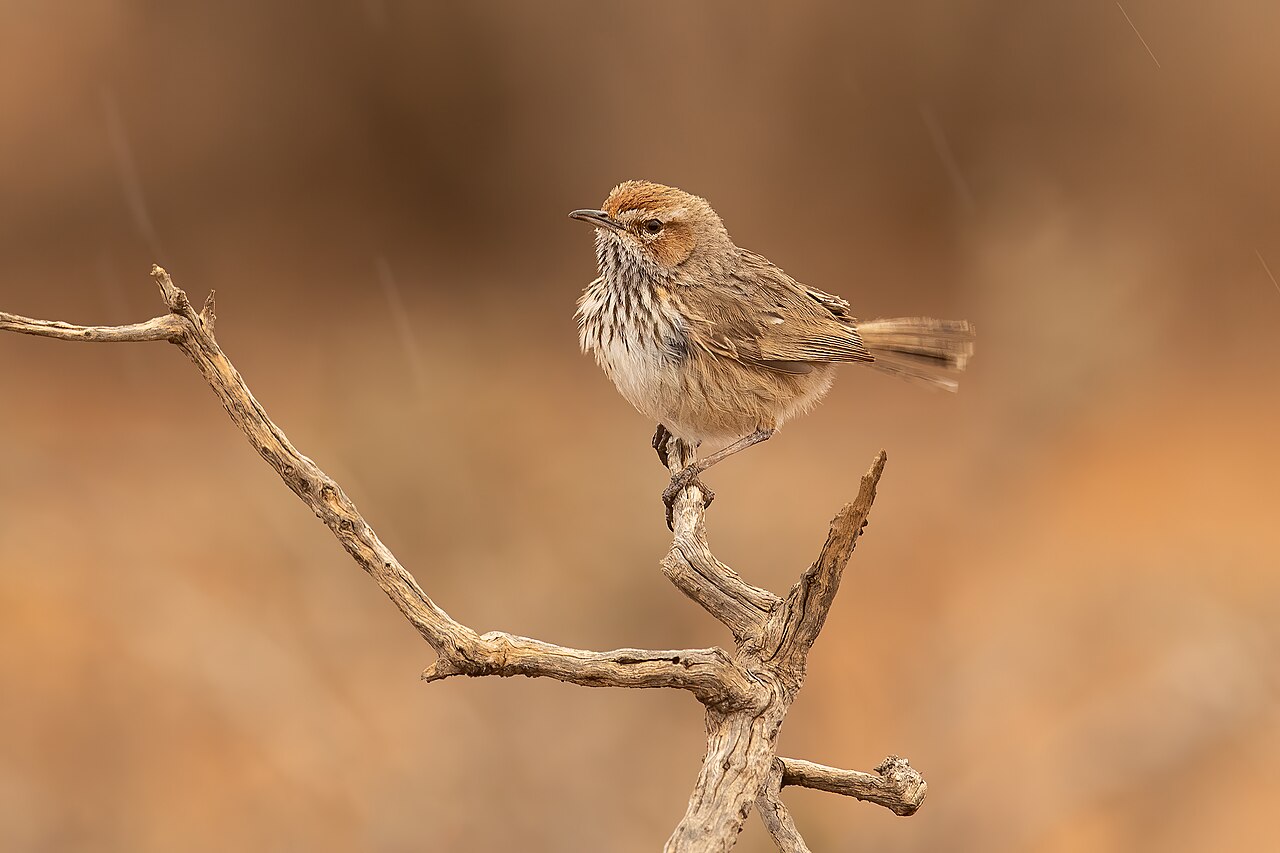
A small, compact ground bird of eleven and a half to thirteen and a half centimetres, grey-brown to warm rufous above with dark streaking, and whitish below with fine streaks across breast and flanks. A pale supercilium runs above the eye, duller in the female. The bill is fine and slightly decurved, clearly longer and slimmer than in the Striated Fieldwren. The most useful field character is posture: the long tail is carried strongly cocked almost all the time, including while running and hopping over open ground.
Confusion species
Striated Fieldwren (Calamanthus fuliginosus) is darker and more olive-brown, more heavily and coarsely streaked, has a shorter and thicker bill, and keeps to damp coastal heath, grassland and saltmarsh in the south-east and Tasmania; where the two approach each other in South Australia, the paler, more rufous, finer-billed bird is the Rufous. Western Fieldwren (Calamanthus montanellus) is very similar but does not overlap: it keeps to south-western Western Australia. Shy Heathwren (Hylacola cauta) shows a white wing spot, an unstreaked crown and back and dark legs; Chestnut-rumped Heathwren (Hylacola pyrrhopygia) is given away by its rufous rump. All four carry the tail cocked, so posture alone settles nothing.
Habitat
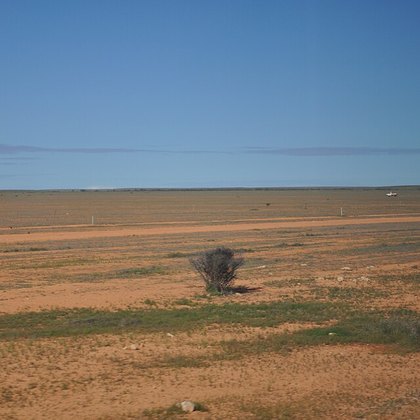
Low, open shrubland without a canopy, on saline or poor soil: the chenopod plains of saltbush (Atriplex) and bluebush (Maireana), the Sarcocornia samphire belts around salt lakes and tidal flats, gibber plains with scattered spinifex, and along the coast the low heath just behind the dune. What these places share is a dense low layer to vanish into and plenty of bare ground between to run over. Food is insects and spiders, taken almost entirely from the ground and the lowest twigs. The nest is a dome of grass and plant fibre some fifteen centimetres long, low in a shrub or on the ground under a tussock, holding three or four eggs; the breeding season runs from June to April and in Western Australia some populations breed nearly year-round.
Where the bird is most often found, arranged by main group and formation.


Range and movements
Southern Australia, from the Western Australian coast east through South Australia to north-western Victoria and western New South Wales, but nowhere continuously: the species exists as subpopulations separated by unsuitable country, which explains the regional differences in colour. An island form lives on Dirk Hartog Island off the west coast. It is sedentary, staying all year in the same patch of shrubland; there is no migration.
- Resident
- dark = core range, pale = thinly spread
Where and when to look
Look for it in early spring, between August and October, and look for it with your ears. Walk slowly through saltbush or samphire and stop the moment you hear the whirring phrase, then watch the shrub tops, because the singer almost always climbs. Outside the song season you will get no more than a small cocked-tailed silhouette running from bush to bush and not coming back. Good country includes Shark Bay, the Nullarbor margins and the Gawler Ranges.
Conservation
Least Concern (LC): the range is vast and the total population large. The concern lies in the parts. Overgrazing by stock and rabbits removes exactly the low shrub layer the species lives in, clearing for cropping has erased whole tracts of habitat in the wheatbelt, and invasive grasses change the structure of the ground layer. Because the subpopulations sit isolated from one another, local losses are hard to make good.
Scientific name
Calamanthus campestris | (Gould, 1841)
The epithet campestris is Latin for ‘of the open field’ and suits the plains the bird lives on; John Gould described it in 1841, and the parentheses around his name record that he first placed it in another genus. The English group name fieldwren puts the field first, the Dutch struiksluiper the shrub. The Dutch is the more confusing of the two, because Dutch uses struiksluiper for the genus Sericornis as well, where English has the separate word scrubwren; in this guide, therefore, always check the scientific name. The species is taxonomically contested: eight subspecies were traditionally recognised, but a 2021 analysis reduces these to two mainland forms and one island form.