All species › Passerines › Thornbills, scrubwrens, gerygones and allies › Striated Fieldwren
Striated Fieldwren | Calamanthus fuliginosus
Gevlekte struiksluiper | Sedosito estriado
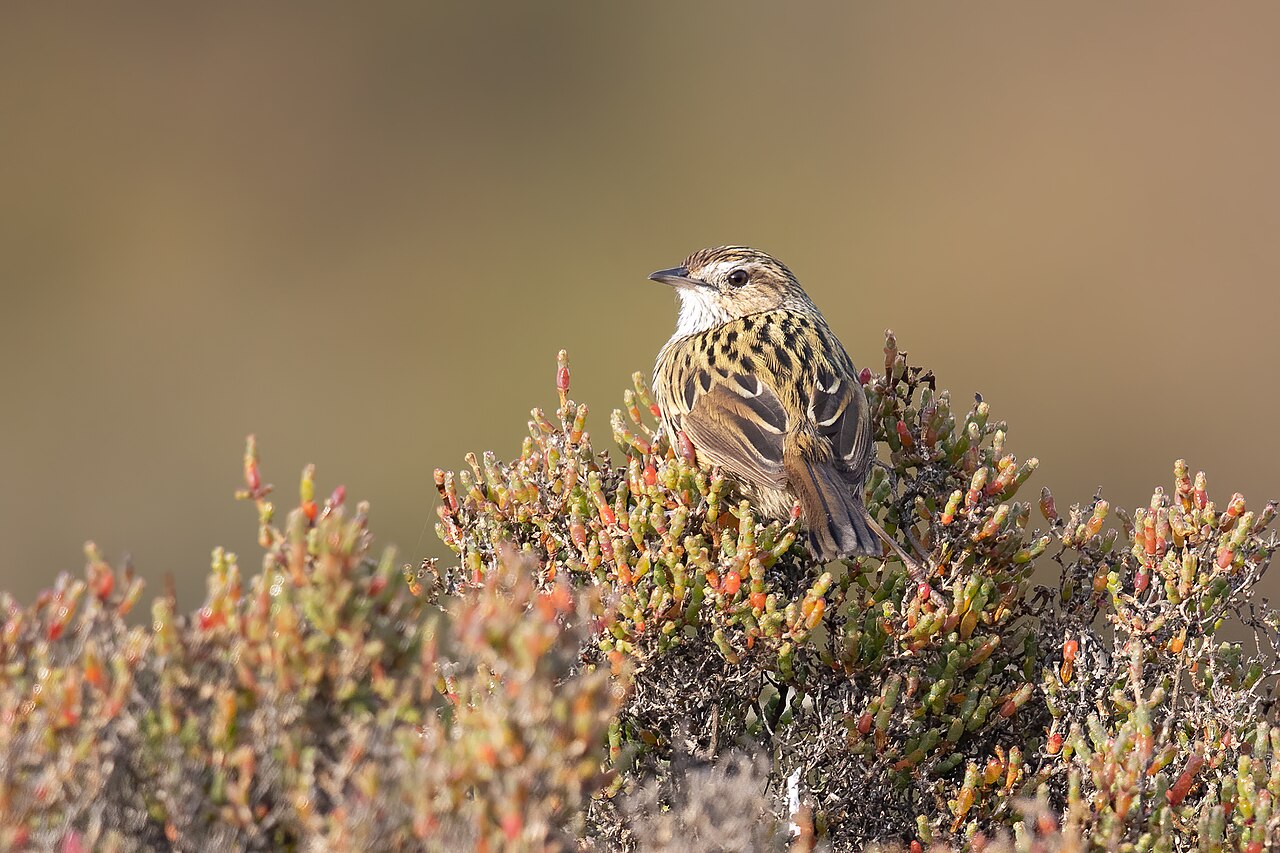
The Striated Fieldwren is a heavily streaked brown bird of twelve to fourteen centimetres that spends its whole life in low dense cover: coastal heath, saltmarsh, buttongrass moorland and alpine herbfield. You see it only when it climbs to the top of a bush to sing in spring, tail held upright, and otherwise essentially never.
Voice
A strong whirring song that field observers render as whit whit chee whit whit pee chew, delivered in spring from a projecting twig or the top of a bush. Outside that season the bird is largely silent and you will hear at most a sharp short alarm note from within the vegetation. The song is the best, and often the only, proof that the species is present.
No freely licensed recording has been found for this species yet; what to listen for is described below.
Identification
Twelve to fourteen centimetres, light brown to olive, heavily streaked black on a buff ground over the whole upperside and the breast; the belly is whiter. A pale eyebrow runs above the eye. The tail is fairly long, whitish with dark barring, and is held steeply cocked when the bird is alarmed. Sexes are alike.
Confusion species
Rufous Fieldwren (Calamanthus campestris) of the arid interior is warmer rufous and less heavily streaked, and lives in saltbush and dry scrub rather than wet heath; Calamanthus montanellus of southwestern Australia is entirely separate from this species geographically. The two heathwrens keep to denser heath: Chestnut-rumped Heathwren (Hylacola pyrrhopygia) shows a bold rufous rump, Shy Heathwren (Hylacola cauta) a white wing stripe and white tail tips, and both lack the heavy streaking above. Speckled Warbler (Pyrrholaemus sagittatus) is also streaked but has a streaked crown and a rufous brow, and lives in open woodland with a grassy ground layer, not in heath.
Habitat
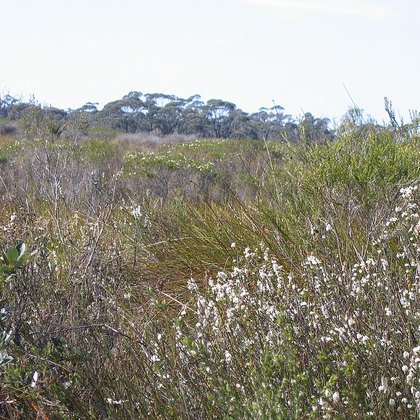
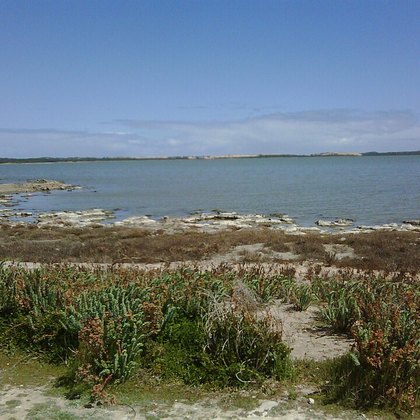
Low dense treeless cover: coastal heath on poor sands, saltmarsh and samphire along estuaries, wet sedgeland and buttongrass moor in Tasmania, and in Victoria and Tasmania the herbfields above the treeline as well. What the sites have in common is a closed layer half a metre to a metre and a half high in which a bird can disappear completely.
Where the bird is most often found, arranged by main group and formation.


Range and movements
Endemic to southeastern Australia: coastal South Australia, Victoria, southern New South Wales and all of Tasmania, with a total range of about two hundred thousand square kilometres. The species does not migrate and holds the same territory the year round. Because the suitable ground is fragmented, the distribution is strongly patchy.
- Resident
- dark = core range, pale = thinly spread
Where and when to look
Go out early to a patch of coastal heath or saltmarsh in September or October and wait for the whirring song; follow it to the singing bird, which will then be perched on top of the vegetation and far more visible than at any other time. Otherwise stay on the edge rather than walking through: a flushed bird dives away and will not show again. The cocked tail as it drops is often all you get.
Conservation
Least Concern (LC). The species has nonetheless lost a great deal of ground as coastal heath and saltmarsh were cleared, drained or built over, and what remains is fragmented. Where heath has been kept in national parks and reserves it is still recorded regularly. Too-frequent burning and the draining of peat and saltmarsh are the main local threats.
Scientific name
Calamanthus fuliginosus | (Vigors & Horsfield, 1827)
Vigors and Horsfield described the species in 1827 as Anthus fuliginosus, among the pipits; the type locality is Tasmania, narrowed to the district of the Derwent. Because the species later moved to another genus, author and year stand in parentheses. Latin fuliginosus means 'sooty'. The genus Calamanthus was introduced by Gould in 1837; the first element is Greek kalamos, 'reed', the second the ending of Anthus, the pipit genus the bird originally stood in.