All species › Passerines › Thornbills, scrubwrens, gerygones and allies › Western Fieldwren
Western Fieldwren | Calamanthus montanellus
Westelijke struiksluiper | Sedosito occidental
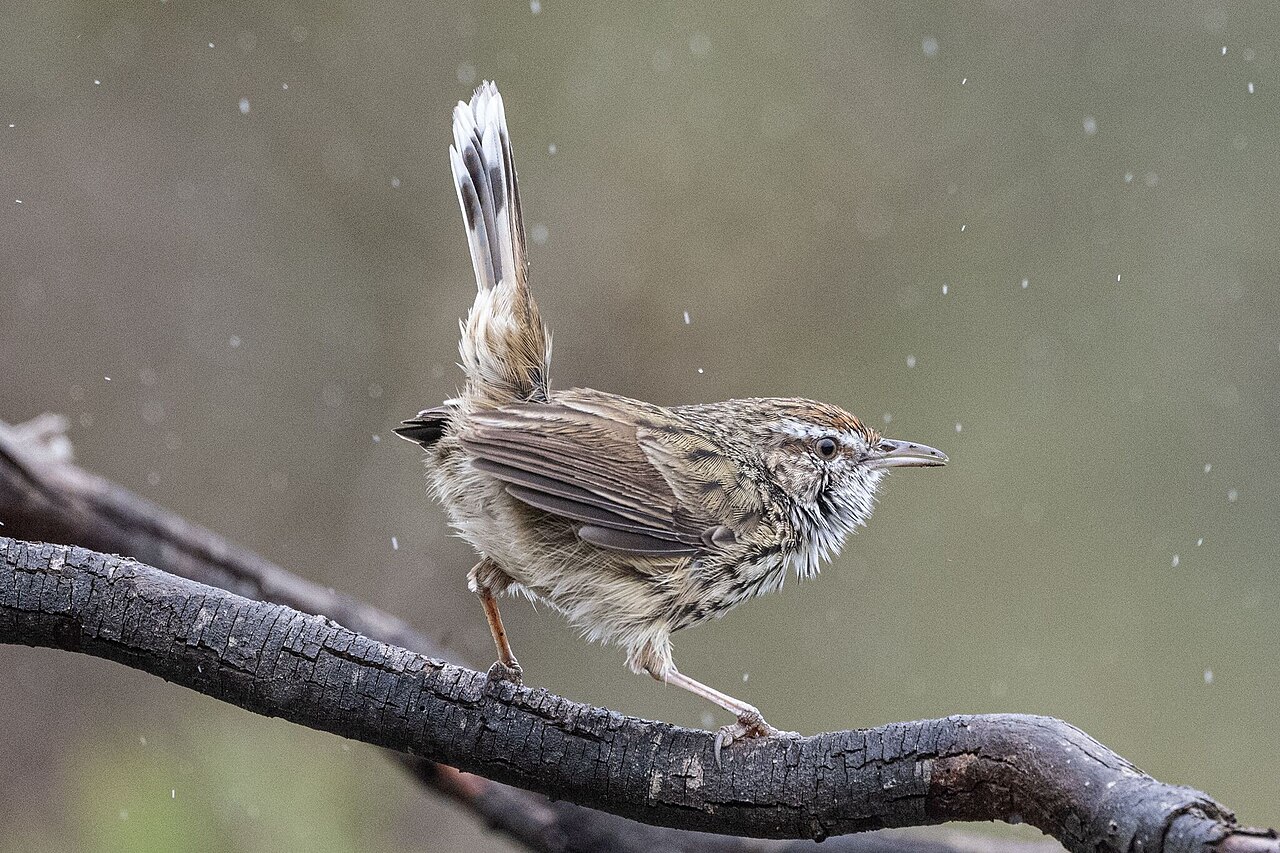
The Western Fieldwren is the fieldwren of Australia's south-western corner: a small streaked bird with a cocked tail that works its way through low kwongan heath and mallee scrub, and that is best known for the problem it sets taxonomists. Whether it is a species of its own or merely the western end of the Rufous Fieldwren has still not been settled after more than a century — and to anyone watching it in the field it hardly matters: it is the same small, shy, prickle-country heath bird.
Voice
As with all fieldwrens, song is the way in: a clear, cheerful, slightly whirring phrase that the male delivers in the breeding season from the top of a shrub, and that closely resembles that of the Rufous Fieldwren. Outside that season you will rarely hear more than a short sharp alarm note from cover, after which contact is broken.
No freely licensed recording has been found for this species yet; what to listen for is described below.
Identification
A small, compact bird of some twelve to thirteen centimetres, pale brown and streaked above, whitish below, streaked across head and breast, with a distinct pale supercilium and a long tail carried almost permanently cocked. The plumage is on the whole more olive-brown and less warmly rufous than in the dry-country birds further east, but that difference runs as a gradient and is seldom decisive in the field. The tail is proportionally long — the one character on which measurements separate it reliably from its eastern counterpart.
Confusion species
Rufous Fieldwren (Calamanthus campestris) is the hard one, but the problem is theoretical: according to eBird the ranges do not overlap, so place settles here what plumage cannot. Striated Fieldwren (Calamanthus fuliginosus) does not occur in Western Australia at all. The genuine confusion is Shy Heathwren (Hylacola cauta), which lives in the same heath: it has an unstreaked crown and back, a white wing spot and dark legs, whereas this species is streaked right onto the head, shows no wing spot and has paler legs. Brown Thornbill (Acanthiza pusilla) and Spotted Scrubwren (Sericornis maculatus) share the same scrub, but neither cocks its tail and both climb rather than run.
Habitat
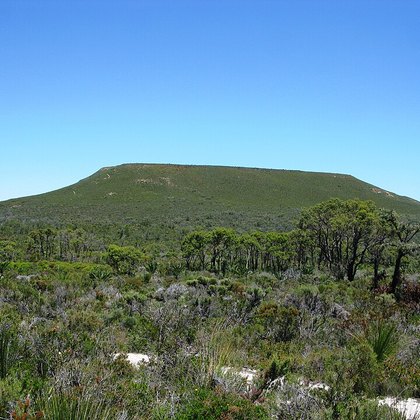
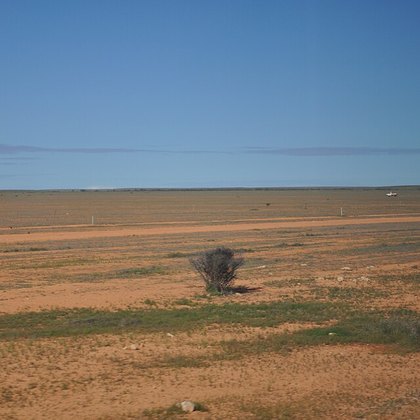
The low, dense sandplain heath of the south-west — the kwongan — together with mallee scrub, open shrubland on sand and stony ground and, at the eastern edge of the range towards the Great Australian Bight, low saltbush plains. Everywhere the point is vegetation low enough to see over and thick enough to vanish into. It forages on the ground and in the lowest branches, almost entirely on insects and spiders, and builds a domed nest low in or under a shrub.
Where the bird is most often found, arranged by main group and formation.

Range and movements
Endemic to south-western Western Australia, according to AviList from Geraldton in the north to Point Culver on the south coast, that is across the whole semi-arid south-western corner of the continent. Within that area it is locally common where heath is intact and absent where heath has been cleared for wheat. It is sedentary.
- Resident
- dark = core range, pale = thinly spread
Where and when to look
Go to intact kwongan in August or September — the reserves of the Geraldton Sandplains, or the south coast — and listen early in the morning. The bird will then be sitting on top of a shrub and can be watched for some minutes; the moment it stops singing it drops into the vegetation and is gone. Watch the cocked tail and the streaking that reaches the crown, because that is what separates it on the spot from Shy Heathwren.
Conservation
Least Concern (LC). The species nonetheless faces Australia's most drastic landscape loss: the Western Australian wheatbelt has been cleared outright over vast areas, leaving the heath fragmented into roadside strips and reserves. Added to that is too-frequent fire, which removes the dense low shrub layer the bird depends on and which takes years to return. At the scale of the whole range the population is adequate; at the scale of a single patch of heath it often is not.
Scientific name
Calamanthus montanellus | Milligan, 1903
Alexander Milligan described the bird in 1903. The epithet montanellus is a Latin diminutive of montanus, ‘of the mountains’. The taxonomic status is the heart of the naming story: the English Wikipedia article records that Christidis and Boles treated it in 2008 as the subspecies Calamanthus campestris montanellus, and that an analysis of genetic and morphological data would merge it into C. campestris altogether, while the IOC and AviList continue to hold it as a species. This guide follows AviList. The Dutch name in the project data reads ‘Westelijhke struiksluiper’; that spelling, with its extra h, is carried over as found and was not invented here.