All species › Passerines › Thornbills, scrubwrens, gerygones and allies › Chatham Islands Gerygone
Chatham Islands Gerygone | Gerygone albofrontata
Chathammangrovezanger | Gerigón de las islas Chatham
The Chatham Islands Gerygone occurs only on the Chatham Islands, a small archipelago eight hundred kilometres east of New Zealand, and nowhere else on earth. Within the genus it is the odd one out: larger than its relatives, and the only one in which male, female and juvenile each wear a plumage of their own. In a genus where most species can be separated only by voice, that makes it strikingly easy to read — provided you are standing on the island where it lives.
Voice
The male sings a loud four-note trill, chi-ch-ch-ch, repeated several times over. New Zealand Birds Online describes it neatly as a grey warbler that has not been fully wound up: the same quality, but shorter, slower and without the long wavering close that marks the mainland species. Because no other Gerygone occurs on the Chathams, any song of this type can be placed at once.
No freely licensed recording has been found for this species yet; what to listen for is described below.
Identification
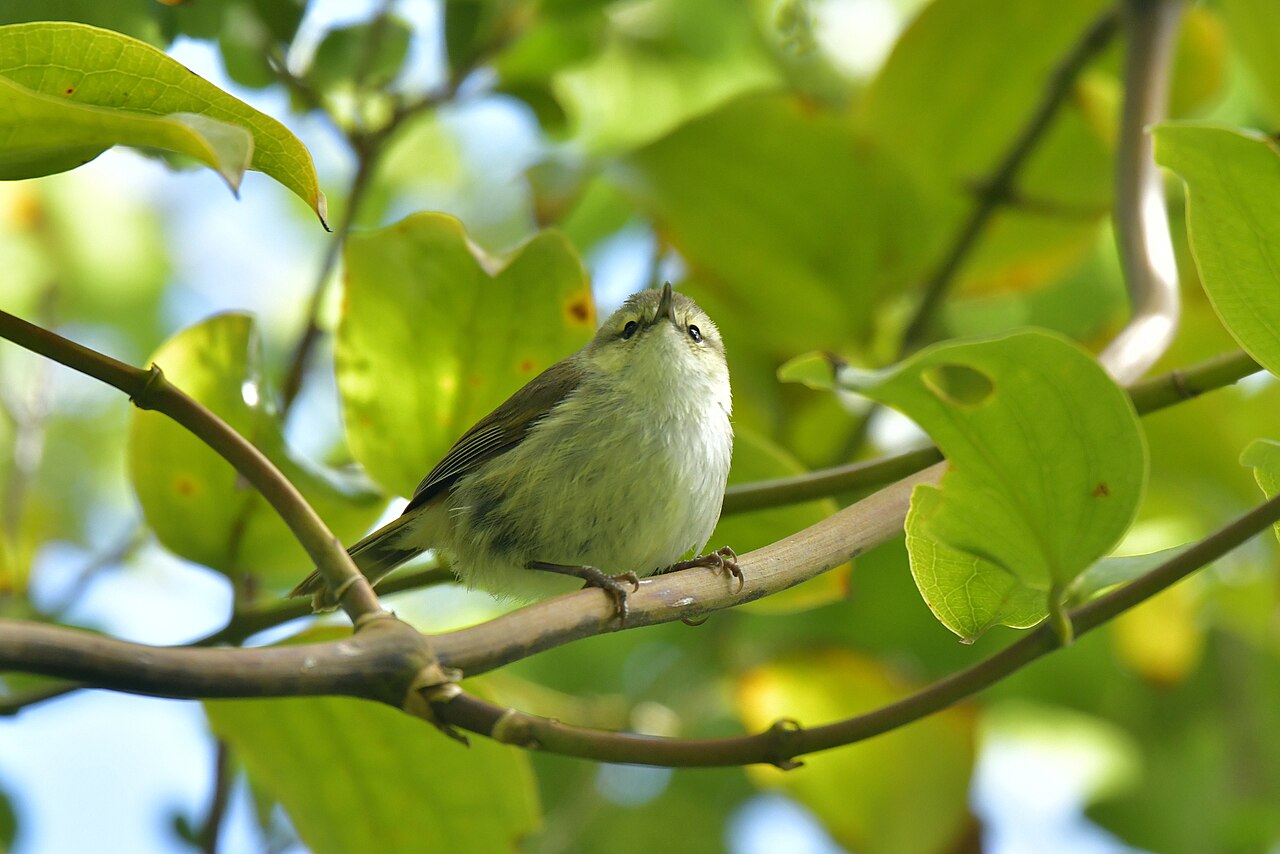
Twelve centimetres, bulkier than the other gerygones of the region. The male has a conspicuous white forehead, a white eyebrow, a white throat and white underparts, with olive-brown upperparts and a red eye. The female lacks the white forehead, shows dull greyish-white underparts and a yellowish eyebrow, cheek and throat, and likewise a red eye. The juvenile resembles the female but is more olive-grey above, yellower below, and has a brown eye. Those three distinct plumages are the character of the species: no other Gerygone here does that.
Confusion species
Within its own range confusion is impossible, as it is the only gerygone of the Chathams. The problem lies in comparison from outside. Grey Gerygone (Gerygone igata) of the New Zealand mainland is smaller, wears the same grey plumage in both sexes with no white forehead, and forages much by hovering, which this species rarely does. Norfolk Gerygone (Gerygone modesta) is likewise an island endemic, plain grey-brown and without the white forehead patch; there too geography separates the species completely. None of the Australian species reaches the Chathams, so Mangrove Gerygone (Gerygone levigaster) and Large-billed Gerygone (Gerygone magnirostris) enter the comparison on paper only.
Habitat
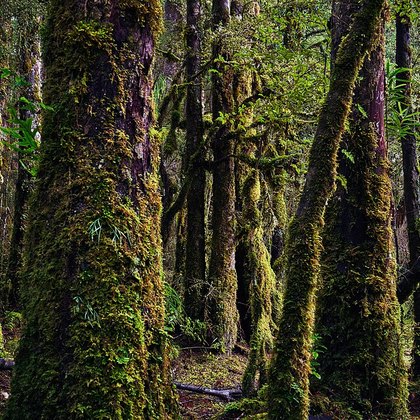
Chatham Islands forest: the remaining mixed broadleaf forest and scrub of the southern half of Chatham Island and of the smaller islands. It forages in the canopy and down into the leaf litter, on caterpillars, flies, beetles and spiders, and seldom hovers — it picks its prey off leaves and branches. The nest is an enclosed hanging dome built by the female; on the main island it hangs free in the open, on the outlying islands it is tucked into dense foliage. Two to four white eggs with reddish markings are laid, incubation averages nineteen and a half days, and the young stay about twenty days in the nest.
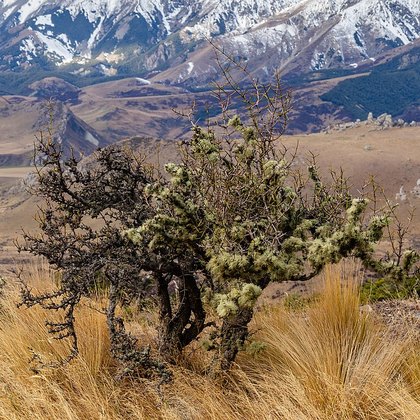
Where the bird is most often found, arranged by main group and formation.
Range and movements
Endemic to the Chatham Islands, where it is widespread and locally common in the forest of the southern half of Chatham Island, with further populations on Pitt Island, Little Mangere, the Star Keys, Rangatira and Mangere. Its entire world range is thus a few tens of square kilometres of forest — among the smallest of any species in this guide. It is sedentary; there is no movement of any consequence between the islands.
- Resident
- dark = core range, pale = thinly spread
Where and when to look
You have to get to the Chathams, and that is itself the main field tip: any small grey-brown bird working the forest there and giving a short trill is this species. Search the southern forest remnants of the main island, listen for the four short notes, then find the bird at mid-height. Look straight at the forehead: white means a male; yellowish cheek and throat mean a female or a juvenile. That distinction matters more here than the identification itself.
Conservation
The IUCN keeps it at Least Concern (LC), but the figure hides the vulnerability. The population is put at some five thousand adults and is thought to be declining, and the range is small enough that a single event could touch all of it. The chief threat is loss of forest — most of Chatham Island's original forest has gone to grazing — followed by predation by rats and cats and, to a lesser degree, brood parasitism by Shining Bronze Cuckoo (Chalcites lucidus). Against that pressure stands a remarkably high breeding success: New Zealand Birds Online gives eighty-seven per cent, against thirty-eight per cent in the Grey Gerygone. New Zealand's own listing is ‘Naturally Uncommon’. Forest restoration and control of introduced mammals are the key.
Scientific name
Gerygone albofrontata | Gray, 1845
George Robert Gray described the species in 1845. The epithet albofrontata is Latin for ‘white-fronted’ and points exactly at the character that identifies the male — an unusually useful name in a genus whose names mostly offer little grip. The genus name Gerygone is usually read as ‘born of song’. The English name Chatham Islands Gerygone takes the locality, as do Dutch chathammangrovezanger and Spanish gerigón de las islas Chatham. The element mangrovezanger in the Dutch name is wholly misleading here: no mangrove grows on the Chathams, and this bird has never seen one.