All species › Passerines › Thornbills, scrubwrens, gerygones and allies › Green-backed Gerygone
Green-backed Gerygone | Gerygone chloronota
Witbuikmangrovezanger | Gerigón dorsiverde
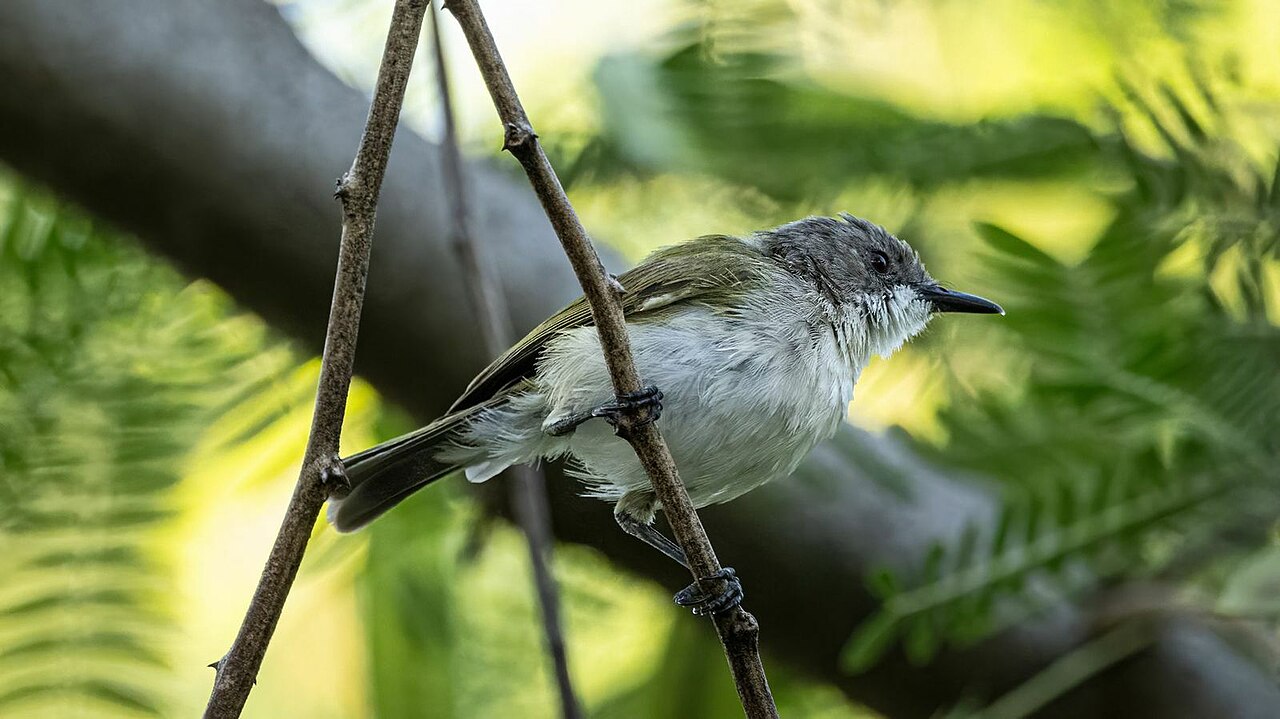
A bird of nine centimetres and five to eight grams that lives in the mangroves, monsoon forest and paperbark swamps of tropical northern Australia. The slate-grey head stands out sharply against the olive-green back, the underparts are pale with a yellow wash on the flanks, and the eye is red. It hardly ever sits still, which makes it harder to look at than to listen to.
Voice
A high, thin phrase with the falling pitch that marks the whole genus Gerygone. Alongside it a series of short contact calls between partners has been recorded, and the persistent begging of young at the nest. The sources consulted give no more precise, usable rendering of the song than that; anyone looking for the species does well to listen to recordings first, because Mangrove and Large-billed Gerygones sing in the same mangroves.
No freely licensed recording has been found for this species yet; what to listen for is described below.
Identification
Small and short-tailed, with a slate-grey head and neck that contrast clearly with the greyish olive-green back and wings. The underparts are pale grey to white, with light yellow on the flanks. The iris is red — brown in young birds, which also have a paler bill. There is no white eyebrow, no eye-ring and no white in the tail: that absence of markings, together with the green back, is the best feature.
Confusion species
Mangrove Gerygone (Gerygone levigaster) shares the mangroves but is grey-brown above, has a clear white eyebrow and white tail tips. Large-billed Gerygone (Gerygone magnirostris) is browner, heavier-billed and shows a conspicuous eye-ring. Fairy Gerygone (Gerygone palpebrosa) begins further east and has yellow underparts. With the remaining members of the genus — Gerygone mouki, Gerygone igata, Gerygone modesta and Gerygone albofrontata — overlap is impossible, since those live in southeastern Australia, New Zealand, Norfolk Island and the Chathams. Within this bird's range the rule holds: where colour and pattern run out, song and habitat have to carry the identification.
Habitat
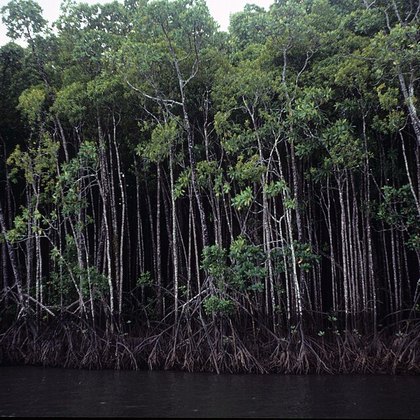
Mangrove, the dense edges of paperbark swamps, monsoon forest and vine thicket, and the open forest next to them. Along the larger rivers it pushes far inland wherever dense leafy growth lines the water. It forages in the foliage, gleaning insects from the leaves, and takes spiders and spider eggs above all, which is what it prefers to bring to its young.
Where the bird is most often found, arranged by main group and formation.


Range and movements
Northern Australia and New Guinea. Two subspecies occur in Australia: the nominate form in the Top End of the Northern Territory and on the nearby islands, and darwini on the coast of northwestern Western Australia. Both follow the river lines inland. The bird is sedentary and territorial, and is nearly always seen singly or in pairs.
- Resident
- dark = core range, pale = thinly spread
Where and when to look
Look along the landward side of the mangroves, where the trees give way to paperbark and open forest — it sits there more often than in the wet outer fringe. Watch for the red iris: in a bird with no streaks, no bars and no eye-ring, that together with the green back is the only hard feature. It is a regular host of the Little Bronze-Cuckoo (Chalcites minutillus), so an oversized youngster in a small hanging nest is no surprise.
Conservation
Least Concern (LC). The species has a large range across northern Australia and New Guinea and is locally common within it. The main concern is the state of the mangroves and the monsoon forest: both are limited in extent in northern Australia, vulnerable to cyclones and to trampling by feral buffalo and pigs, and monsoon forest burns readily when savanna fires reach too close to its edges.
Scientific name
Gerygone chloronota | Gould, 1843
Gould described the bird in 1843 as Gerygone chloronotus, with Port Essington in the Northern Territory as the type locality; because he placed it in Gerygone from the start, author and year carry no parentheses. Gould himself introduced the genus in 1841, from Greek gērugonos, born of sound, after the thin song; it replaced his earlier name Psilopus, already in use for an insect. chloronota means green-backed, from Greek khlōros, green, and nōton, back. The Dutch name points at the pale belly, the English name at the back — two sides of the same bird.