All species › Passerines › Thornbills, scrubwrens, gerygones and allies › Western Gerygone
Western Gerygone | Gerygone fusca
Witstaartmangrovezanger | Gerigón coliblanco
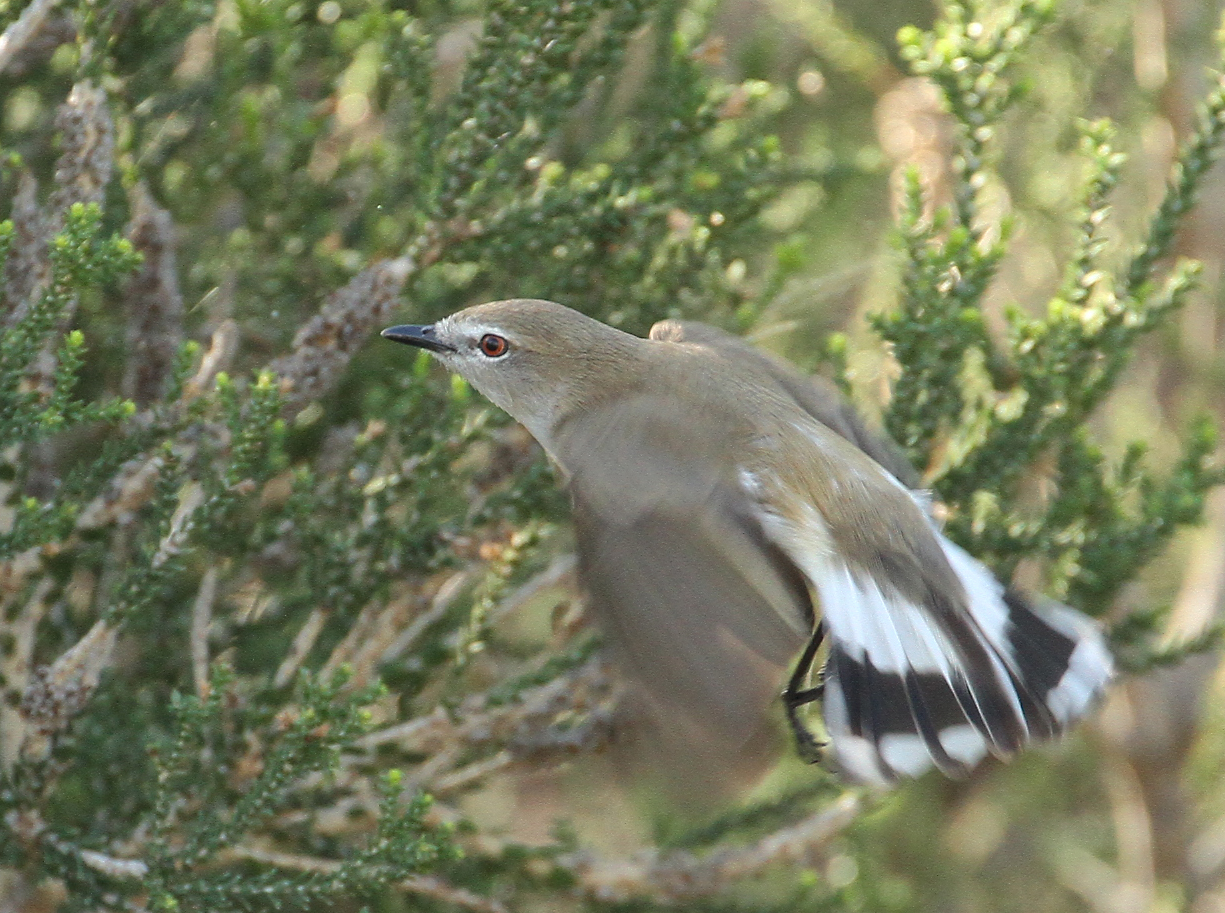
A grey bird of ten centimetres and six grams which, contrary to what the Dutch name suggests, lives not in mangroves but in dry open forest, mulga and acacia scrub — from the Great Divide to the jarrah and karri forests of southwestern Australia. Its feature is in the tail: two broad white bars that flash as a black-and-white pattern when it fans out.
Voice
A clear, sweet, silvery song whistled by the males throughout the day, including in the heat of midday. It is thin but carries, and in dry woodland where little else sings it is often the only sound above the rustling leaves. Anyone looking for the species usually finds this phrase first and the bird in the canopy afterwards.
No freely licensed recording has been found for this species yet; what to listen for is described below.
Identification
Grey above with a brown wash over back and wings, pale grey on throat and breast and dull white on the belly. A faint white eyebrow, a thin white eye-ring and a dark red eye. The bill is black, legs and feet blackish. The decisive feature is in the tail: across all but the central feathers run two broad white bars, one near the base and one towards the tip.
Confusion species
This is the only Australian gerygone with a black-and-white barred tail, which separates it from all its relatives. Mangrove Gerygone (Gerygone levigaster), Large-billed Gerygone (Gerygone magnirostris), Dusky Gerygone (Gerygone tenebrosa) and Brown Gerygone (Gerygone mouki) all resemble it in colour and size, but none has that tail pattern; besides, the first three live in mangroves and the fourth in eastern rainforest. White-throated Gerygone (Gerygone olivacea) shares the woodland but is bright yellow below. Fairy Gerygone (Gerygone palpebrosa) stays in the northeast, and Gerygone igata, Gerygone modesta and Gerygone albofrontata live in New Zealand, on Norfolk Island and on the Chathams.
Habitat
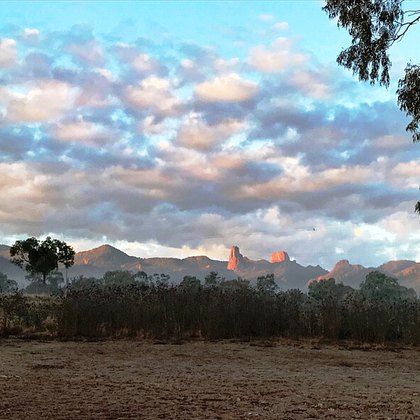
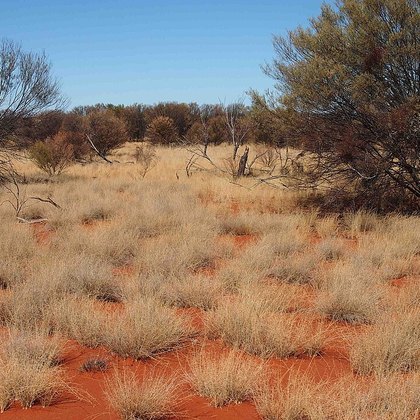
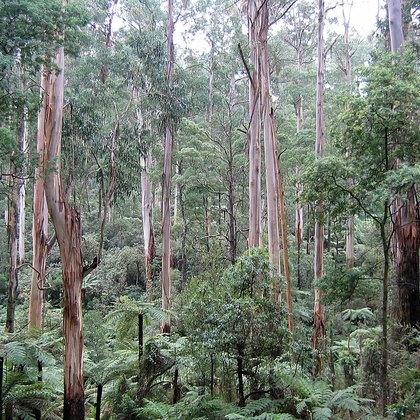
Dry open forest and woodland: eucalypts on the coast and inland, mulga and other acacia scrub, and the tree belts along the creeks that cut through the dry interior. In southwestern Western Australia it also occupies jarrah forest and even wet karri. It hunts high in the canopy and on the outer twigs, gleaning insects and other invertebrates from the foliage or snatching them in flight.
Where the bird is most often found, arranged by main group and formation.

Range and movements
Much of eastern Australia, particularly along the Great Divide and on the inland plains, plus the southern Northern Territory, northwestern South Australia, the Eyre Peninsula and the western half of Western Australia. It is sedentary and also nomadic: where rain falls and the bush flowers, birds appear that were not there the year before.
- Resident
- dark = core range, pale = thinly spread
Where and when to look
Watch the tail, not the colour. The moment the bird turns or brakes it spreads the tail and the two white bars show from a long way off; there is nothing to be had from the wing or the head. In dry country follow the creek timber, because there the foliage is thick enough to hold the bird all year.
Conservation
Least Concern (LC), spread over a very large part of Australia and common in many districts. It uses both tall forest and low acacia scrub and can therefore still make do with narrow strips along roads and creeks in the fragmented farmland of the south. Where mulga is cleared at scale or grazed to bare ground by stock it goes, because no canopy is left to hunt in.
Scientific name
Gerygone fusca | (Gould, 1838)
Gould described the species in 1838 as Psilopus fuscus; the type locality was later fixed on the Swan River in southwestern Australia. Because the name then moved to Gerygone, author and year stand in parentheses. Gould himself introduced Gerygone in 1841, from Greek gērugonos, born of sound. fusca is Latin for dark or dusky brown. The English name Western Gerygone refers to the west of the range, the Dutch name Witstaartmangrovezanger to the white tail bars — the bird's only hard field mark.