All species › Passerines › Honeyeaters › Bar-breasted Honeyeater
Bar-breasted Honeyeater | Ramsayornis fasciatus
Sperwerhoningeter | Mielero pechibarrado
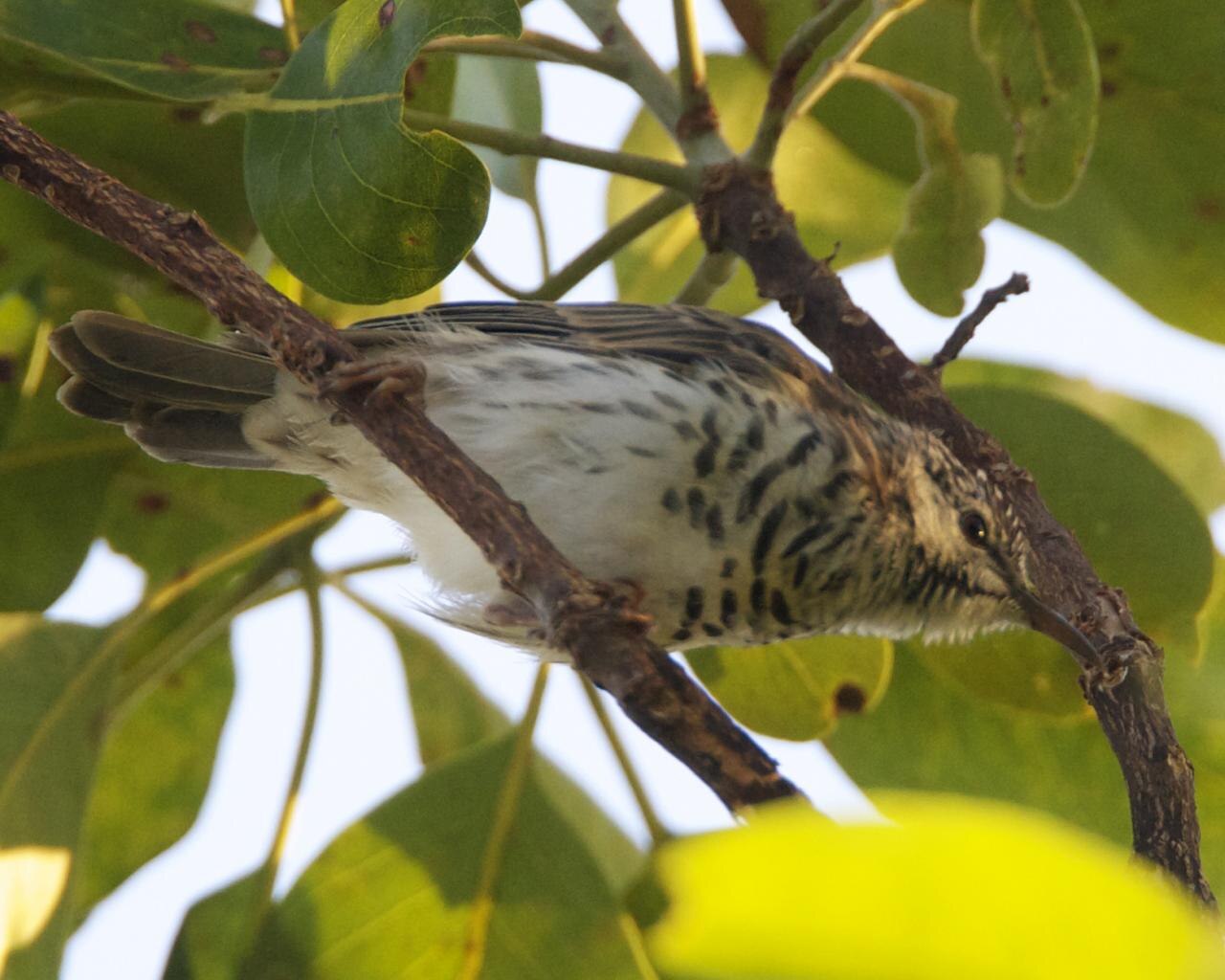
The Bar-breasted Honeyeater is named for the fine barring across breast and flanks that gives it a sparrowhawk-like pattern. It is a small, busy honeyeater of paperbark swamp and mangrove in tropical Australia, and builds a striking hanging bottle-shaped nest of paperbark strips over water.
Voice
A high, sharp and rather shrill note, given most often when defending a flowering tree; in the crown of a flowering melaleuca it rattles at bold intruders such as Brown Honeyeater. Otherwise a run of short, dry contact notes repeated as it works from flower to flower, with no true song.
No freely licensed recording has been found for this species yet; what to listen for is described below.
Identification
A small honeyeater of thirteen to fifteen centimetres and eleven to sixteen grams. The upperparts are dark grey-brown with paler streaking, the underparts light grey to white with clear dark barring across the breast and along the flanks; the throat stays unmarked white. The crown is scalloped by pale feather edges. The eye is dark brown, the slightly down-curved bill dark grey with a paler base, and the legs pinkish grey. It is restless, hangs on the tips of flowering twigs and is best seen on the outer edge of a flowering paperbark.
Confusion species
Its nearest relative, Ramsayornis modestus, is smaller, shows fine streaking rather than crisp barring, has a smooth brown crown without scalloping, and above all a conspicuously pink-red bill instead of a dark one with a pale base; both occupy the same swamp forest. Across northern Australia it also overlaps the Conopophila species: Conopophila rufogularis has a rufous throat patch and a yellow-olive wing panel, Conopophila albogularis a white throat with a rufous breast band, and Conopophila whitei is a paler bird of the arid interior. None of them shows the regular barring.
Habitat
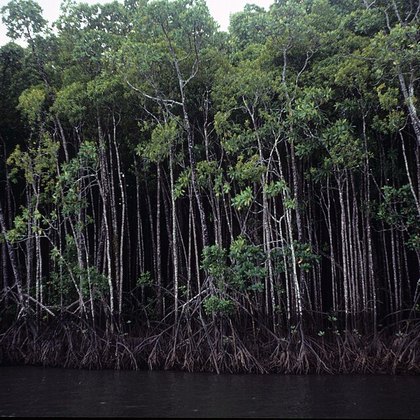
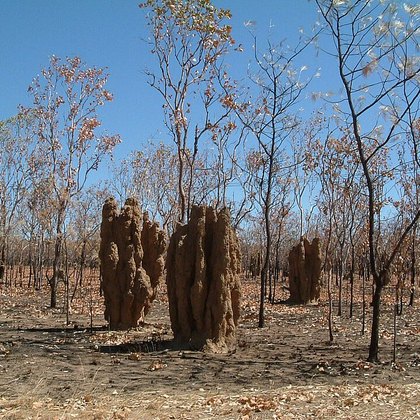
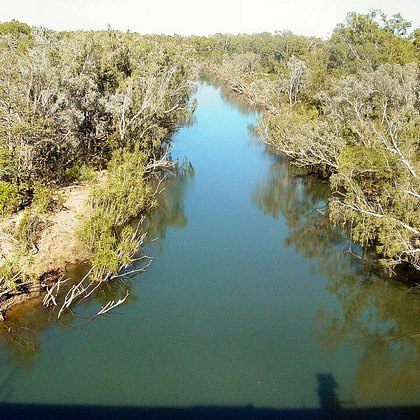
Mangrove, paperbark swamp forest and other open woodland, almost always along or over water: creek banks, lagoons and the margins of the northern floodplains. The nest is a hanging dome or 'bottle' of paperbark strips, more than a metre above the ground and often over water; the breeding season runs September to January with three or four eggs, though in good conditions birds may breed at any time of year.
Where the bird is most often found, arranged by main group and formation.

Range and movements
Endemic to tropical northern Australia: from the Kimberley in Western Australia through the Top End of the Northern Territory and the southern coast of the Gulf of Carpentaria across the whole of Cape York Peninsula, and down the Queensland east coast to about the Tropic of Capricorn. Within that range it shifts with flowering and water levels.
- Resident
- dark = core range, pale = thinly spread
Where and when to look
In the dry season go to a lagoon or a creek with flowering melaleucas and look for the hanging paperbark nests — they are often easier to find than the birds. If you get a small patterned honeyeater in view, hold the breast in the glass: barring makes it this species, streaking makes it Brown-backed Honeyeater. Check the bill too, which is the quickest way to separate the pair.
Conservation
Least Concern (LC). The species is widespread across the tropical north and numerous in suitable habitat. Where mangrove and melaleuca swamp are lost to coastal development, grazing or altered floodplain water regimes it drops out locally, but the overall range is large and mostly thinly settled.
Scientific name
Ramsayornis fasciatus | (Gould, 1843)
Gould described the species in 1843. The genus Ramsayornis was erected in 1912 by Gregory Mathews, after the Australian ornithologist Edward Pierson Ramsay and Greek ornis 'bird'. fasciatus is Latin for 'banded' and refers to the barring on the breast — the same feature named by the English Bar-breasted Honeyeater and by the Dutch name. An older English name is White-breasted Honeyeater.