All species › Passerines › Honeyeaters › White-fronted Honeyeater
White-fronted Honeyeater | Purnella albifrons
Witvoorhoofdhoningeter | Mielero frentiblanco
The White-fronted Honeyeater is the honeyeater of the dry scrub: a streaked bird with a white face mask, a white 'moustache' and a small pink-red spot behind the eye, turning up wherever emu-bush or mallee comes into flower. It arrives and leaves with the blossom, and can be absent from a district for years before appearing there in dozens.

Voice
Surprisingly loud for its size, with two very different registers: hard, metallic, almost grating notes that carry like a warning, and alongside them a cheerful melodic song delivered from an exposed twig of an emu-bush. In a flowering mallee stand holding dozens of honeyeaters, it is its sharp metallic note that cuts through.
No freely licensed recording has been found for this species yet; what to listen for is described below.
Identification
A medium-sized honeyeater of thirteen to eighteen centimetres with a long, strong, curved bill. The face carries a white mask and a white malar stripe with a grey cheek patch between them, and just behind the eye a small, conspicuous patch of pink-red skin. Throat and upper breast are black-brown speckled with white, the back is dark brown, the underparts white with black streaking, and a yellow panel runs across the brown wing and flashes in flight. Young birds are paler, with vaguer face markings and less streaking. It is restless and wary, dropping into dense shrubs and often showing only in a short undulating flight from flower to flower.
Confusion species
Young birds closely resemble young Phylidonyris pyrrhopterus, but are darker, with a more pronounced dark bib and heavier streaking below. From Phylidonyris novaehollandiae it separates on the eye: that species has a striking white iris, while this one has a dark eye with the pink-red spot behind it. Phylidonyris niger has a large white cheek patch and no white frontal band, and Gliciphila melanops has a tawny-yellow crown and a black, not white, face mask. In the field the combination of white forehead, white moustache and red fleck behind the eye is decisive.
Habitat
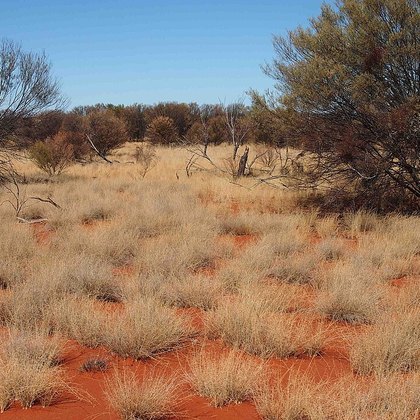
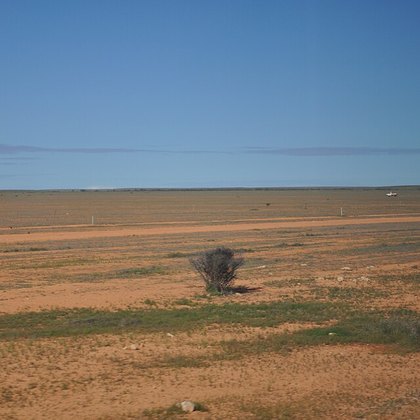
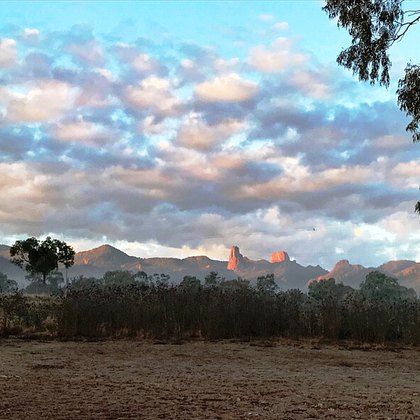
Arid and semi-arid shrubland and woodland, with a clear preference for mallee and acacia scrub carrying emu-bush (Eremophila). Also semi-arid coastal country, dry open forest, roadsides and occasionally gardens. It nests semi-colonially, low in shrubs or in spinifex clumps.
Where the bird is most often found, arranged by main group and formation.

Range and movements
Endemic to mainland Australia: western New South Wales, western Victoria, South Australia and much of Western Australia, chiefly in the arid and semi-arid zone. It is scattered in the Northern Territory and only rarely reaches western Queensland. Strongly nomadic — numbers at a site say everything about that year's flowering and nothing about the year before.
- Resident
- dark = core range, pale = thinly spread
Where and when to look
Find a flowering emu-bush or a mallee stand that has just come into blossom and stay with it: White-fronted Honeyeaters join mixed honeyeater flocks at such places. If you hear a hard metallic note among the whistling, scan the outer branches — it likes to sit just outside cover, and then the white mask is visible from a distance.
Conservation
Least Concern (LC, assessed 2021) and listed as secure in virtually every Australian state. The species has an enormous range and its nomadic habits make it little affected by local setbacks. It is, however, tied to intact mallee and acacia scrub, and broad-scale clearing and too-frequent fire in those vegetation types reduce the long-term supply of flowering shrubland.
Scientific name
Purnella albifrons | (Gould, 1841)
Gould described the species in 1841 as Glyciphila albifrons. The genus Purnella was erected in 1914 by Gregory Mathews and named for Herbert A. Purnell, an Australian oologist and collector; it holds this species alone. albifrons is Latin: albus 'white' and frons 'forehead' — exactly the feature the English and Dutch names return to as well.