All species › Passerines › Honeyeaters › Grey-fronted Honeyeater
Grey-fronted Honeyeater | Ptilotula plumula
Groenkaphoningeter | Mielero de plumón
The Grey-fronted Honeyeater is the honeyeater of the mulga and mallee plains ringing the Lake Eyre Basin: a small, softly marked bird whose whole identification story sits in one detail — an exceptionally broad, bright yellow ear plume with a thin black line along its upper edge. The English and the Dutch names each point at a different half of the head, since the crown is olive-yellow and only the forehead is grey. It must drink daily and is therefore, however dry the country, always to be found within flying distance of water.

Voice
The repertoire closely resembles that of the other Ptilotula species and is described only coarsely in the literature; recordings, however, are plentiful on xeno-canto. The everyday sound is a sharp, repeated chip contact call with which birds keep in touch within a territory, over which runs a series of rolling, faintly metallic whistles as song. No reliable character for separating it by ear from Grey-headed Honeyeater was found in the sources consulted; anyone identifying by voice would do well to weigh the habitat as well.
No freely licensed recording has been found for this species yet; what to listen for is described below.
Identification
A small honeyeater of fifteen to seventeen centimetres with a black bill and grey legs. The crown is olive-grey to olive-yellow; only the forehead carries a small grey patch, which gave the English name and which in the field is far less conspicuous than that name suggests. The lores are blackish. The decisive feature stands behind the eye: a very broad, bright yellow plume, edged above with a thin black line — broader than in any other species of the genus. The upperparts are grey with olive-brown edges to the flight feathers; the underparts are off-white with faint grey streaking on the chest. Young birds have a yellow gape and a yellow base to the lower mandible.
Confusion species
Grey-headed Honeyeater (Ptilotula keartlandi) is the sister species and the greatest problem: it has the whole crown grey rather than just the forehead, wears a much darker and sharper mask around the eye, and sits on rock and in gorges while Grey-fronted occupies the sandplains with mulga and mallee. Yellow-plumed Honeyeater (Ptilotula ornata) overlaps in the south: it is more heavily streaked below and has a distinctly black-bordered, upswept plume, whereas the plume of Grey-fronted is broader and carries that black edge only along the top. Yellow-tinted Honeyeater (Ptilotula flavescens) is yellower overall, has grey-yellow rather than black lores and a narrower plume. White-plumed Honeyeater (Ptilotula penicillata) has a white plume. Ptilotula fusca lacks the conspicuous plume altogether and sits far to the east. Finally, in mallee, Purple-gaped Honeyeater (Lichenostomus cratitius) can confuse, but that species has purple bare skin behind the bill.
Habitat
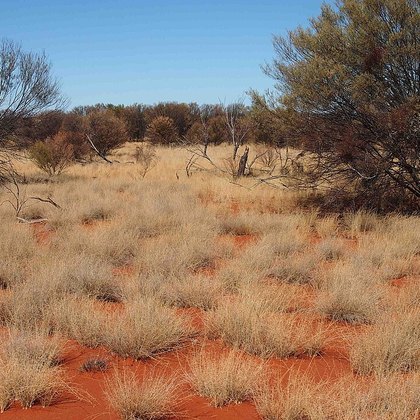
Open woodland, mallee and mulga-dominated scrub on the sandplains and loam plains of the dry interior, locally with spinifex beneath and with creek woodland along the watercourses. It is territorial and lives alone or in pairs, not in the parties many other honeyeaters form. Adults eat nectar and insects in roughly equal measure, young birds mainly insects. Characteristic is the dependence on water: the species must drink daily and in the dry season is therefore tied to pools, stock dams and artificial waters. It is resident but shifts over shorter distances when flowering or water fails.
Where the bird is most often found, arranged by main group and formation.


Range and movements
Endemic to Australia, with a strikingly annular range around the Lake Eyre Basin: the species encircles the lowest part of the continent without occupying it. From that ring the range continues into the Kimberley and the Northern Territory and into central Western Australia. Three subspecies are recognised, each holding part of the ring. The species is absent from the east coast, from the wet southeast, from Tasmania and from New Zealand.
- Resident
- dark = core range, pale = thinly spread
Where and when to look
Judge the width of the plume, not the forehead. The little grey forehead patch on which the English name hangs is almost never decisive in the field, whereas the strikingly broad yellow ear plume shows at ten metres and separates the species at once from Yellow-plumed and Yellow-tinted Honeyeaters. The second test is the terrain: flat sandy country with mulga or mallee belongs to this species, rocky gorges to Grey-headed Honeyeater. The best spot is a stock dam or an inland pool on a hot afternoon, because the species must drink daily and will then almost certainly come past.
Conservation
Least Concern (LC), with a very large range in thinly settled interior country and no evidence of decline. The main risks are indirect: overgrazing by stock, goats and rabbits thins the mulga and mallee scrub it nests and forages in, and large, hot spinifex fires can remove flowering shrubs for years. Against that, the pastoral industry with its dams and troughs has added water to a landscape where scarcity of it set the terms, which for a species that must drink daily probably works in its favour; firm figures on that balance were not found.
Scientific name
Ptilotula plumula | (Gould, 1841)
John Gould described the species in 1841 as Ptilotis plumula; author and year stand in parentheses, because it later moved to Lichenostomus and, after the 2011 molecular work showed that genus to be polyphyletic, to Ptilotula — a name Gregory Mathews had already coined in 1912 from Greek ptilon, 'feather', and ous, 'ear'. The epithet plumula is Latin for 'little feather' or 'small plume' and refers to the broad yellow ear plume, precisely the feature by which the species is known in the field; the Spanish name mielero de plumón follows it. The Dutch name groenkaphoningeter picks the olive-yellow crown, while the English name takes the small grey forehead — two names that seem to contradict each other on the same little bird, but which simply describe different halves of the head. The species was formerly also called Yellow-fronted or Plumed Honeyeater.