All species › Passerines › Honeyeaters › White-plumed Honeyeater
White-plumed Honeyeater | Ptilotula penicillata
Witpluimhoningeter | Mielero empenachado
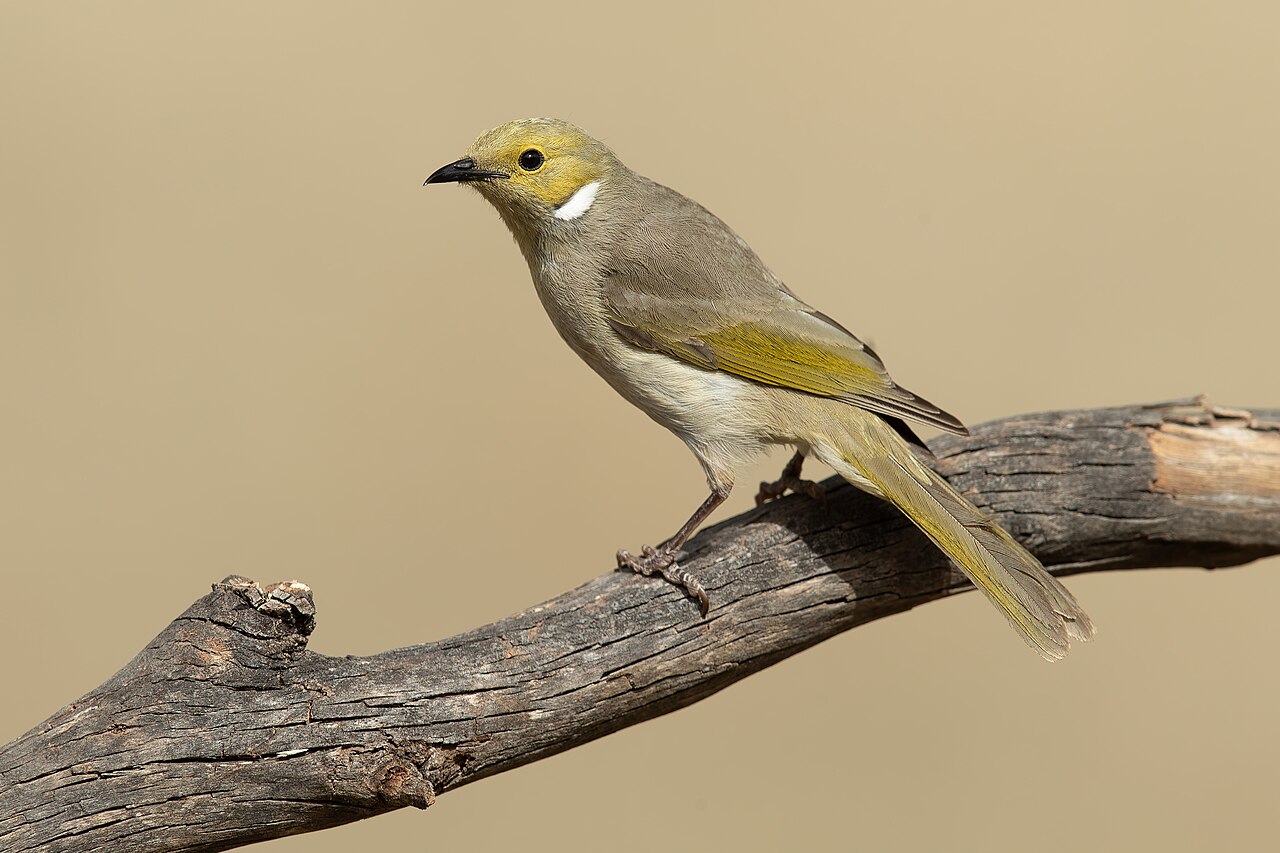
The White-plumed Honeyeater is the honeyeater of the river red gum: a small, yellow-green bird with a black-edged white plume on the side of the neck, working the crowns of riverside gums in noisy little parties. Wherever there is water in dry Australia — a creek, a stock dam, a town pond — it is almost certainly there, and audible all day.
Voice
It is among the first birds to call in the morning and among the last to fall silent at night. The best-known sound is a bright, cheerful 'chick-ick-o-wee' or 'chirrapo-we-weet', mixed with whistles and a sharp, shrill descending 'chip'. The repertoire varies noticeably by region, so birds on the Murray sound different from birds in the Pilbara. A hawk or a snake sets the whole party off in a rattling alarm that pulls in birds from every direction.
Recording: Romuald Mikusek — CC BY-NC-SA 4.0 · Lake Fyans Holiday Park (near Lake Fyans), Northern Grampians Shire, Victoria, Australia · xeno-canto
Identification
A small honeyeater of fifteen to seventeen centimetres, yellowish-olive above and pale brown-grey below, with a distinctly yellow-tinged head and a slightly down-curved bill. Everything turns on the plume: a narrow white streak of feathers low on the side of the neck, edged black above and below, standing out as a small white dash in the yellow face. Breeding birds have a black bill and black bare skin round the eye; outside the season both are yellower. Young birds are duller, with a less clean-cut plume and a pale bill. It moves fast and restlessly, hangs upside down on flowering twigs and crosses between trees in short fluttering flights.
Confusion species
The white neck-plume is unique — no other honeyeater has it — but at range, against the light or high in a crown that mark is lost and what remains is a plain olive-yellow bird. That brings in the five other Ptilotula species, all fairly plain olive to brown and separated mainly on head detail and range: Yellow-plumed Honeyeater (Ptilotula ornata) has a yellow-and-black ear plume and keeps to mallee (low, multi-stemmed eucalypt scrub of dry southern Australia), Grey-fronted Honeyeater (Ptilotula plumula) and Grey-headed Honeyeater (Ptilotula keartlandi) are arid-interior birds with a yellow-green and a grey crown respectively, Yellow-tinted Honeyeater (Ptilotula flavescens) is paler and yellower in the tropical north, and Fuscous Honeyeater (Ptilotula fusca) is darker and duller with a small yellow-and-black ear stripe. Watch also for Yellow-tufted Honeyeater (Lichenostomus melanops), which carries a black head patch with a yellow tuft rather than a white neck-plume.
Habitat
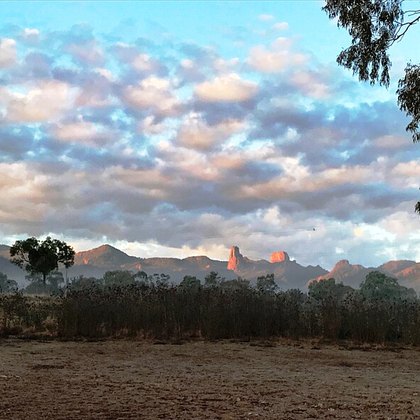
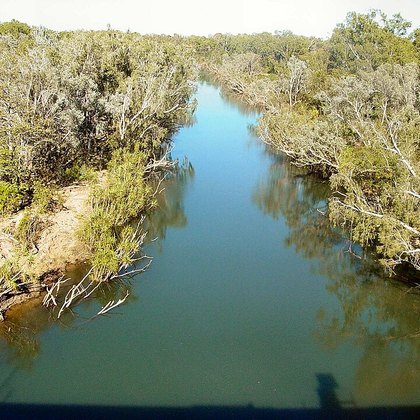
Open eucalypt forest and woodland, almost always within reach of water: riparian strips along creeks and rivers, swamp edges, stock dams and small reservoirs. The tie to river red gum (Eucalyptus camaldulensis) is so strong that inland the species follows the river belts like a ribbon. It also occupies urban bushland, parks and gardens. In genuinely arid country without artificial water it is absent.
Where the bird is most often found, arranged by main group and formation.



Range and movements
Nearly the whole Australian mainland, except the humid tropical north, Cape York Peninsula and the barest deserts. The stronghold is the Murray-Darling basin and the inland river systems. In Sydney it was scarce until the 1940s; since then it has taken the city and spread north to Newcastle. Four subspecies are recognised, of which southern Kimberley calconi is the smallest and palest.
- Resident
- dark = core range, pale = thinly spread
Where and when to look
Look for it not in the trees but at the water: walk the bank of a creek or stock dam and listen for 'chick-ick-o-wee' in the crowns of the river gums. Once you have an olive-yellow honeyeater in view, wait for it to turn its head — the white neck streak flares for a moment against the yellow. Time of day matters little: it stays active over water even in the heat of the afternoon.
Conservation
Least Concern (LC). The species is abundant, has profited from stock dams, irrigation and town plantings, and is expanding locally. Where inland river red gums die back through water extraction and prolonged drought it does drop out, because in dry Australia its distribution hangs directly on those trees.
Scientific name
Ptilotula penicillata | (Gould, 1837)
Gould described the species in 1837 as Meliphaga penicillata; because it now sits in Ptilotula, author and year stand in parentheses. Ptilotula is a diminutive of Ptilotis, from Greek ptilon 'feather' and ous, ōtos 'ear' — after the ear feathering of this group. The genus was resurrected in 2011 after molecular work by Nyári and Joseph showed that the old Lichenostomus was made up of several unrelated lineages. penicillata is Latin for 'with a small brush', after the white neck-plume, and that same plume carries into the English and Dutch names.