All species › Passerines › Honeyeaters › Yellow-plumed Honeyeater
Yellow-plumed Honeyeater | Ptilotula ornata
Malleehoningeter | Mielero adornado
The Yellow-plumed Honeyeater is the resident of the mallee: the low eucalypt scrub that springs from an underground lignotuber in a bundle of thin stems and that covers great stretches of southern Australia. It lives there in fixed, noisy parties that defend their territory jointly, and announces itself with a clear, far-carrying chick-o'wee. The feature that names it is the upswept yellow neck plume, bordered black and more conspicuous than in any other honeyeater of the mallee.

Voice
The characteristic call is a loud, clear, ringing chick-o'wee, three syllables with the stress at the front, carrying remarkably far across low scrub and the handiest mark the species has. Alongside it runs a series of short, rapid alarm chirps and rolling trills, which also carry far and which the whole party takes up at once as soon as a raptor or an intruder appears. Because the species lives in fixed groups the sound is almost always plural: one call from a mallee bush is answered within seconds by three or four others.
No freely licensed recording has been found for this species yet; what to listen for is described below.
Identification
A medium-sized honeyeater of fourteen to eighteen centimetres with a relatively long, down-curved black bill. The head is olive-green with a dark face and a faint yellow line below the eye; the upperparts are grey-green. The underparts are heavily streaked grey-brown — unusually conspicuous for this genus. The decisive feature is the neck plume: bright yellow, clearly bordered black and directed obliquely upward, so that it stands out behind the ear coverts like a small pennant. Young birds have a yellow bill base and a yellow eye-ring. The sexes look alike.
Confusion species
Grey-fronted Honeyeater (Ptilotula plumula) is the hardest, since the two share mallee and dry woodland in South and Western Australia: that species, however, has a much broader yellow plume without a clear black border, whiter and far fainter streaking below, and a small grey forehead patch. Ptilotula fusca has only a tiny, inconspicuous plume and entirely plain, unstreaked underparts, and occurs mainly east of this species' range. White-plumed Honeyeater (Ptilotula penicillata) carries a white rather than a yellow plume and is yellower on the face. Two more pitfalls outside the genus sit in the same mallee: Purple-gaped Honeyeater (Lichenostomus cratitius), recognised by the purple bare skin behind the bill, and Yellow-tufted Honeyeater (Lichenostomus melanops), with a black head patch in which the yellow tuft sits.
Habitat
Mallee above all — the low eucalypt scrub of sandplains and dune fields — together with dry eucalypt woodland and open forest, with seasonal visits to any eucalypt stand in heavy flower. On the coasts of South and Western Australia it reaches the sea where mallee touches the shore, and it also turns up at freshwater wetlands. It is chiefly insectivorous, working the outer foliage, branches and trunks of low trees and sometimes the ground, and supplements this with lerp and with nectar from eucalypts and mistletoe. Breeding takes place in loose colonies from July to January: the nest is an open cup of wool, grass and spiderweb slung from a thin fork in a mallee bush, with one to three eggs. Both parents feed the young, often with helpers, and the species is parasitised by several cuckoo species.
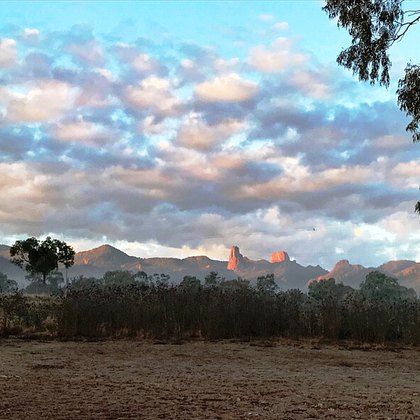
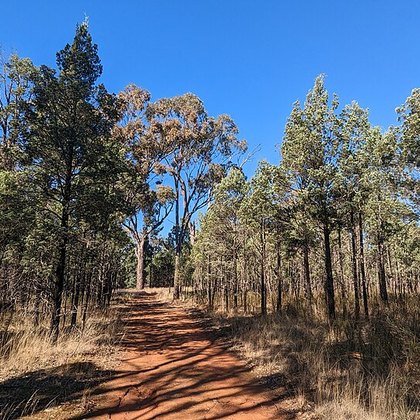
Where the bird is most often found, arranged by main group and formation.

Range and movements
Endemic to southern mainland Australia. The range runs from western New South Wales through the mallee of Victoria and South Australia into southwestern Western Australia, with its centre of gravity in the temperate and semi-arid zone. It is absent from the tropical north, from the arid centre north of the mallee, from Tasmania and from New Zealand. Within its range it is resident and strongly site-faithful: parties stay year after year in the same patch of scrub.
- Resident
- dark = core range, pale = thinly spread
Where and when to look
Start with the habitat. If you are in true mallee — low eucalypts with several thin stems from a single lignotuber — a streaked honeyeater with a yellow neck plume is almost certainly this species, and you will usually hear the ringing chick-o'wee before you see anything. Then use the streaking as the test: heavily streaked underparts belong to Yellow-plumed, faint or absent streaking to Grey-fronted or to Ptilotula fusca. The plume itself is the third check: narrow, upswept and with a clear black border here, broad and with only a thin black line along the top in plumula.
Conservation
Least Concern (LC) and common to numerous within the remaining mallee. The species' vulnerability lies not in itself but in its habitat: the mallee of southern Australia has been cleared over vast areas for grain cropping, and what survives is fragmented into blocks between paddocks. Mallee also recovers slowly after fire, so that too-frequent burning makes a site unsuitable for years; the species needs older, flowering scrub. Because it is strongly site-faithful and does not wander far, parties in isolated blocks can disappear locally after fire or clearing without being quickly replaced.
Scientific name
Ptilotula ornata | (Gould, 1838)
John Gould described the species in 1838 as Ptilotis ornata; author and year stand in parentheses, because it later moved to Lichenostomus and then, after molecular work in 2011 showed that genus to be polyphyletic, to Ptilotula. That generic name, proposed by Gregory Mathews in 1912, comes from Greek ptilon, 'feather', and ous, 'ear', with a diminutive ending: the ear plume. The epithet ornata is Latin for 'adorned' or 'ornamented' and refers to that same conspicuous plume. The English name Yellow-plumed Honeyeater and the Spanish mielero adornado follow the epithet, the first literally by naming the plume, the second by taking over the word 'adorned'. The Dutch name malleehoningeter alone picks the habitat, and is arguably the most useful of the three for a field observer.