All species › Passerines › Honeyeaters › Bell Miner
Bell Miner | Manorina melanophrys
Belhoningeter | Mielero cejinegro
The Bell Miner is a bird of south-eastern Australia: an olive-green miner living in colonies of tens to hundreds, driving every other insect-eater out of the forest and keeping up, year round, a continuous metallic tink that rings across the gully like a distant bell. Where a colony sits, the forest sounds different — and often looks sicker, because the species stands at the centre of one of Australia's most persistent forest problems.

Voice
The voice is both the calling card and the name. It is a sweet, musical, high tink, one note at a time, given irregularly and out of step by the birds of a colony, so that a continuous chiming hangs over the forest all day. From a distance it really does sound like a small bell, and it scarcely stops while the light lasts. The species also has harsher, rasping calls for alarm and for mobbing intruders — and that collective mobbing is a daily ritual.
Recording: Romuald Mikusek — CC BY-NC-SA 4.0 · Australia · xeno-canto
Identification
The smallest of the miners at seventeen to twenty centimetres, with olive-green plumage darker on the wings and yellower on the belly. The head gives it away at once: a short, downcurved yellow bill, and behind and below the eye a patch of bare skin in orange-red, with a dark brow above it. The legs are bright orange and are often the first thing that shows on a bird in shade. The sexes are alike, though the male is slightly larger; young birds are duller and browner. It is the only green miner — the other three species of the genus are grey.
Confusion species
Within the genus it is effectively unmistakable, because it alone is green. Yellow-throated Miner (Manorina flavigula) is grey with a white rump, a black cap and a yellow bill, and lives in open, dry inland woodland rather than dense gullies; Black-eared Miner (Manorina melanotis) is likewise grey, has a dark ear region and no white rump, and is confined to the mallee (low, multi-stemmed eucalypt scrub of dry southern Australia) of the Murray country. Those two are the difficult pair, because they hybridise in the contact zone. Noisy Miner (Manorina melanocephala) is grey with a black head and is the miner of parks and streets. At range, an olive-green bird in a gully can also suggest Yellow-tufted Honeyeater (Lichenostomus melanops), but that species has a black mask, a yellow crown and a black bill instead of an orange-red eye patch and a yellow bill.
Habitat
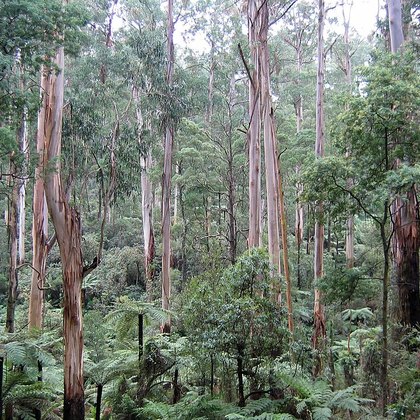
The margins of wet and dry sclerophyll forest and thick woodland, preferably in gullies with a dense shrub layer but an open midstorey, and almost always near a stream or other permanent water. Suburbs retaining large eucalypts and shrub plantings are occupied too. Food consists almost entirely of psyllids and the sweet lerp shelters (sugary scale secreted by psyllids, food for honeyeaters) those insects build over themselves — up to about ninety per cent of the diet — supplemented with nectar and manna. It breeds cooperatively: colonies of eight to more than two hundred birds are built from related coteries in which monogamous pairs are assisted by helpers, sometimes as many as twenty per nest; nest success is higher once at least six helpers attend a nest.
Where the bird is most often found, arranged by main group and formation.


Range and movements
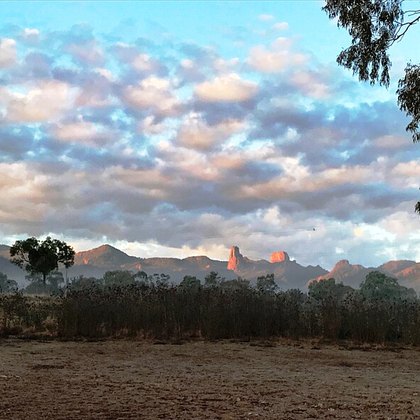
Endemic to south-eastern mainland Australia, from Gympie and Maryborough in south-eastern Queensland south through eastern New South Wales to central southern Victoria, as far as the outskirts of Melbourne. The range is confined to the coastal strip and the ranges behind it; inland, where forest gives way to dry woodland, it stops. It is sedentary: a colony stays in the same place for years and at most spreads slowly along suitable forest. It does not occur in New Zealand.
- Resident
- dark = core range, pale = thinly spread
Where and when to look
You find this species with your ears, from a distance, and you cannot get it wrong: continuous chiming above a wooded gully in south-eastern Australia means a Bell Miner colony. Walk quietly in and wait, because the birds come to look of their own accord and gather above an intruder. Watch for the orange legs and the orange-red patch behind the eye; against the light the plumage reads dark rather than green. One further sign is negative but useful: inside a colony you hear almost no other songbirds.
Conservation
Least Concern (LC), common and locally increasing — with this species the concern is not its survival but its consequences. A colony systematically drives all other insect-eating birds out of its area, after which the psyllid population can build up undisturbed; this has been linked to the phenomenon known in Australia as bell miner associated dieback, in which eucalypts weaken and die over large areas. Whether the birds genuinely 'farm' those psyllids, as has been proposed, is contested and still under investigation. Colonies also displace threatened species from their last habitat: at Yellingbo the bird in question is the Helmeted Honeyeater, the subspecies cassidix of Yellow-tufted Honeyeater (Lichenostomus melanops).
Scientific name
Manorina melanophrys | (Latham, 1801)
John Latham described the species in 1801 as Turdus melanophrys, that is, initially as a thrush; the parentheses around his name record the later move. Louis Pierre Vieillot introduced the genus Manorina in 1818; the original spelling was later corrupted to Manorhina and has since been restored to Vieillot's form. The epithet melanophrys is Greek for 'black-browed'. The group name miner has nothing to do with mining but is a nineteenth-century reworking of myna, the Hindi word for the starlings these birds were thought to resemble. Within the genus the Bell Miner stands apart: it is the only species of the subgenus Manorina, with green plumage, its own calls and distinct skeletal characters, while the other three form the subgenus Myzantha. The English name Bell Miner and the Dutch belhoningeter take the call; the Spanish mielero cejinegro follows the scientific epithet and takes the brow.