All species › Pigeons and doves › Doves and pigeons › Black-banded Fruit-Dove
Black-banded Fruit-Dove | Ptilinopus alligator
Alligatorjufferduif | Tilopo de Alligator
The only fruit dove in Australia that is not green: a solid black-and-white pigeon of the sandstone walls of the Arnhem Land plateau. Its entire world range is a narrow band of monsoon forest at the foot of that escarpment, from Kakadu into western Arnhem Land — it occurs nowhere else, which makes it one of the most place-bound birds on the continent.
Voice
A loud, slow, heavily booming call: a series of deep oom ... oom ... oom notes that quickens at the end and bounces off the sandstone, so the bird sounds further away than it is. There are also soft, clipped contact notes between birds in the same fig. In the still hour around sunrise the sound carries a kilometre down a gorge.
Recording: Marc Anderson — CC BY-NC-SA 3.0 · Kakadu National Park (near Kakadu), Northern Territory, Australia · xeno-canto
Identification
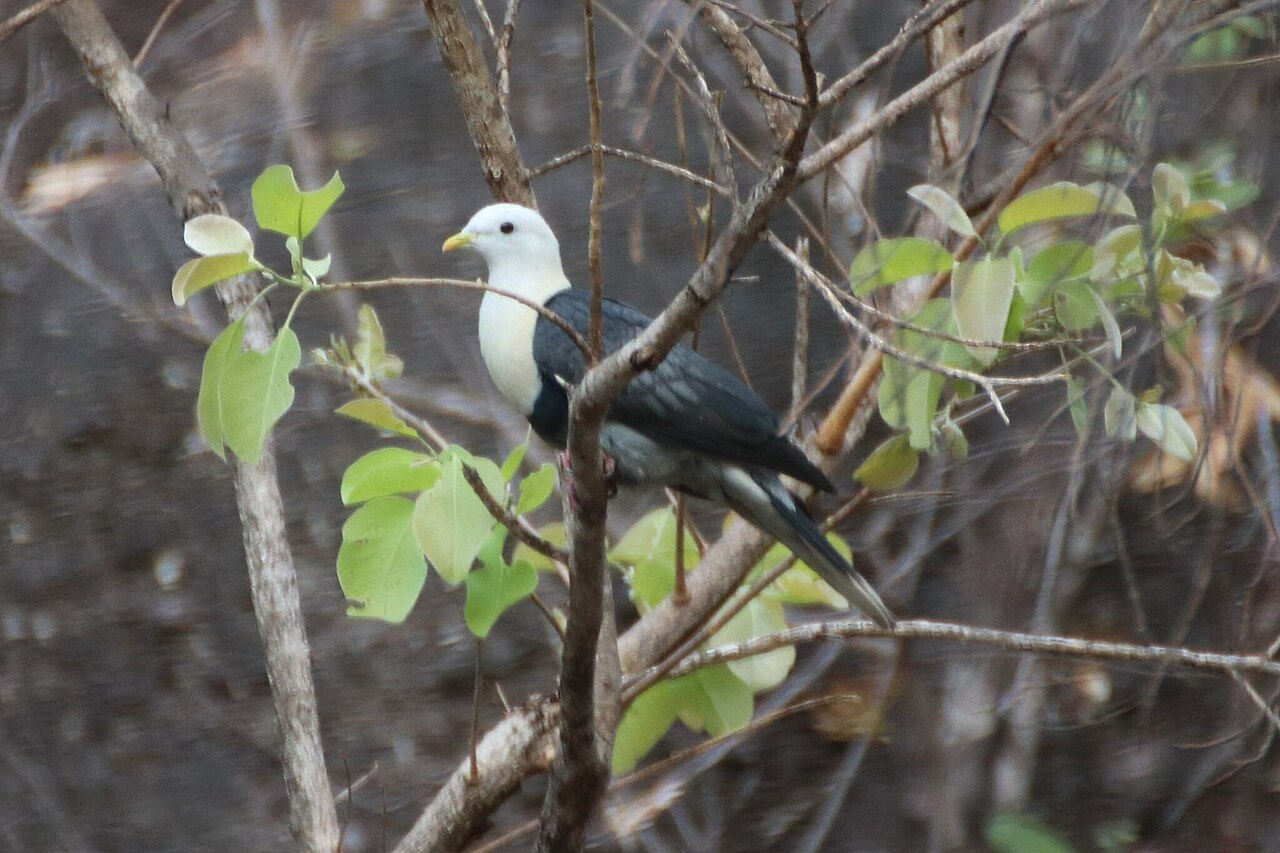
A large pigeon of 38 to 44 cm and 200 to 260 grams, far bulkier than the other Australian fruit doves. Head, neck and upper breast are white to yellowish white and are cut off sharply by a broad black breast band; back and wings are dark slate to black, paling to grey towards the rump. The tail is black with a broad grey terminal band. The underparts below the black band are grey, paler towards the undertail coverts. The bill is yellowish, the iris red-brown, the legs grey-pink. At range the picture is simple: a white head and breast above a dark body, with one black stripe between them.
Confusion species
The colourful fruit doves of the region look nothing like it: Rose-crowned Fruit-Dove (Ptilinopus regina) and Superb Fruit-Dove (Ptilinopus superbus) are green and barely half as long. The real risk is Torresian Imperial-Pigeon (Ducula spilorrhoa), which is the same size in the Top End and also black and white: that bird, however, is mostly white, with black only on the wingtips and tail edge and no breast band at all, and it keeps to mangrove, coastal woodland and islands rather than sandstone. A heavy black-and-white pigeon on the escarpment with a closed black band below a white breast has no alternative.
Habitat
Patches of monsoon rainforest and vine thicket in gorges and at the foot of the sandstone escarpment, plus the narrow gallery forest along creeks that thread through the rock. It is tied to fruiting trees in those patches, above all native figs, and also forages in the open rocky ground between them. The key is the combination of sandstone and a permanently moist forest patch: without both, it is absent.
Where the bird is most often found, arranged by main group and formation.


Range and movements
Only the western edge of the Arnhem Land plateau in the Northern Territory, from Kakadu National Park — Burrungkuy (Nourlangie), Jim Jim, Gunlom, Koolpin — east into western Arnhem Land. Nothing beyond that: not elsewhere in Australia, not New Guinea, nowhere in the world. That makes it one of the few true Top End endemics, and the number of Australian records is correspondingly low compared with that of the other fruit doves.
- Resident
- dark = core range, pale = thinly spread
Where and when to look
Walk a track at the foot of the sandstone early in the morning — the Nourlangie rocks or the creek at Gunlom are the best-known places — and look first for a fig in fruit; that is where it sits, or where it will come. Listen for the deep booming and then search high in the crown, where it can stay motionless for minutes. The dry season, May to September, is by far the best time, when the tracks are passable and the birds concentrate at the few fruiting trees.
Conservation
Least Concern (LC) on the global assessment, but that reassurance rests on a narrow base: the whole species fits on one plateau. The risk is not hunting or trade but fire. The monsoon forest patches at the foot of the escarpment have long been protected by cool burning early in the dry season; when fire runs late and hot, the flames eat into the edges of the patches and the fruiting trees are lost. The return of early-season burning through Aboriginal ranger programmes on the Arnhem Land plateau is therefore the single most important measure for this bird.
Scientific name
Ptilinopus alligator | Collett, 1898
Robert Collett, director of the zoological museum in Christiania (now Oslo), described the species in 1898 in the Proceedings of the Zoological Society of London as Ptilopus (Leucotreron) alligator, from material the Norwegian collector Knut Dahl gathered in the Alligator Rivers country between 1894 and 1896; the type locality is 'near the sources of the South Alligator River, Arnhem Land'. Author and year carry no parentheses, because Ptilopus was simply another spelling of Ptilinopus at the time. Swainson introduced that genus in 1825, from Greek ptilon, 'feather', and pous, 'foot', for the feathered legs. The epithet alligator therefore refers not to an animal but to the river: Phillip Parker King named the Alligator Rivers in 1818 after mistaking the saltwater crocodiles in them for alligators.