All species › Pigeons and doves › Doves and pigeons › Rose-crowned Fruit Dove
Rose-crowned Fruit Dove | Ptilinopus regina
Swainsons jufferduif | Tilopo reina
A small green dove with a deep rose crown edged by a thin yellow rim and an orange-yellow belly. It is the most widespread of the small fruit doves within this map window: from the Kimberley across the Top End and Cape York to the mid-north coast of New South Wales, everywhere in dense forest with trees in fruit.

Voice
A rising, accelerating call that sounds like boo-uk-boo or woo-up-woo, quickening and lifting slightly at the end — clearly livelier than the flat, monotonous series of Superb Fruit Dove. The call is usually the only proof of presence, because the bird itself stays motionless in the leaves. Between birds come short, soft contact notes.
No freely licensed recording has been found for this species yet; what to listen for is described below.
Identification
22 to 24 cm, small and compact. The crown is deep rose to red-pink with a narrow yellow border around it — that rim is the mark that fixes it. Throat and upper breast are grey and slightly mottled, upperparts plain green, belly orange, undertail coverts yellow, and the tail carries a yellow terminal band. In flight the picture is clean: dark underwings against a yellow body and a yellow tail tip. The female is like the male but slightly paler on crown and belly. Birds of the north-west are smaller and more brightly coloured than those of the east coast.
Confusion species
The three colourful fruit doves of the region are in fact easy to separate on colour pattern. Superb Fruit Dove (Ptilinopus superbus) has a purple crown, fiery orange nape and blue-black breast band in the male, and an almost wholly green female with a small purple crown patch — that green-female plumage does not exist in Rose-crowned Fruit Dove, where the female also carries the rose crown. Black-banded Fruit Dove (Ptilinopus alligator) is nearly twice as long and black and white, and sits only on the Arnhem Land plateau. Wompoo Fruit Dove (Megaloprepia magnifica) is twice the size, with a purple breast and a yellow wing bar. Only in eastern Queensland and northern New South Wales do all three small species come together.
Habitat
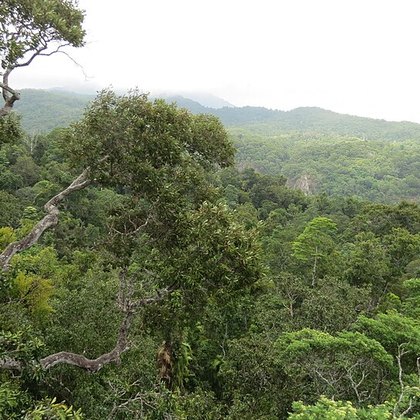
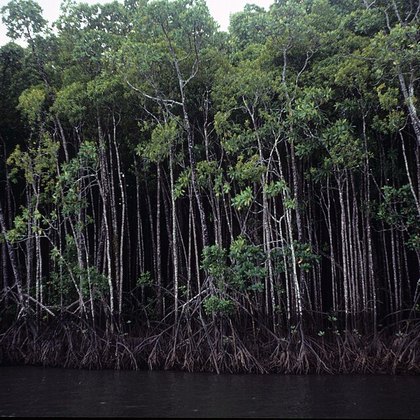
Tall tropical and subtropical coastal forest, especially where vines and creepers are dense: monsoon rainforest and vine thicket in the north, lowland rainforest in the east, and tall woodland adjoining rainforest with plenty of fruiting trees. Also gallery forest along creeks and, less often, mangrove. It feeds in the canopy, mostly in the morning or late afternoon, and swallows fruit whole.
Where the bird is most often found, arranged by main group and formation.


Range and movements
Widely spread across the northern and eastern coastal country: from the Kimberley in Western Australia through the Top End, across Cape York and the Torres Strait islands, and down the Queensland coast to the mid-north coast of New South Wales. Partly resident, partly migratory: in the east birds move north and south with the season, elsewhere mostly locally, following trees into fruit. It is absent from New Zealand and Norfolk Island.
- Resident
- dark = core range, pale = thinly spread
Where and when to look
Go on the call: the accelerating boo-uk-boo is far easier to find than the bird. Then look from below for the orange belly and yellow tail tip, because the green back is invisible from underneath. Good places are the monsoon forest at Fogg Dam and Howard Springs in the Top End and the lowland rainforest remnants at Iluka and Port Macquarie in New South Wales. A fig or camphor laurel in fruit at first light is almost always the shortest route.
Conservation
Least Concern (LC): widespread and locally numerous, with a large range spanning three states. At the southern edge, in New South Wales, the picture is tighter through loss of lowland rainforest, and here too birds are lost against windows during the seasonal movements. In the north its future hangs mainly on fire management: the monsoon forest and vine thicket patches it lives in do not tolerate hot burns late in the dry season.
Scientific name
Ptilinopus regina | Swainson, 1825
William Swainson described the species in 1825 and placed it straight into Ptilinopus, the genus he introduced that same year, so author and year carry no parentheses; at first he took the bird for a variety of another fruit dove. The type locality is New South Wales. Ptilinopus is from Greek ptilon, 'feather', and pous, 'foot', for the feathered legs, and regina is the Latin for 'queen' — hence the Spanish name tilopo reina. The Dutch name honours the describer himself; the English rose-crowned fruit dove points to the pink crown.