All species › Pigeons and doves › Doves and pigeons › Superb Fruit Dove
Superb Fruit Dove | Ptilinopus superbus
Kleine prachtjufferduif | Tilopo soberbio
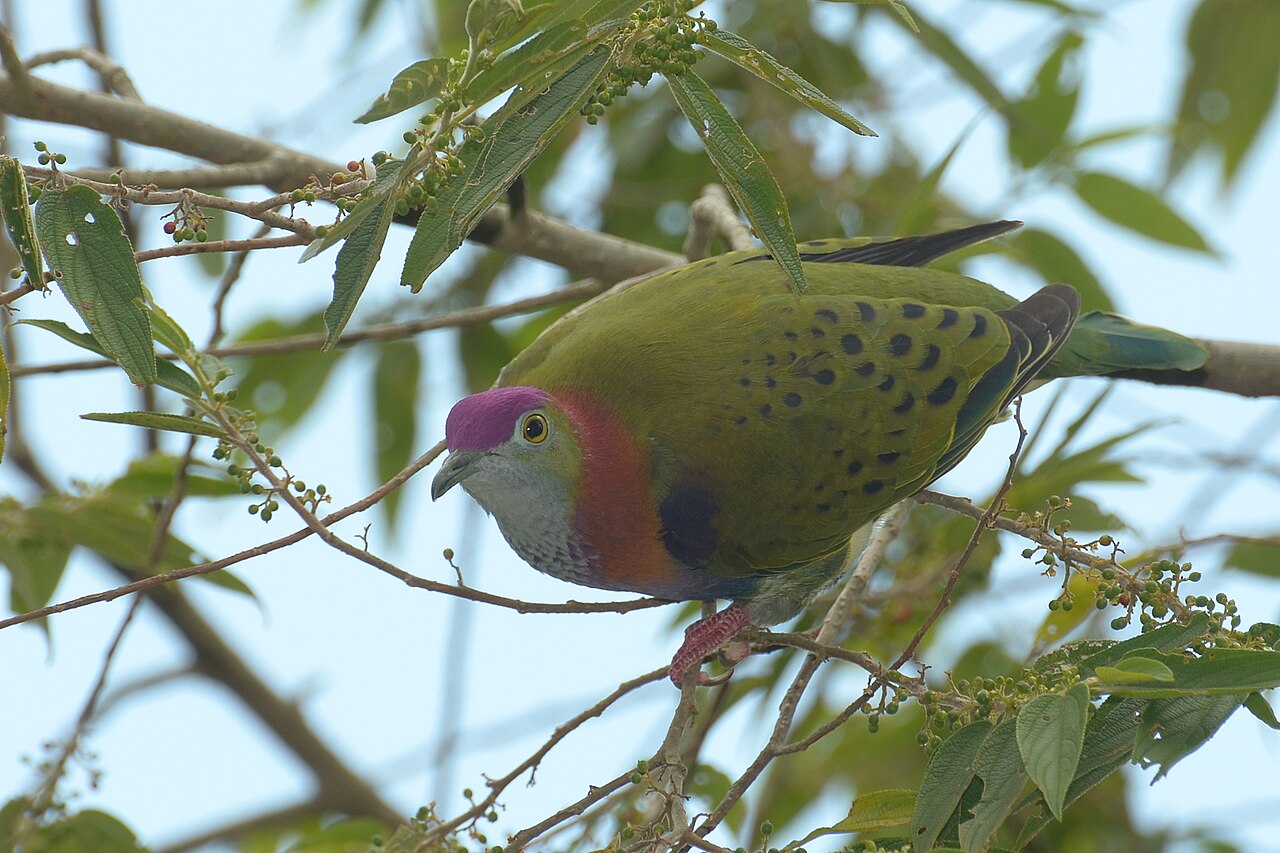
A small, rotund dove with a purple crown and a fiery orange nape, and still one of the hardest birds to find in Australian rainforest: it sits motionless high in the crown and its green vanishes against the leaves. Alone among the Australian fruit doves the sexes differ sharply, which makes identifying it easier than finding it.
Voice
A slow, even series of the same deep note: whoop ... whoop ... whoop, kept up for minutes and far less varied in pitch and interval than the call of Rose-crowned Fruit Dove. That monotony is the mark. On take-off the wings whistle audibly, a thin high sound that cuts through the canopy.
No freely licensed recording has been found for this species yet; what to listen for is described below.
Identification
22 to 24 cm — a starling-sized dove, short-tailed and thickset. The male carries a purple crown, a fiery orange nape, green ear coverts, a grey upper breast divided from the white belly by a narrow blue-black breast band, green barring on the flanks and olive-green spots on the wing; the tail is white-tipped. The female is almost wholly green with a grey breast and white belly, and has just one mark: a small purple patch on the crown. Young birds resemble the female but lack that patch.
Confusion species
It separates cleanly from the other colourful fruit doves, because each of the three carries its own crown pattern. Rose-crowned Fruit Dove (Ptilinopus regina) has a rose-pink crown with a narrow yellow border, an orange belly and no breast band, and its sexes look alike. Black-banded Fruit Dove (Ptilinopus alligator) is nearly twice as long, black and white, and confined to the Arnhem Land plateau. Wompoo Fruit Dove (Megaloprepia magnifica) is far larger, with a purple breast and a yellow wing bar. The only real problem is the green female: look for the purple crown patch, and failing that for the sharply defined white belly with no orange.
Habitat
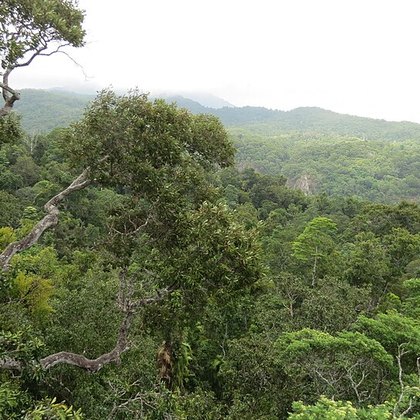
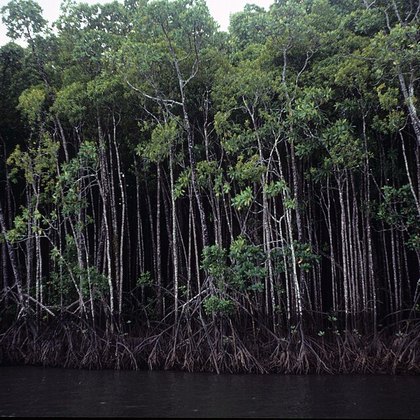
Closed forest: rainforest and rainforest margin, mangrove and wooded stream margins. Beyond that, and this is what sometimes makes it unexpectedly findable, isolated fruiting trees outside forest — a single fig, lilly pilly or pittosporum in a garden, a park or a roadside can hold birds for days. It is wholly arboreal and does not come to the ground.
Where the bird is most often found, arranged by main group and formation.


Range and movements
The coast and nearby ranges of Queensland and New South Wales, south to Moruya, growing steadily more numerous northwards to Cape York. Outside the breeding season it wanders further: south into Victoria and even Tasmania, while some birds cross to New Guinea. Exactly how those movements run is still poorly known, because the species is so hard to follow.
- Resident
- dark = core range, pale = thinly spread
Where and when to look
Do not look for it, listen for it: the slow, monotonous series of whoops is almost the only way you will find it, and only then do you scan the crown for a white belly from below. Stand under a fruiting fig early in the morning. A less cheerful but telling clue are the birds that strike windows during their north-south movements: a stunned or dead young bird beside a building is often the first proof the species is in the district.
Conservation
Least Concern (LC) globally and numerous across most of the tropical range. In New South Wales, by contrast, it is listed as vulnerable at state level, through clearing and fragmentation of the lowland rainforest at the southern edge of its range. A second, less visible cause is added there: many young birds are killed against building windows while moving along the coast.
Scientific name
Ptilinopus superbus | (Temminck, 1809)
Coenraad Jacob Temminck described the species in 1809 as Columba superba, in the plate work Les Pigeons he issued with Pauline Knip; the type locality was given as 'O-Taiti' — Tahiti — which later proved a mistake: the material came from Halmahera in the Moluccas. Because the species now sits in Ptilinopus, author and year take parentheses. Swainson introduced that genus in 1825, from Greek ptilon, 'feather', and pous, 'foot', for the legs feathered down to the toes. superbus means 'proud, magnificent'; in older literature the bird also appears as purple-crowned fruit dove.