All species › Pigeons and doves › Doves and pigeons › Spotted Dove
Spotted Dove | Spilopelia chinensis
Parelhalstortel | Paloma ala dorada
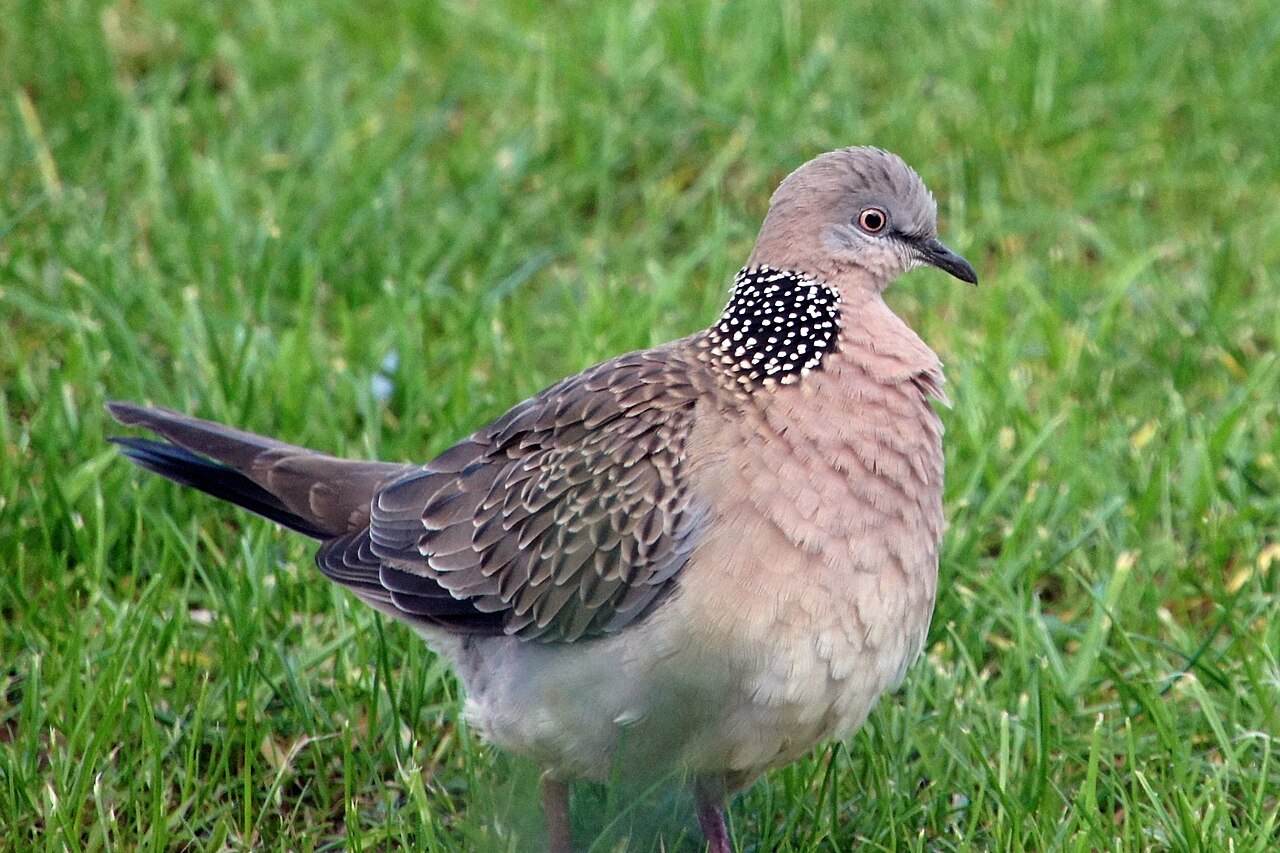
The Spotted Dove is the dove of the Australian and New Zealand suburb: a slim, long-tailed bird with a grey head, a pink-brown breast and a black neck patch peppered with white spots. It comes from southern and southeastern Asia, was released at several places in the nineteenth century, and has been part of the garden ever since.
Voice
The call is a deep, slightly lilting phrase of three or four syllables: coo-crroo-cuk, the middle part rolling and the last note dropping away. It repeats for minutes on end from a roof edge, a wire or a branch in a street tree, above all early in the morning. In display it adds a steep clapping flight, then glides down with the tail spread.
Recording: Untung Sarmawi — CC BY 4.0 · Sano Nggoang, West Manggarai Regency, East Nusa Tenggara, Indonesia · xeno-canto
Identification
A dove of about 32 cm that looks bigger than it is thanks to a long tail broadly tipped white. Head and neck are grey, breast and belly pink-brown, back and wing brown with dark feather centres that give a scaled effect. The mark is on the side of the neck: a broad black band densely set with small white pearls. Young birds lack that band and are duller and plainer; in flight it is the white tail tip that catches the eye.
Confusion species
Rock Dove (Columba livia) shares the town but is stockier, short-tailed and carries two black wing bars. Laughing Dove (Spilopelia senegalensis), also introduced and established mainly around Perth, is smaller and warmer rufous, and instead of a pearled neck patch has a black-speckled band lower on the breast. The small Geopelia doves, such as Peaceful Dove (Geopelia placida), are far smaller and finely barred over head and neck.
Habitat
Gardens, city parks, campuses, schoolyards and tree-lined streets are the core; beyond that orchards, vineyards, crop edges and farmyards with spilt grain. It avoids closed forest and the dry interior and stays within reach of human food and water. It feeds walking on the ground, on paths, lawns and car parks; the nest is the usual see-through platform of twigs, low in a shrub or against a building.
Where the bird is most often found, arranged by main group and formation.


Range and movements
Its native range runs from India and China through southeastern Asia; in Australasia it is an introduced bird. In Australia it is established in and around Melbourne, Sydney, Brisbane, Adelaide and Perth and is spreading along the coast and up the river valleys. In New Zealand it holds the North Island from Whangarei south to Turangi and Rotorua and along the Bay of Plenty, with a small stronghold near Christchurch. It does not migrate; the spread is slow and follows settlement.
- Resident
- dark = core range, pale = thinly spread
Where and when to look
In a suburb, listen early for the slow lilting phrase and then search the roof edge or the telephone wire. On the ground the tail tip works fastest: white and broad, even on birds walking away from you. In a group on a lawn there are usually young birds without the neck band among the adults, and then the scaled wing is the thing to hold on to.
Conservation
Least Concern (LC); in Australia and New Zealand the question is less how it is faring than what it does. It is an introduced bird that lives off the town, and the fear that it displaces native doves has been raised more than once but rarely demonstrated: its gain is mostly in habitat that would not exist without people. Several Australian states list it as an unwanted species and include it in pest bird control.
Scientific name
Spilopelia chinensis | (Scopoli, 1786)
Scopoli described the bird in 1786 as Columba chinensis, from an account Sonnerat had published four years earlier; because it was later moved to another genus, author and year stand in parentheses. The genus Spilopelia was introduced by Sundevall in 1873 and is built from Greek spilos, 'spot', and peleia, 'dove' — the pearled neck patch, in other words. chinensis means 'from China'; the type locality was later restricted to Canton.