All species › Tubenoses › Albatrosses › Black-browed Albatross
Black-browed Albatross | Thalassarche melanophris
Wenkbrauwalbatros | Albatros ojeroso
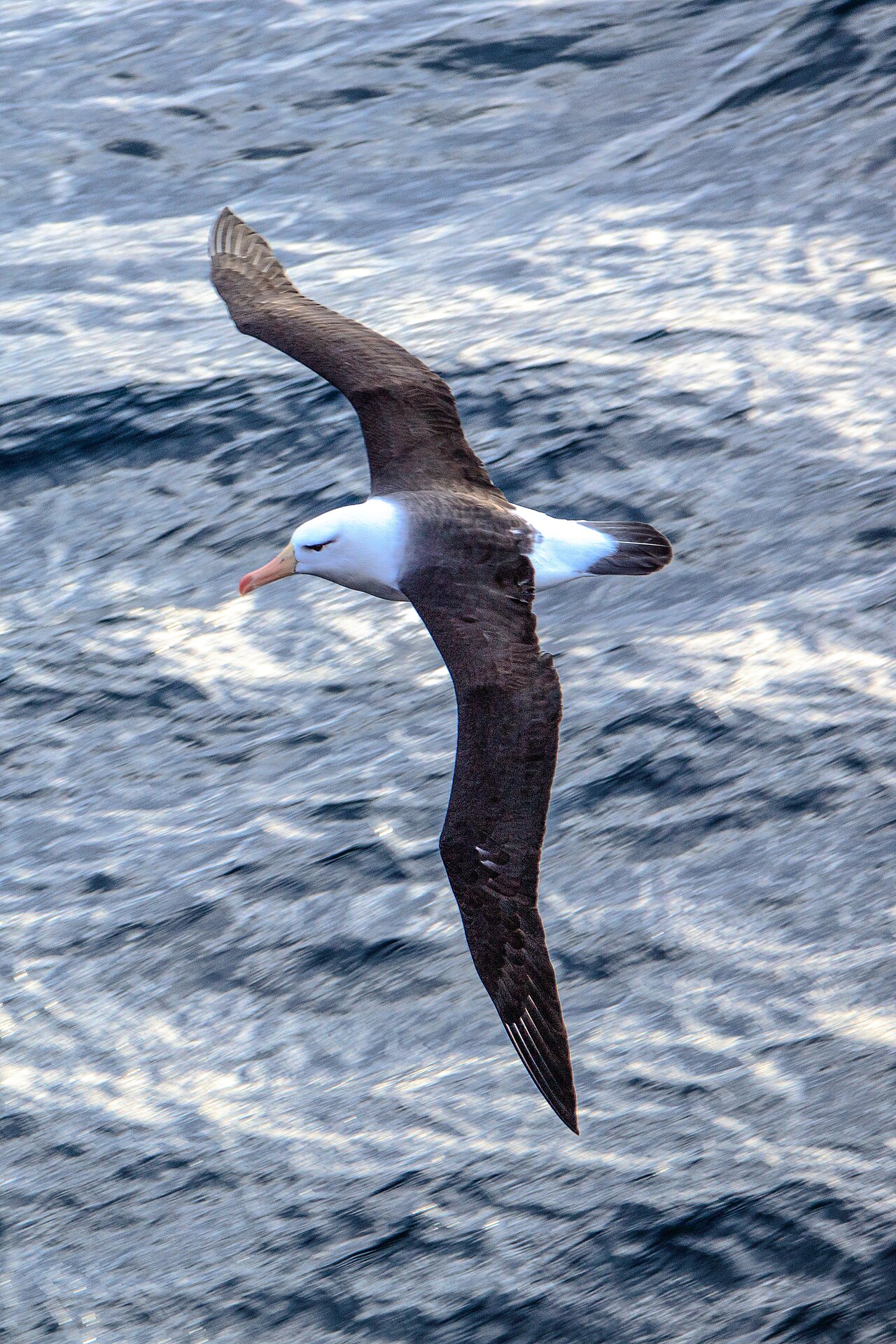
The Black-browed Albatross is the albatross that turns up in front of the bow most often in Australian and New Zealand waters: a medium-sized mollymawk with a white head and underparts, a dark mantle and upperwing, and a heavy orange-yellow bill with an orange-red tip. The black line along the eye gives it the scowl it is named for, and that line together with the bill colour is often enough for the identification at sea.
Voice
On the open ocean it is usually silent, but around a trawler hauling its nets there is hoarse growling and cackling between squabbling birds. At the colony the sound belongs to display: a loud two-toned bray, aaah-aah, with the two halves of the bill visibly vibrating, alternating with dry clattering and a high whine during mutual preening. A chick begging for food gives a sustained piping whistle that carries over the surf.
No freely licensed recording has been found for this species yet; what to listen for is described below.
Identification
A mollymawk of eighty to ninety-five centimetres and three to nearly five kilos, with a wingspan of two to two and a half metres. Head, neck, breast and belly are white, the mantle, upperwing and tail dark grey to black. The bill is the mark: an even orange-yellow with a deeper orange-red hook, without the black sides of the yellow-nosed albatrosses and without the grey-green of the shy group. The black brow runs as a short, thick line in front of and above the dark eye. From below the wing is white with broad, irregular black margins — the leading edge broadest — leaving a white central band of roughly half the wing width. Young birds have a horn-coloured bill with a dark tip, a grey wash across the neck like a collar, and a much darker underwing; they take five to ten years to reach adult plumage. Birds from Campbell Island (the form impavida, which this guide keeps within Thalassarche melanophris) have a honey-coloured iris and broader dark underwing margins.
Confusion species
Grey-headed Albatross (Thalassarche chrysostoma) is the classic mistake with young birds: it has a wholly grey head with a white crescent behind the eye and a black bill with yellow ridges above and below, while the young Black-browed has a dingy grey collar and a horn-coloured bill with a dark tip. Buller's Albatross (T. bulleri) and both yellow-nosed albatrosses (T. carteri, T. chlororhynchos) all have a slender black bill with a yellow ridge line and a far narrower black underwing margin. Shy Albatross (T. cauta) and Salvin's Albatross (T. salvini) are larger and broader-winged, with a grey-green or blue-grey bill and an almost white underwing bearing only a black thumbprint in the armpit. Snowy Albatross (Diomedea exulans) and Southern Royal Albatross (D. epomophora) are half a metre longer and grow white into the upperwing. The sooty albatrosses (Phoebetria palpebrata, P. fusca) are wholly dark with a wedge-shaped tail and lack any white on head and underparts.
Habitat
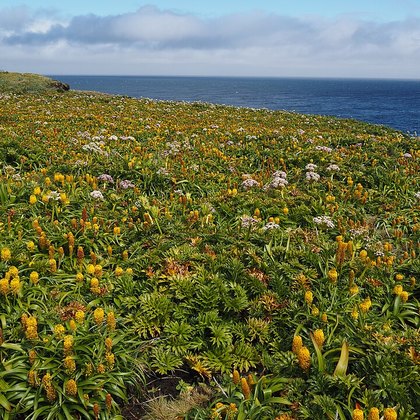
Continental shelf and above all the shelf break, upwellings and fronts, from subtropical water down into the subantarctic sea. It follows trawlers and longliners and gathers in hundreds behind a vessel dumping offal. Of all the albatrosses it comes closest inshore: in New Zealand it feeds into the bays and at times into a harbour mouth. Breeding is in colonies on grassy cliff slopes and tussock terraces of subantarctic islands.
Where the bird is most often found, arranged by main group and formation.


Range and movements
Within this guide's window it breeds on Bollons Island in the Antipodes (some hundred and twenty pairs), on Campbell Island (a handful of nominate pairs beside over twenty thousand pairs of Campbell birds) and with a single pair on Toru Islet at the Snares, and on Australian territory on Macquarie and on Heard and McDonald. Outside the breeding season it is numerous along the whole south coast of Australia and right around New Zealand, in winter north to off Queensland and the northern North Island. The largest numbers are far from these colonies, on the Patagonian Shelf and off South Africa, but in Australian and New Zealand waters it is the most reported albatross of all.
- Resident
- Winter
- dark = core range, pale = thinly spread
Where and when to look
Take a winter pelagic out of Wollongong or Sydney, out of Port Fairy or Portland in Victoria, out of Eaglehawk Neck in Tasmania or out of Kaikoura; behind the burley it is nearly always among the first birds in. Look first at the bill — even orange-yellow with a red tip — and then at the underwing: broad black margins with a narrow white central band. In a solid onshore gale it can sometimes be picked up from a headland, which is not true of most other mollymawks.
Conservation
Least Concern (LC), taken off the threatened categories in 2013 after numbers recovered in the Falklands and South Georgia: roughly 1.2 million birds and more than six hundred thousand breeding pairs worldwide. That does not make it carefree: it is the seabird most often killed as bycatch in longline and trawl fisheries anywhere, and birds are lost in New Zealand nets and on New Zealand hooks every year. The colonies inside this guide are small — a few dozen pairs in the Antipodes and on Macquarie — and therefore sensitive to the loss of individual birds.
Scientific name
Thalassarche melanophris | (Temminck, 1828)
Temminck described the species in 1828 as Diomedea melanophris, with the Cape of Good Hope as type locality; author and year stand in parentheses because it later moved to Thalassarche, the genus Reichenbach introduced in 1853. The epithet is from Greek melas ('black') and ophrys ('eyebrow'), for the dark line above the eye; the spelling melanophrys is also met with. The Maori name toroa covers albatrosses in general, and the word mollymawk comes from Dutch 'mallemok'.