All species › Passerines › Honeyeaters › Black-chinned Honeyeater
Black-chinned Honeyeater | Melithreptus gularis
Zwartkinhoningeter | Mielero barbinegro
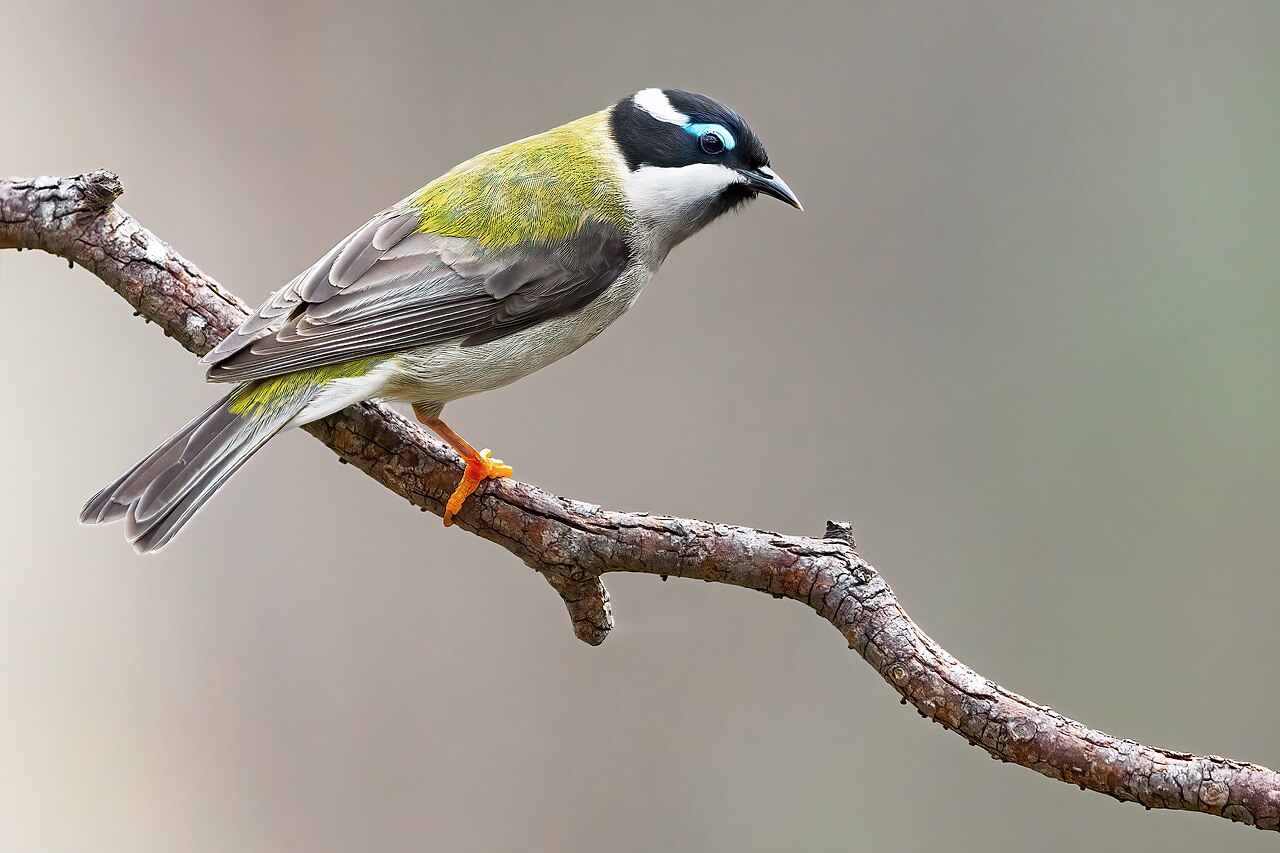
The Black-chinned Honeyeater is the largest mainland Melithreptus and at once the most colourful: a black head with a white nape band, a back running from olive-green to warm golden yellow, orange-red legs and — the character that settles everything — a bright blue patch of bare skin above the eye. In good light that blue crescent shows from a distance. It belongs to the old box and ironbark woodland of the inland slopes, where it moves through the highest crowns in noisy parties.
Voice
Noisy: a strong, slightly hoarse kree-ip or chok, often repeated in series, lower and fuller in tone than the clear whistling of White-naped Honeyeater (Melithreptus lunatus) and the monotone high whistles of White-throated Honeyeater (Melithreptus albogularis). A party of ten or so birds together produces a sustained rattling din that carries far through quiet woodland and is usually the first sign that the species is about.
Recording: Louis Masarei — CC BY-NC-SA 4.0 · Marble Bar, Shire of East Pilbara, Western Australia, Australia · xeno-canto
Identification
A medium-sized honeyeater of fourteen to sixteen centimetres and around twenty grams, sturdier and broader-headed than most of its relatives. The head is black, with a narrow white crescent band across the nape. Above the eye lies a patch of bare skin that in adults is bright blue — more intense and larger than the blue-white patch of White-throated Honeyeater. The upperparts are olive-green to golden yellow, in the northern subspecies laetior so warmly golden that it formerly went under a separate English name. Chin and upper throat carry a black wedge running back from the bill, the feature from which the bird takes its name; the rest of the underparts are dull white. The legs are orange-red. Immatures are duller, with a brown crown and a subdued eye patch.
Confusion species
White-throated Honeyeater (Melithreptus albogularis) shares the blue colour of the bare skin above the eye and is therefore the main confusion species in the north and east, but it is clearly smaller and finer, with a blue-white rather than bright blue eye patch, a white chin and throat instead of a black wedge, and an even olive-green back without a golden cast. White-naped Honeyeater (Melithreptus lunatus) is likewise smaller and has red to orange skin above the eye. Brown-headed Honeyeater (Melithreptus brevirostris) has a brown head and a complete pale eye-ring. Gilbert's Honeyeater (Melithreptus chloropsis) is confined to south-western Australia and has greenish-white eye patches; Strong-billed Honeyeater (Melithreptus validirostris) and Black-headed Honeyeater (Melithreptus affinis) occur only in Tasmania and on the Bass Strait islands. Note also that this species' name and that of White-throated Honeyeater are mirror images of one another: black below the bill against white below the bill.
Habitat
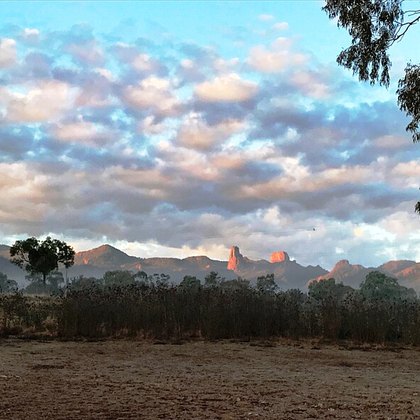
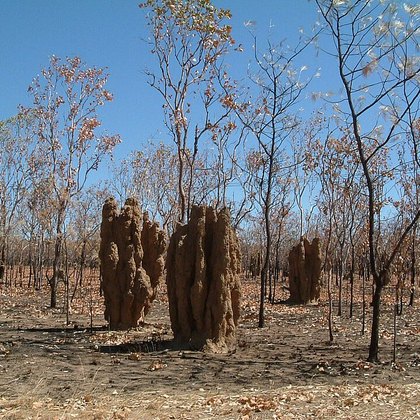
Dry eucalypt forest and woodland with mature trees, with a strong preference for box and ironbark species, and in the arid interior chiefly the timbered strips along creeks and rivers. It forages almost entirely in the upper crown and along the branches, taking nectar, lerp (sugary scale secreted by psyllids, food for honeyeaters), honeydew and insects from bark and leaf. The species is sociable and lives in groups of up to a dozen birds, which cooperate in breeding as well: several adults feed the young of a single nest. The female builds a compact cup nest high in the crown from bark fibre, interwoven with hair, wool or fur. The breeding season runs July to December, with two to three eggs.
Where the bird is most often found, arranged by main group and formation.

Range and movements
Widely but patchily distributed across mainland Australia. In the east from the inland slopes of the Great Dividing Range in Queensland and New South Wales through northern Victoria into South Australia, everywhere tied to remnants of box and ironbark woodland. In the north and west the range runs from the Gulf of Carpentaria through the interior of the Northern Territory into the Kimberley and northern Western Australia; that is the country of the golden-backed subspecies. It is absent from Tasmania, from the south-west of the continent and from around Darwin and Arnhem Land, and does not occur in New Zealand. Largely resident with local wandering.
- Resident
- dark = core range, pale = thinly spread
Where and when to look
Go by sound: the hoarse, rattling racket of a party carries far in quiet inland woodland and will usually take you to them. Then search high in the crown of an old box or ironbark (eucalypt with deeply furrowed, hard bark), preferably one in flower. Once you have a bird in view, look at the colour above the eye — bright blue, not blue-white — and at the back, which in this species carries a golden sheen that no other Melithreptus shows. The orange-red legs are a pleasing confirmation when the bird settles on a bare branch.
Conservation
Globally the species is assessed as Least Concern (LC), but that picture conceals substantial regional problems. In New South Wales and South Australia the eastern form is listed as vulnerable, while federally and in Queensland and Victoria it is rated secure. The cause is always the same: the box and ironbark woodland of the inland slopes is one of the most heavily cleared forest types in Australia, and what remains is fragmented and often lacks the old flowering trees the species lives on. Added to this, large aggressive honeyeaters such as Yellow-throated Miner (Manorina flavigula) take over small remnants and drive species like this out. Retaining and restoring continuous old woodland is the only real remedy.
Scientific name
Melithreptus gularis | (Gould, 1837)
Gould described the bird in 1837 as Haematops gularis; because it later moved to Melithreptus, author and year stand in parentheses. The epithet gularis comes from Latin gula, 'throat', and points at the black wedge below the bill. The English name, the Spanish mielero barbinegro and the Dutch zwartkinhoningeter all name that same feature. The northern, golden-backed population is distinguished as the subspecies laetior — Latin laetior means 'brighter' or 'more cheerful', after the warmer back colour — and long carried the separate English name Golden-backed Honeyeater; some checklists still treat it as a full species.