All species › Passerines › Honeyeaters › White-naped Honeyeater
White-naped Honeyeater | Melithreptus lunatus
Diadeemhoningeter | Mielero nuquiblanco
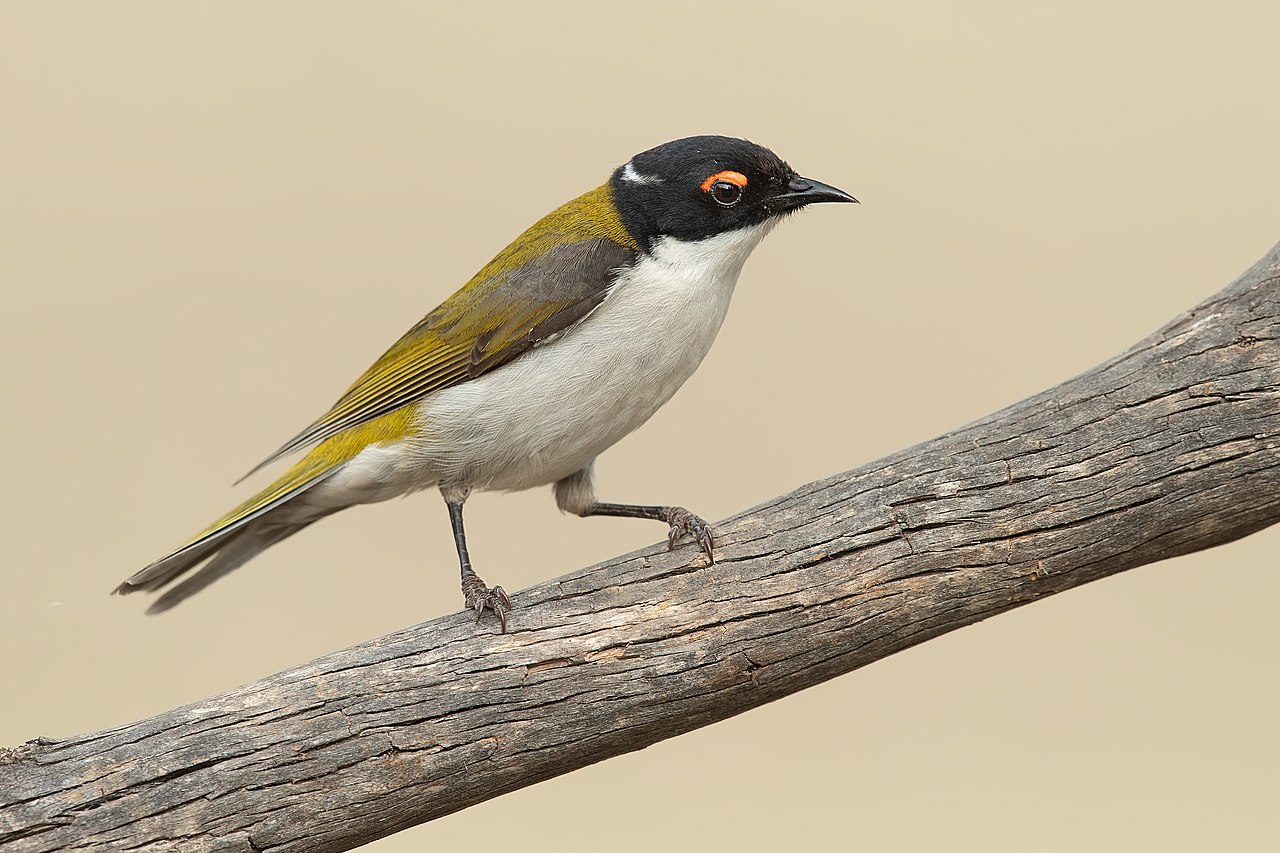
The White-naped Honeyeater is the classic Melithreptus of south-eastern Australia: a jet-black head, a crisply drawn white band across the nape like a diadem, olive-green upperparts and white underparts. The mark that decides it in the field is small but unmistakable — a crescent of bare skin above the eye, and in this species it is red to orange, not blue-white. It is a bird of the highest crowns, moving through the forest in large, noisy parties in autumn.
Voice
A clear, musical cherp or tchop, often repeated in short series and distinctly whistled in tone, together with a nasal, slightly plaintive contact note. The song is a fast, cheerful run of clear notes at varying pitch. That variation separates it from White-throated Honeyeater (Melithreptus albogularis), which gives simple high whistles all on the same pitch, and from Brown-headed Honeyeater (Melithreptus brevirostris), whose voice is dry and scratchy. Where all three occur together, voice is the most reliable character of all.
No freely licensed recording has been found for this species yet; what to listen for is described below.
Identification
A small, short-tailed honeyeater of thirteen to fifteen centimetres. Head, chin and sides of the throat are black, the upperparts bright olive-green, the underparts white with grey-brown wash along the flanks. A narrow, pure white band crosses the nape and stops short on each side well before the eye: a black strip is left standing between band and eye. The bare skin above the eye forms a small, sharp crescent and in adults is red to orange — in good light the quickest mark of all. Bill and legs are dark. Immatures are duller, with a brownish head, a vague nape band and a yellowish-looking bill.
Confusion species
The chief problem is White-throated Honeyeater (Melithreptus albogularis), which overlaps with this species in Queensland and north-eastern New South Wales. That bird has blue-white rather than red bare skin above the eye, a broader and longer white nape band running almost to the eye, a white rather than black chin, and is slightly smaller and paler. Black-chinned Honeyeater (Melithreptus gularis) is noticeably larger and heavier, with bright blue skin above the eye, an olive-yellow to golden back, and a black wedge running from the chin down the throat. Brown-headed Honeyeater (Melithreptus brevirostris) has a brown, not black, head and a complete pale eye-ring. Gilbert's Honeyeater (Melithreptus chloropsis) is the western counterpart — until recently the same species — but has greenish-white to white skin above the eye and occurs only in south-western Australia, where this species is absent. Strong-billed Honeyeater (Melithreptus validirostris) and Black-headed Honeyeater (Melithreptus affinis) are confined to Tasmania and the Bass Strait islands.
Habitat
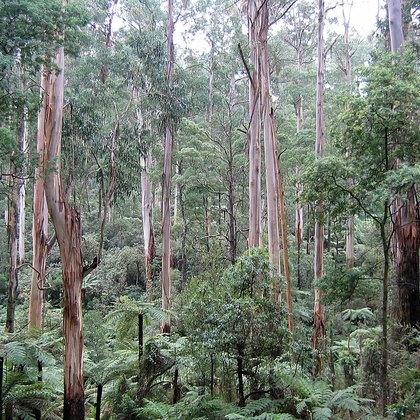
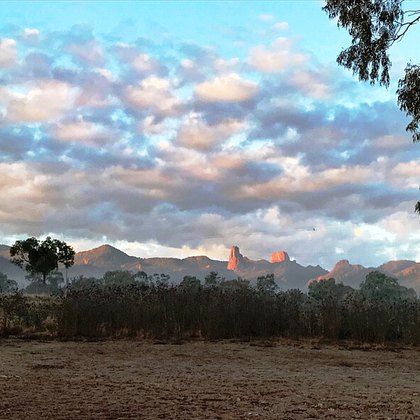
Mainly open eucalypt forest and woodland of the temperate zone, with a preference for tall and moister forest over dry woodland — a point on which it differs from White-throated Honeyeater, which is far less particular. It feeds almost exclusively in the tallest trees, taking nectar, insects, lerp and honeydew from leaves and twigs. Flowering eucalypts can draw dozens of birds into a single crown. The nest is a small deep cup of grass and spider web slung high in the canopy; helpers attend it and two broods a season are often raised. It visits gardens and nectar feeders near forest readily.
Where the bird is most often found, arranged by main group and formation.

Range and movements
Eastern and south-eastern Australia, from north-eastern Queensland — where an isolated population sits in the Wet Tropics — south along the east coast and the Great Dividing Range through New South Wales and Victoria into eastern South Australia, including the Mount Lofty Ranges and Kangaroo Island. It is absent from the arid interior, the Northern Territory, Western Australia and Tasmania, and does not occur in New Zealand. In the south-east it is partly migratory: large flocks move north along the ranges in March and April and return in August and September, when hundreds of birds an hour may pass along a flyway.
- Resident
- Winter
- dark = core range, pale = thinly spread
Where and when to look
Do not look at the nape band, look at the eye. Red or orange skin above the eye means this species; blue-white means White-throated, or, on a larger bird with a yellow back, Black-chinned. Since the bird is nearly always high and against the sky, that colour detail shows best when it turns briefly side-on. If it will not oblige, listen instead: the clear, varied whistling identifies it without a view. In the south-east it pays to stand on a pass or a ridge in March and April and wait for the migration stream.
Conservation
Least Concern (LC) and rated secure in every state where it occurs; in suitable forest it is locally one of the most numerous honeyeaters. Its habitat is nonetheless under pressure: the taller, moister eucalypt forests in which it is most abundant are logged, thinned and burnt, and the large-scale fires of recent decades in the south-east have removed great areas of canopy. Because the species responds strongly to flowering and travels far, it shifts with the supply; that makes local numbers highly variable without implying a national decline.
Scientific name
Melithreptus lunatus | (Vieillot, 1802)
Vieillot described the bird in 1802 as Certhia lunata, that is, as a treecreeper; author and year therefore stand in parentheses. The epithet lunatus is Latin for 'crescent-shaped' and refers to the white half-moon across the nape. The generic name Melithreptus comes from Greek meli, 'honey', and threptos, 'nourished'. The English name and the Spanish mielero nuquiblanco both name that white nape, while the Dutch diadeemhoningeter reads the band as a diadem and in doing so gives the whole genus its Dutch group name. The western form was long treated as a subspecies of this species and now stands apart as Gilbert's Honeyeater (Melithreptus chloropsis).