All species › Passerines › Honeyeaters › Strong-billed Honeyeater
Strong-billed Honeyeater | Melithreptus validirostris
Tasmaanse honingeter | Mielero picudo
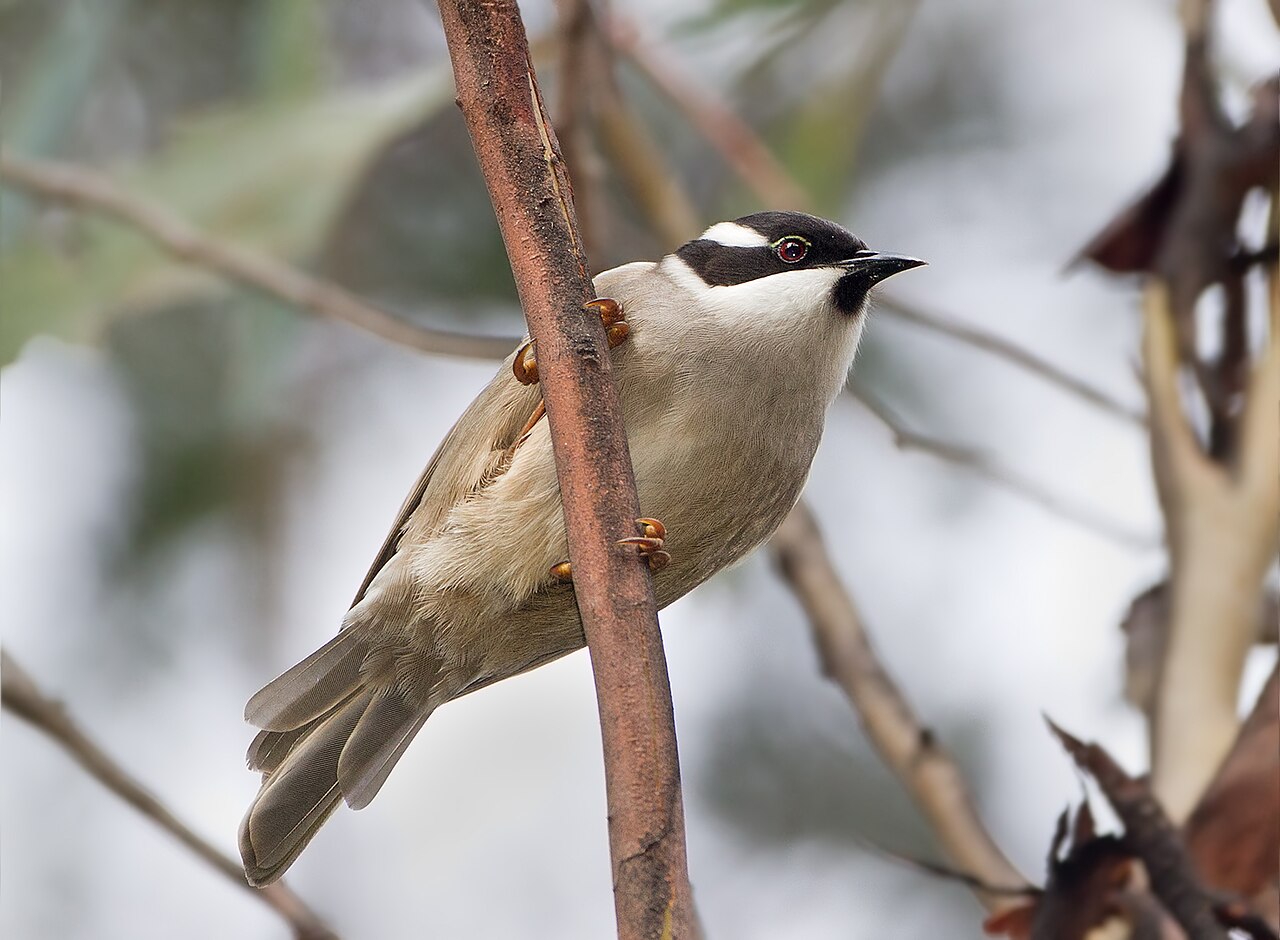
The Strong-billed Honeyeater is the largest and heaviest-billed of its genus, and the only one that earns its living not among flowers or leaves but on the trunk. It works up and down the bark like a treecreeper, often upside down, and uses that stout, almost straight bill to tear strips of bark away audibly in order to reach the insects beneath. Together with the Black-headed Honeyeater it is one of the two Melithreptus of Tasmania, and it occurs nowhere else in the world.
Voice
Loud and sharp, with a penetrating, faintly metallic chak or chop often repeated in series as the party works along the trunks. There is also a rattling, almost grunting note when the birds are agitated. The most distinctive sound, however, comes not from the bird but from the tree: the dry cracking and rustling of bark being ripped loose, audible tens of metres away on a still day and produced in that way by no other Tasmanian songbird.
Recording: Ramit Singal — CC BY-NC-SA 4.0 · Sheffield, Kentish Council, Tasmania, Australia · xeno-canto
Identification
At fifteen to seventeen centimetres and about twenty-five grams, the bulkiest Melithreptus. The bill is what strikes you first: long, nearly straight and heavy at the base, far more powerful than in any relative. The head is black with a white chin and throat, a clear white crescent band crosses the nape, and the bare skin above the eye is white-green. Upperparts are olive-brown to grey-brown, underparts dull white to light buff. The legs are sturdy and dark. Immatures have a browner head and a vaguer nape band. Behaviour is at least as diagnostic as plumage: upright against the trunk, spiralling upwards, in parties of a handful of birds.
Confusion species
In Tasmania it occurs alongside Black-headed Honeyeater (Melithreptus affinis), and that is the only pair you genuinely have to separate. That species is distinctly smaller and finer-billed, has a wholly black head and black throat with no white nape band at all — the only member of the genus lacking it — and feeds among the foliage rather than on the trunk. A Melithreptus climbing the bark like a treecreeper and tearing it loose is by definition this species. White-naped (Melithreptus lunatus), White-throated (Melithreptus albogularis), Black-chinned (Melithreptus gularis), Brown-headed (Melithreptus brevirostris) and Gilbert's Honeyeater (Melithreptus chloropsis) all fail to reach Tasmania, so they can be left out of account on the island; anyone judging a photograph taken in Tasmania need weigh only those two.
Habitat
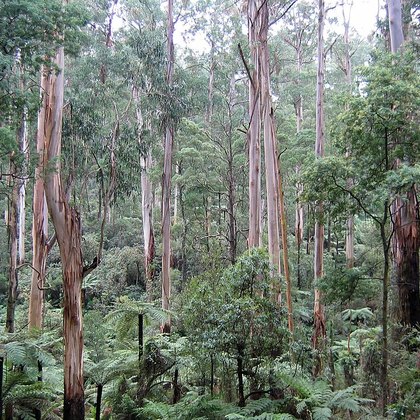
Old and mature wet eucalypt forest is the core habitat, especially stands of mountain ash and alpine ash with thick, loose bark, along with cool temperate rainforest of southern beech. In winter, parties move down into drier eucalypt forest at lower elevations. It takes almost exclusively arthropods prised from under and behind the bark; nectar plays a much smaller part than in the other honeyeaters. Pairs are monogamous and sometimes nest in small colonies. The nest is a small, deep cup of bark strips faced with lichen; the breeding season runs from July to January, usually with three eggs and about sixteen days in the nest.
Where the bird is most often found, arranged by main group and formation.

Range and movements
Endemic to Tasmania and the islands of Bass Strait, notably King Island and Flinders Island. On the main island it is most numerous in the wet forests of the north, west and centre, and scarcer in the dry east. It does not occur on the Australian mainland — there are no established populations outside the Tasmanian region — nor in New Zealand. It is resident, with at most seasonal altitudinal and local movements.
- Resident
- dark = core range, pale = thinly spread
Where and when to look
Do not look for it in blossom, look for it on the trunk. Walk in old wet forest around Mount Field, the Tarkine or the Great Western Tiers and listen for the sound of bark tearing high above you; then search the trunks rather than the crowns. A party often works one tree systematically before moving to the next. When the bird comes into view, check the bill — heavy and straight — and the white nape band, because the two together rule out Black-headed Honeyeater.
Conservation
The IUCN Red List places the species in the Vulnerable category (VU), while the Tasmanian and federal Australian lists still rate it secure; the two judgements therefore differ. The reason for concern is habitat: the species is tied to old, mature wet forest with rough-barked trees, and that forest type has been much reduced by logging, conversion to plantation and the large fires of recent decades. Young and uniform stands offer too little loose bark to forage in. Retaining old-growth reserves and rough-barked trees in managed forest is accordingly at the heart of its conservation.
Scientific name
Melithreptus validirostris | (Gould, 1837)
Gould described the bird in 1837 as Haematops validirostris; because it was later moved to Melithreptus, author and year stand in parentheses. The epithet validirostris is Latin for 'strong-billed', from validus, 'strong', and rostrum, 'bill', which the English name renders literally. The Spanish name mielero picudo likewise points at the bill. The Dutch name Tasmaanse honingeter takes another line and names the island, which is slightly confusing because Tasmania has three other endemic honeyeaters: Black-headed Honeyeater, Yellow-throated Honeyeater (Nesoptilotis flavicollis) and Yellow Wattlebird (Anthochaera paradoxa).