All species › Passerines › Honeyeaters › Red-headed Myzomela
Red-headed Myzomela | Myzomela erythrocephala
Roodkopdwerghoningeter | Mielero cabecirrojo
The Red-headed Myzomela is the honeyeater of the Australian mangrove: a compact bird of barely twelve centimetres and eight grams, short-tailed, with a long and markedly decurved bill. The male carries a deep blood-red head, neck and rump that gleams in sunlight against a blackish-brown back and dull grey underparts — a scheme that makes him flare like a spark in the green half-light of a mangrove belt. The female is grey-brown with at most a pink wash on forehead and chin. The species is a true mangrove specialist and rarely leaves that belt.
Voice
A small, incessant sound that gives the bird away long before the bird itself does. The repertoire runs to metallic, slightly scratchy contact notes and short, abruptly repeated song phrases, broken by a scolding rattle whenever two males meet in the same flowering tree. What is characteristic is that it calls almost continuously while it feeds: a thin, high tsip-tsip that travels through the mangrove and lets you follow the bird even after you have lost it in the canopy. Anyone hearing a persistent high ticking in the mangroves of Darwin or Broome almost always has the species overhead.
No freely licensed recording has been found for this species yet; what to listen for is described below.
Identification
A dwarf honeyeater of eleven to thirteen centimetres, stocky, with a short tail and a proportionately long, sickle-curved black bill. The male is unmistakable: head, neck, throat and rump deep crimson to blood-red, back and wings blackish-brown, underparts pale brownish grey. A narrow black loral stripe runs from the base of the bill to the eye and forms a thin dark ring there, sharply bounding the red of the face. The female is far plainer: grey-brown, darker on the wings, paler on breast and belly, with a reddish-pink cast on forehead and chin and a yellow gape. Juveniles resemble the female but show a conspicuous pale yellow edge to the lower mandible; the first red facial feathers appear at about a month old.
Confusion species
Among the three Australian myzomelas the male is the easy one. Dusky Myzomela (Myzomela obscura) lacks red entirely and is uniformly grey-brown; it shares the mangrove and paperbark of the north, so females and juveniles of the two are barely separable in the field — look then for the yellow gape and the trace of pink on forehead and chin of M. erythrocephala, and note that M. obscura averages larger and longer-tailed. Scarlet Myzomela (Myzomela sanguinolenta) is clearly smaller, and its male carries the red through onto mantle and back as one continuous scarlet field, whereas in M. erythrocephala head and rump are red with a blackish-brown back between them. The two meet only in north-eastern Queensland, and even there habitat separates them: M. sanguinolenta in dry eucalypt forest, M. erythrocephala in tidal mangrove.
Habitat
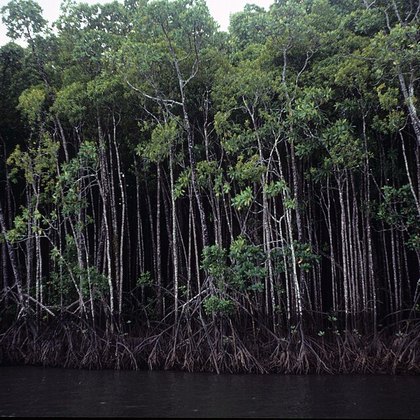
Almost exclusively mangrove in the monsoon belt: dense stands of Rhizophora, Bruguiera and Avicennia along river mouths, creeks and island shores. The tie is so strong that the species is called a mangrove specialist, probably an adaptation that arose as northern Australia grew more arid. It also appears in adjoining swamp woodland, casuarina, pandanus and flowering melaleuca, usually within a few hundred metres of the tidal zone. It forages high in the canopy and very actively: darting flower to flower, probing nectar with the curved bill, gleaning spiders, beetles, bugs, wasps and caterpillars from the foliage between times, and sallying after flying insects. For the rib-fruited mangrove it is the principal pollinator. The nest is a small suspended cup of bark, leaf, plant fibre and sometimes seaweed, bound with spider web and slung from a horizontal fork six to ten metres above ground or water; the clutch is two or three eggs.
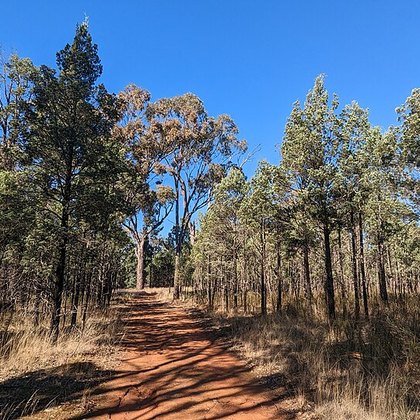
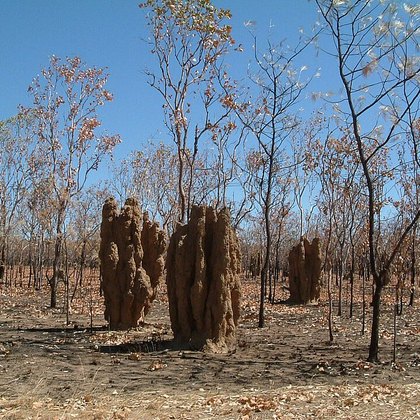
Where the bird is most often found, arranged by main group and formation.

Range and movements
The tropical coasts of Australia, from the Kimberley in Western Australia through the Northern Territory and around the Gulf of Carpentaria to Cape York and the Queensland coast, with many populations on offshore islands. The species follows the distribution of mangrove almost exactly and is entirely absent inland. The subspecies M. e. infuscata occurs at scattered sites in West Papua and southern Papua New Guinea, from Mimika to the Fly River, and in the Aru Islands; its Australian occurrence is confined to a few small islands in Torres Strait. It does not occur in New Zealand.
- Resident
- dark = core range, pale = thinly spread
Where and when to look
Enter the mangrove at low tide along a boardwalk or creek edge and listen first — the persistent metallic ticking betrays it before anything is seen. Then search flowering mangrove trees deliberately: the bird hangs in the blossom clusters and shifts in jerks, rarely more than a few seconds on one twig. With a red male in view, do not look only at the head but at the back: a dark back with the red interrupted means this species; red running unbroken onto the mantle means you are in Scarlet Myzomela country. The first hour after sunrise is by far the best time.
Conservation
Least Concern (LC): the species is widespread along the whole tropical coast and locally numerous wherever mangrove is intact. Because it depends almost wholly on a single habitat type, it is sensitive to anything that erodes mangrove — port expansion, wharf construction and land reclamation around northern towns, and, over the longer term, sea-level rise and altered tidal regimes. The Australian population of the subspecies infuscata is regarded as near threatened, confined to three small low islands totalling about a hundred square kilometres, where rising seas are the chief threat. For the species as a whole the outlook is favourable.
Scientific name
Myzomela erythrocephala | Gould, 1840
John Gould described the species in 1840 as Myzomela erythrocephala, from specimens taken at King Sound in northern Western Australia; author and year stand without parentheses, because it has never been moved out of this genus. Myzomela is built from Greek myzo, 'to suck', and meli, 'honey', for the nectar-feeders the genus holds. The epithet erythrocephala comes from erythros, 'red', and kephale, 'head'. The Dutch name roodkopdwerghoningeter and the Spanish mielero cabecirrojo follow that head literally; in Australia the current name is Red-headed Honeyeater, with the older vernaculars mangrove redhead and blood-bird. Two subspecies are recognised; the former Sumba and Wetar subspecies now rank as separate species.