All species › Passerines › Bowerbirds › Black-eared Catbird
Black-eared Catbird | Ailuroedus melanotis
Vogelkopkatvogel | Maullador orejinegro
The catbird of the far north-east: a green, heavily built rainforest bird with a black ear mask, living on Cape York, in southern New Guinea and on the Aru Islands. Like the other catbirds it builds no bower, and it announces itself with a wailing miaow that sounds nothing like a songbird.

Voice
A sustained, nasal miaow, plaintive and rising, carrying far through dense forest and indistinguishable in tone and character from that of the Spotted Catbird; here too pairs call in turn. The whole genus is named for this sound, in the scientific Ailuroedus as much as in the English name. In between come short rattles and a hard clicking. A melodic song is absent.
No freely licensed recording has been found for this species yet; what to listen for is described below.
Identification
A stocky bird of 24 to 29 centimetres, bright green above, with a dark brown to blackish crown thickly sown with pale flecks and a broad, sharply bounded black patch across the ear-coverts — the clearest such patch of any catbird. The throat is lightly spotted and the underparts are green with large, bright white drops that stand out more strongly than on the southern species. Wing tips and tail tip are white, the bill pale and heavy, the iris red-brown. The sexes are alike. This species too builds nothing: no bower, no court, only a fixed territory that a pair defends for years.
Confusion species
The Spotted Catbird (Ailuroedus maculosus) is the immediate southern neighbour and the likeliest confusion: it is larger, has a grey-brown rather than dark crown and a smaller, less sharply defined ear patch, and its underparts are creamier and less white-spotted. The decisive mark is range, for the two nowhere occur together: the rainforest of Cape York as against the Wet Tropics further south, with the dry belt around Laura in between. In New Guinea the range abuts that of related catbirds from the same split, among them the White-eared Catbird (Ailuroedus buccoides), which is much smaller and carries a white ear patch instead of a black one.
Habitat
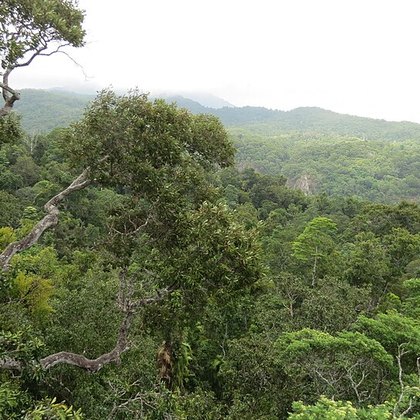
Closed lowland tropical rainforest, monsoon forest and vine thicket, and gallery forest along creeks running as a green thread through the surrounding savanna. On Cape York that last is decisive: the bird keeps to the rainforest blocks and creek lines of the Iron Range and the McIlwraith Range and to the forest strips that issue from them.
Where the bird is most often found, arranged by main group and formation.


Range and movements
North-eastern Cape York in Queensland, centred on the Iron Range and the McIlwraith Range, and beyond that the lowlands of southern and south-eastern New Guinea and the Aru Islands to the west, where the type locality lies. Sedentary, with no migration at all. The strait between Australia and New Guinea has been no barrier to this forest bird: the forest was continuous during glacial low stands.
- Resident
- dark = core range, pale = thinly spread
Where and when to look
In Australia this is above all a bird of the Iron Range: set out early, stand on the forest road and wait for the miaow, which usually comes from the middle storey. Watch the crown and the ear patch rather than the green, since the green is the same on every catbird. Anyone wanting both Australian species must make two separate journeys: their ranges do not touch.
Conservation
AviList carries the species as not evaluated, since the Red List has not yet weighed the genus split in 2016 species by species. Within its range the bird is common, and the Australian part of it lies largely in national park. The concern is the small area of rainforest on Cape York and the fire pushing in from the surrounding savanna, which eats at the edges of those forest patches.
Scientific name
Ailuroedus melanotis | (Gray, 1858)
Gray described the species in 1858 as Ptilonorhynchus melanotis, with the Aru Islands as type locality; because it later moved to another genus, author and year stand in parentheses. melanotis is Greek for 'black-eared', from melas, 'black', and ous, 'ear', after the black ear patch, which the English name translates. The Dutch name points to the Vogelkop, the peninsula in western New Guinea, but neither the type locality nor the range of this species lies there: this guide therefore keeps to the scientific name wherever confusion could arise.