All species › Gannets and cormorants › Cormorants and shags › Black-faced Cormorant
Black-faced Cormorant | Phalacrocorax fuscescens
Blauwmaskeraalscholver | Cormorán carinegro
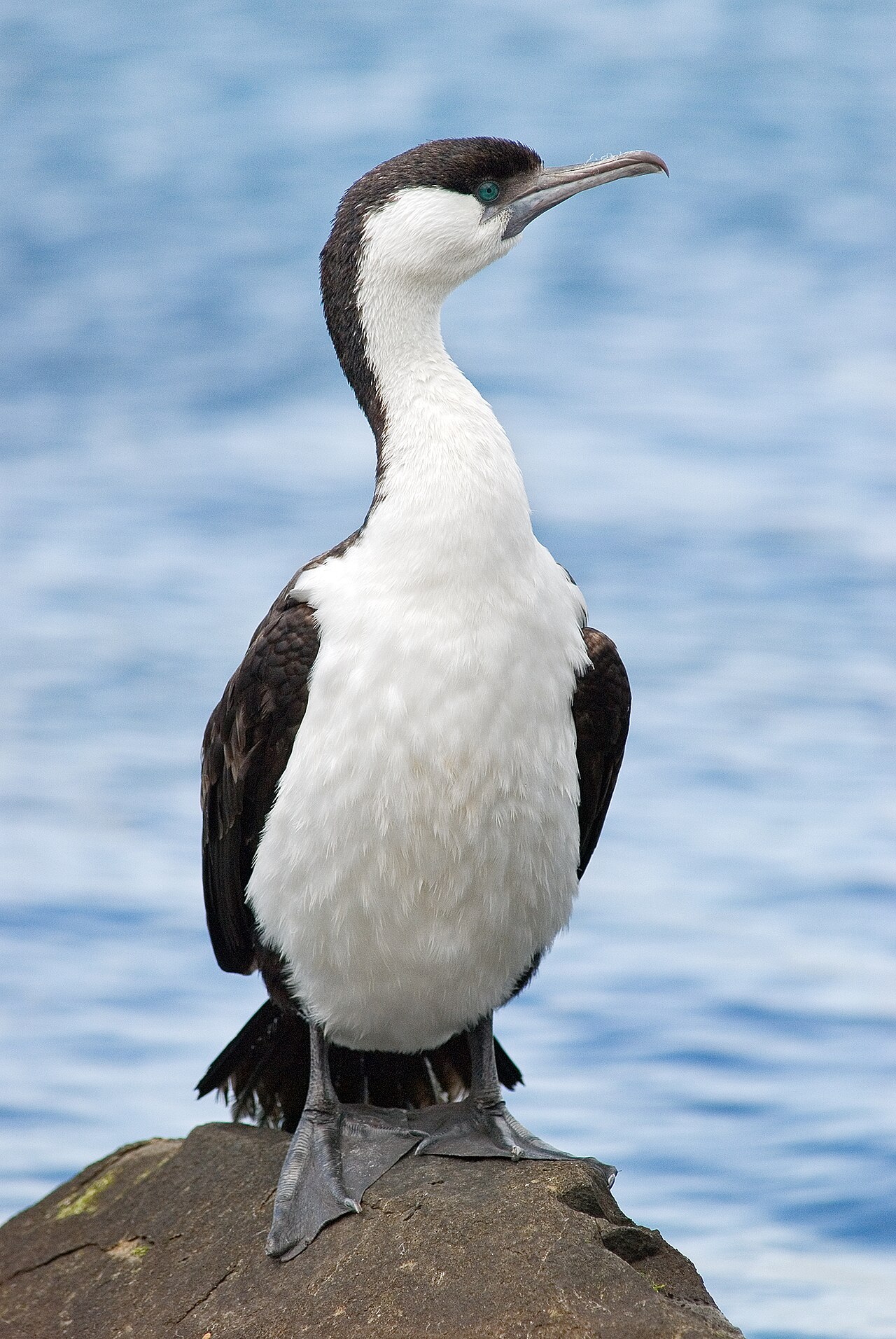
The Black-faced Cormorant is the only cormorant restricted to Australia, and the only one there that is wholly tied to the sea: it rarely if ever comes to fresh water. It is black and white like Australian Pied Cormorant, but instead of an orange face patch it carries a completely bare black mask, set with a striking blue-green eye — the feature behind its Dutch guide name.
Voice
Away from the breeding site it is silent. At the nest the male gives a loud honk or a guttural croak, while the female hisses when anyone comes close. A colony on a rock island therefore sounds like an irregular chorus of short hard exclamations over the noise of the surf, with the hoarse piping of chicks in between.
Recording: nick talbot — CC BY-NC-SA 4.0 · Penneshaw, South Australia, Australia · xeno-canto
Identification
A medium-sized pied cormorant of sixty to seventy centimetres, black above with a blue-green gloss and white below, with a black patch on the thigh. The face is completely bare and black, without any orange or yellow, and set in it is a bright blue-green eye. The bill is dark grey with a pronounced hook at the tip, the legs and feet black. In breeding condition fine white streaks appear over neck and head; there is no crest. Young birds are brownish black where adults are black, with dingier white and a duller face. In flight it is more compact and shorter-necked than Australian Pied Cormorant, and it often travels in loose lines low over the sea.
Confusion species
Australian Pied Cormorant (Phalacrocorax varius) is the species it shares the southern Australian coast with daily, and the distinction lies entirely in the face: that bird has an orange bare patch in front of the eye, a blue eye-ring and a grey rather than dark grey bill, and it is also a size larger and longer-necked. Little Pied Cormorant (Microcarbo melanoleucos) is much smaller, with a short yellow bill and a white face. Great Cormorant (Phalacrocorax carbo) is all black with yellow facial skin and a white chin. The Leucocarbo shags of New Zealand are also pied, but do not overlap with this species and have pink feet.
Habitat
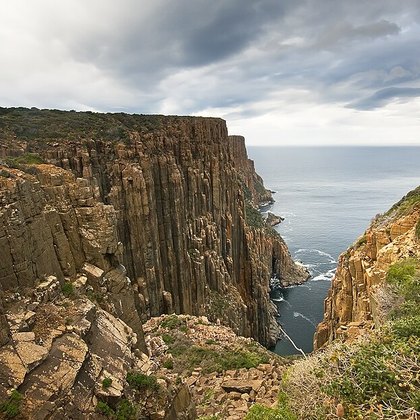
Sea only: coastal waters, large bays, deep inlets, rocky headlands and islands, where it forages in flocks. It avoids beaches. It breeds all year round in large colonies on the bare rock of offshore islands and on steep cliff edges; the nest is a heap of seaweed and grass laid straight on the rock. After fishing it sits with wings spread to dry, because its plumage is not waterproof.
Where the bird is most often found, arranged by main group and formation.


Range and movements
Endemic to the southern coast of Australia, from southern Western Australia east to south-eastern New South Wales, plus Tasmania and the Bass Strait islands. There are two separate populations: one along the south-west coast and one along the southern and south-eastern coasts. The strongholds are Bass Strait and Spencer Gulf in South Australia. The species does not occur in New Zealand.
- Resident
- dark = core range, pale = thinly spread
Where and when to look
Take a penguin or seal trip at Phillip Island, Kangaroo Island or the Tasmanian east coast: the rocks the seals haul out on are also its roost, and it sits there in rows. Look at the face, not the plumage: black and bare makes it this species, orange makes it Australian Pied Cormorant. On the open coast it flies in long low ribbons of dozens of birds close over the water — a picture Australian Pied Cormorant rarely gives.
Conservation
Least Concern (LC), with a population in the tens of thousands and a stable picture over most of its range, although it is listed as vulnerable in Victoria. The exposure is at the colonies, which are markedly sensitive to human presence: a single walk through a colony can keep the sitting birds off their nests long enough for gulls to take eggs and chicks. Beyond that come drowning in gillnets, oil pollution in Bass Strait and disturbance from aquaculture and tourism.
Scientific name
Phalacrocorax fuscescens | (Vieillot, 1817)
Vieillot described the species in 1817 as Hydrocorax fuscescens; because it later moved to Phalacrocorax, author and year are in parentheses. The epithet fuscescens means 'darkening' or 'brownish', from Latin fuscus, 'dark brown' — a curious choice for a sharply black-and-white bird, best explained by a faded or immature specimen. The type locality is given no more precisely than 'Australasia'. The Dutch guide name points to the bluish cast over the black bare face and the blue-green eyes, where the English and Spanish names simply name the black face; the same feature, seen from two sides.