All species › Gannets and cormorants › Cormorants and shags › Spotted Shag
Spotted Shag | Phalacrocorax punctatus
Gevlekte aalscholver | Cormorán moteado
The Spotted Shag is the least cormorant-like cormorant in New Zealand: slim, blue-grey rather than black, finely spotted with black over back and wings, with a long slender bill and orange-yellow feet. In breeding plumage it adds two broad white stripes curving from each eye down the side of the neck, and a black double crest on forehead and nape.

Voice
It is silent nearly everywhere; only at roosting, loafing and nesting places does a loud low grunting sound. On a cliff colony the grunting of dozens of birds runs together into a deep mutter held in by the rock, with the hoarse begging of chicks above it. At sea and in flight it gives nothing away.
Recording: David Boyle — CC BY-NC-SA 4.0 · Duffers Reef, Marlborough, New Zealand · xeno-canto
Identification
A slim, medium-sized marine shag of sixty-five to seventy-five centimetres, with a long slender bill, a long neck and orange-yellow feet. The upperparts are blue-grey to brown-grey with small black spots on back and wing coverts — hence the name — and the underparts are silver-grey, without the sharp black-and-white contrast of the other cormorants. In breeding plumage two broad curved white stripes run from each eye down the side of the neck, a black double crest stands on forehead and nape, and the bare facial skin turns green-blue with a blue eye-ring; the iris stays dark brown. Out of the breeding season the crests are gone and the neck stripes far fainter. In flight it is long and thin, with quick beats low over the sea.
Confusion species
Pitt Shag (Phalacrocorax featherstoni) is the nearest relative and the closest match: smaller, darker grey-brown, without the white neck stripes and confined to the Chatham Islands, where Spotted Shag does not breed — place decides it. The New Zealand Leucocarbo shags, such as Stewart Island Shag (Leucocarbo chalconotus) and New Zealand King Shag (Leucocarbo carunculatus), are far heavier in build, sharply black and white and have pink feet. Great Cormorant (Phalacrocorax carbo) and Little Black Cormorant (Phalacrocorax sulcirostris) are all black, Australian Pied Cormorant (Phalacrocorax varius) sharply pied — none of them ever grey and spotted.
Habitat
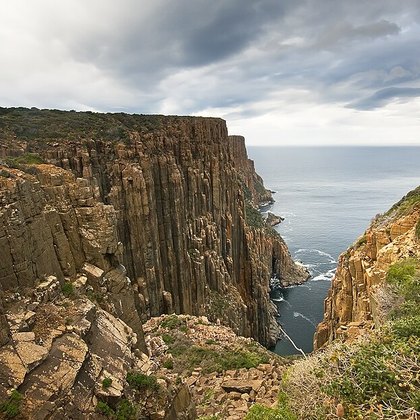
Entirely marine: inshore water and the sea beyond it, out to about sixteen kilometres, where it feeds deeper and further from land than the other New Zealand shags. It breeds and roosts on narrow ledges of steep sea cliffs and on rock stacks, with the nests set in long rows against the face.
Where the bird is most often found, arranged by main group and formation.


Range and movements
Endemic to New Zealand and mainly a South Island bird, with strongholds in the Marlborough Sounds, around Banks Peninsula and along the Otago coast. On the west coast and around Stewart Island it is local. The North Island holds scattered populations in the Hauraki Gulf, along the Kapiti coast, in Hawke's Bay and in Wellington Harbour. It occurs nowhere outside New Zealand.
- Resident
- dark = core range, pale = thinly spread
Where and when to look
Take a boat along the cliffs from Akaroa or Picton, or walk the Wellington coast at Point Halswell: the birds sit in rows on the ledges and come and go in long low ribbons over the water. The best time is late spring, when the double crest and the white neck stripes are at their sharpest — out of the breeding season the bird is far plainer and the silhouette does the work: longer and thinner than any other cormorant present.
Conservation
Least Concern (LC) globally, but less comfortable at home: the New Zealand government classes the species as 'Nationally Vulnerable', because several subpopulations have fallen sharply — the Hauraki Gulf one has all but gone. The colonies are on cliffs and therefore sheltered from rats, but not from disturbance by boats and drones, which can put a whole ledge into the air and let gulls clean out the nests. Drowning in inshore gillnets and shifts in the food supply weigh on top of that.
Scientific name
Phalacrocorax punctatus | (Sparrman, 1786)
Anders Sparrman described the species in 1786 as Pelicanus punctatus, from material collected on Cook's second voyage; because it later moved to Phalacrocorax, author and year are in parentheses. The type locality is Queen Charlotte Sound — Totaranui — on the South Island. punctatus is Latin for 'spotted', after the black spots on back and wings, and the Dutch, English and Spanish names all follow that same feature. The Maori name kawau tikitiki means something like 'shag with a topknot', after the breeding crest.