All species › Gannets and cormorants › Cormorants and shags › Pitt Shag
Pitt Shag | Phalacrocorax featherstoni
Chatham-aalscholver | Cormorán de la Pitt
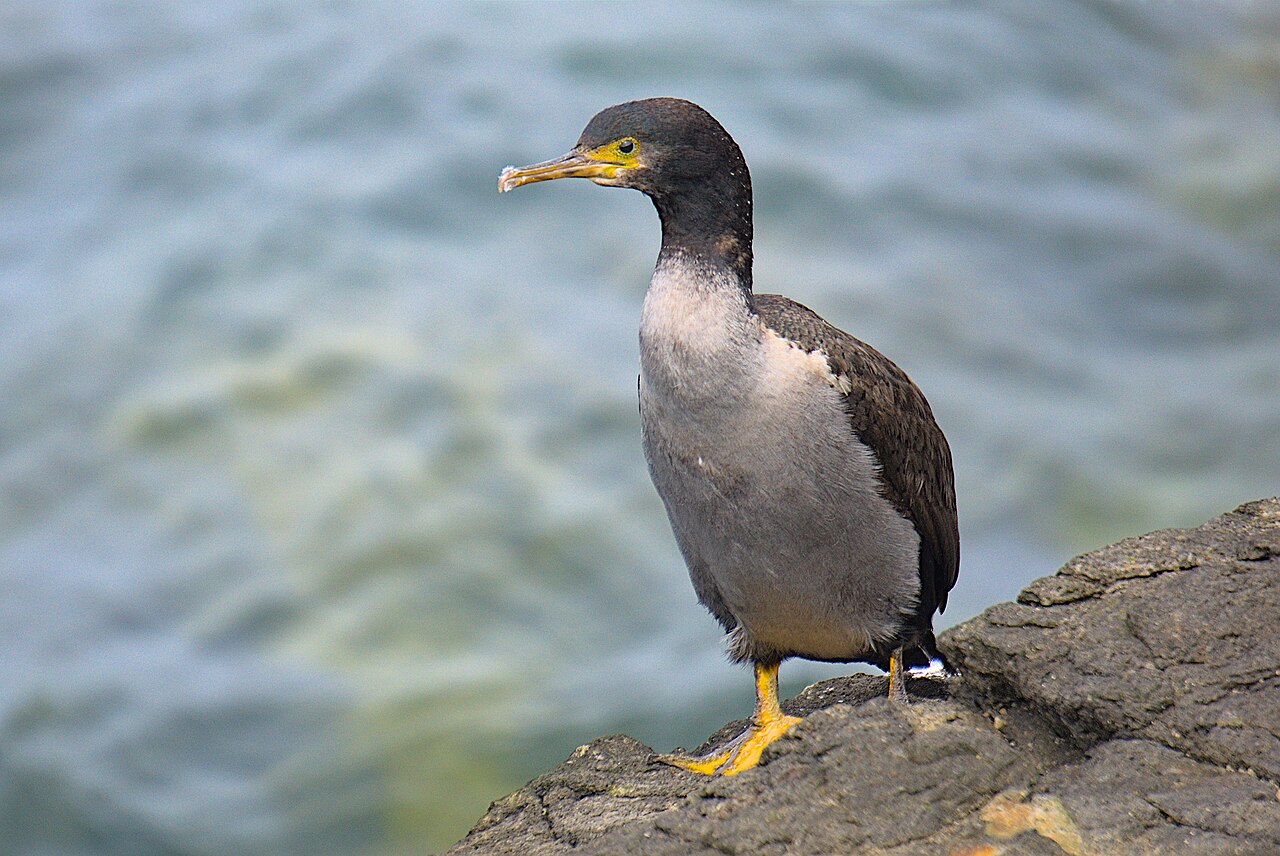
The Pitt Shag is the small, slim grey shag of the Chatham Islands and breeds nowhere else in the world. It is not a pied blue-eyed shag but a relative of the Spotted Shag: dark grey-brown above with a pale grey breast, yellow feet, and in breeding dress a double crest and bright green facial skin.
Voice
At sea and away from the colony it is not heard. At the nest ledge the male gives a run of grunting, gargling and ticking notes — a dry tk-tk-tk followed by a harsh gargle — while the female stays silent. Changeovers at the nest bring hissing, and chicks beg with a squeaky ah-whee.
No freely licensed recording has been found for this species yet; what to listen for is described below.
Identification
A shag of a little over sixty centimetres but weighing only a kilo, so strikingly slim and lightly built, thin-necked and long-tailed. The upperparts are dark grey-brown, the breast and belly pale grey; there is no white wing patch at all. In breeding dress it carries a double crest, one on the forehead and one on the nape, bright green facial skin and dense white filoplumes over the hindneck. The feet are yellow — the only shag on the Chathams with yellow legs. Out of season the crests lie low and the colours are dull; young birds are a plain duller brown.
Confusion species
Chatham Shag (Leucocarbo onslowi) breeds on the same islands and is the only real confusion: it is heavy and boldly pied black-and-white with white wing patches, orange-red caruncles above the bill base and pink feet, and weighs well over twice as much. Note that the Dutch guide names mislead here — 'Chatham-aalscholver' is this bird, the Pitt Shag, while the English Chatham Shag is 'Onslows aalscholver'; go by build, foot colour and the absence of white rather than by name. Spotted Shag (Phalacrocorax punctatus) of the mainland is the closest look-alike but has a finely black-spotted back and a white stripe running from above the eye down the neck, both lacking here, and the two do not overlap. Little Black Cormorant (Phalacrocorax sulcirostris) is wholly black with no pale breast.
Habitat
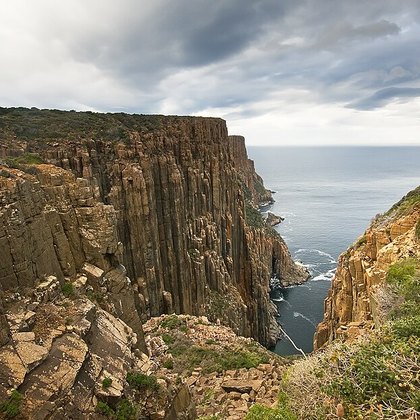
Shallow, sheltered coastal water along rocky shores and in bays and passages, where it dives close inshore for small fish and invertebrates. It breeds in loose groups of five to forty pairs on ledges of sea cliffs and on rocky stacks, often where no one can reach from land. Unlike the blue-eyed shags it seldom goes far out to sea.
Where the bird is most often found, arranged by main group and formation.

Range and movements
The Chatham Islands only, seven hundred kilometres east of the South Island: Chatham Island itself, Pitt Island, Rangatira, Mangere, the Star Keys, Rabbit Island, The Sisters and the Forty-Fours. It has not been recorded outside that group; there is no migration and even wandering stays within island waters.
- Resident
- dark = core range, pale = thinly spread
Where and when to look
Work the south and east coasts of Chatham Island or run around Pitt Island and scan the low ledges of the cliffs; the birds sit close above the surf, often with wings spread. Check the legs first: yellow means this species, pink means Chatham Shag. In late spring the double crest identifies a perched bird at range on its own.
Conservation
Endangered (EN). Between 1997 and 2011 the count fell from about 729 breeding pairs to some 434, nearly forty per cent in fourteen years, and nationally the species rates as Vulnerable. Loss of nest sites, disturbance by stock and by people, persecution, introduced predators on the inhabited islands and gull predation all weigh in, and because the decline also runs on predator-free islets, causes at sea including fisheries bycatch are suspected as well.
Scientific name
Phalacrocorax featherstoni | Buller, 1873
Buller described the species in 1873 as Phalacrocorax featherstoni, where it still stands, so author and year carry no parentheses. The epithet honours Isaac Earl Featherston (1813–1876), physician, Superintendent of Wellington Province and later New Zealand's Agent-General in London, a patron of Buller's work. The type locality is the Chatham Islands. The Maori name kawau o Rangihaute refers to Rangihaute, Pitt Island.