All species › Falcons › Falcons and caracaras › Black Falcon
Black Falcon | Falco subniger
Zwarte valk | Halcón negro
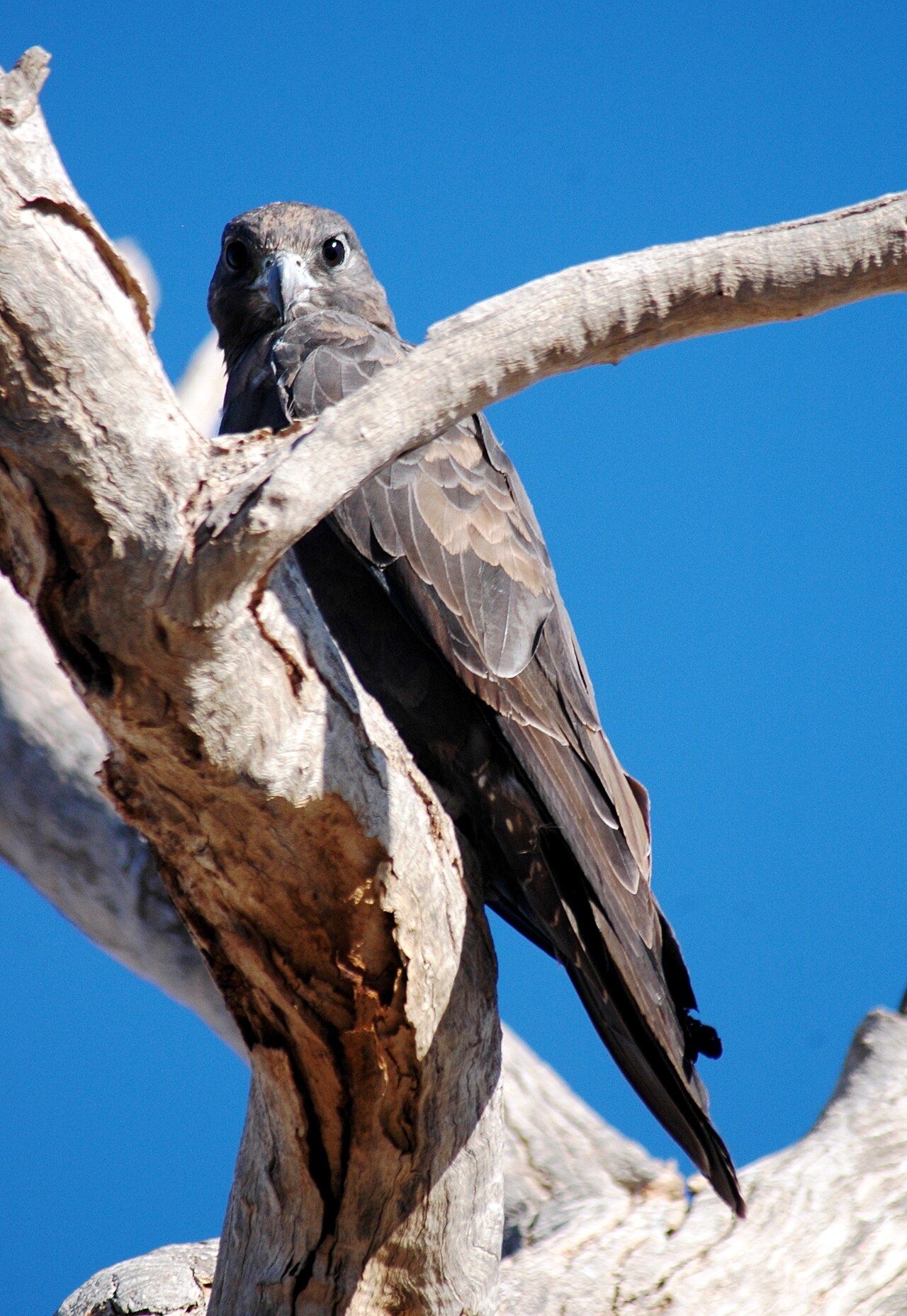
The Black Falcon is the largest falcon in Australia and at the same time the least predictable: a uniformly sooty to blackish-brown bird of the inland creek timber, wandering nomadically after drought, fire and mouse plagues. Anyone who sees it in full flight understands why it looks so little like a Brown Falcon: it is fast, tight and purposeful where the other rows untidily.
Voice
Usually it says nothing. At the nest and in disputes with its own kind it gives a deep, harsh rattling chatter, slower and heavier than the cackle of the Brown Falcon, along with a drawn-out whining note and a soft whistle. Unlike Brown Falcon, voice is not to be expected here: a dark falcon that slips silently off a post and departs over the grassland with powerful beats is more likely this species.
No freely licensed recording has been found for this species yet; what to listen for is described below.
Identification
A large, slim falcon of about half a metre, uniformly dark sooty brown to nearly black from head to tail, with only a pale throat and sometimes a faint light nape patch. The tail is long and plain — no bars — and the legs are short and feathered low down, so little bare leg shows; bill base and feet are bluish-white. Perched, the high squared shoulder line stands out and the wingtips reach the tail tip or beyond. In flight the wings are broad-based and taper to a point, the tail is square-cut, and the beat is fast, deep and powerful, often running into long, high glides.
Confusion species
The darkest Brown Falcons (Falco berigora) are the classic pitfall: they have a clearly barred tail, long bare legs, a pale face with a tear-stripe, and fly slowly and rowing with wings in a V — and they call constantly. Grey Falcon (Falco hypoleucos) is the opposite extreme: pale grey with black wingtips and orange bare parts. Black Kite (Milvus migrans) is the hardest at range, but has a clearly forked tail that it twists in flight, fingered wingtips and a looser, sailing flight. Peregrine Falcon (Falco peregrinus) is stockier, shorter-tailed and white below with barring.
Habitat
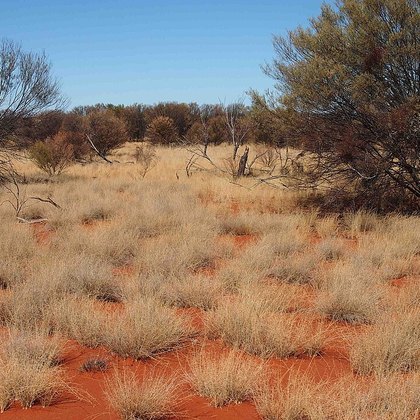
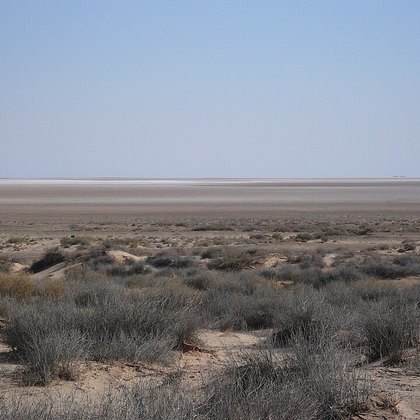
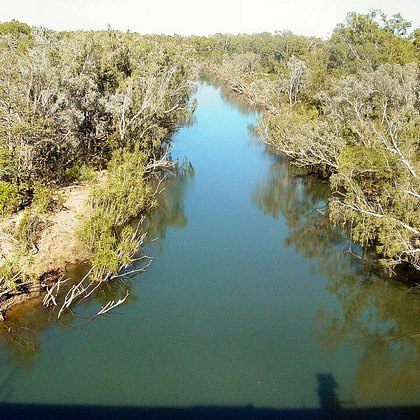
Tree lines and gallery timber along inland creeks and rivers, with open grassland, Mitchell grass plains, mulga scrub and claypans that fill after rain around them. It needs large trees to nest in — it builds nothing itself but takes over abandoned stick nests of ravens, Wedge-tailed Eagles and other raptors — and open plain to hunt over. It roosts in trees and by day often perches on power poles. Where waterbirds, pigeons or mice gather in numbers, it appears.
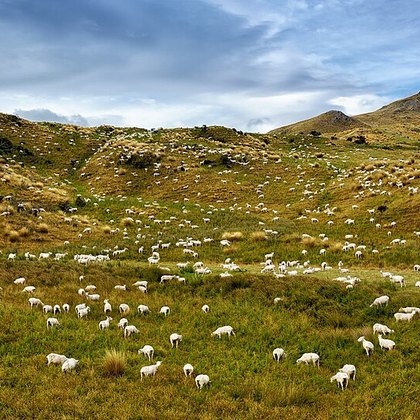
Where the bird is most often found, arranged by main group and formation.


Range and movements
Endemic to Australia and thinly spread across the interior, centred on the dry east and centre: the Murray-Darling plains, the channel country of south-west Queensland, the Barkly Tableland and the inland of the Northern Territory and Western Australia. It is entirely absent from Tasmania, and along the south coast it shows up mainly in dry years, when birds move coastwards. New Zealand has only an old vagrant claim. Nowhere is it numerous: this is a bird you run into by chance rather than one you go to a site for.
- Resident
- dark = core range, pale = thinly spread
Where and when to look
Work the tree lines along an inland creek and watch for a large, wholly dark falcon on a dead branch or a transmission pylon with wingtips reaching the tail tip. Put it up and look at the tail: plain and unbarred is the decisive clue against Brown Falcon. It is also a bold pirate that chases prey off other raptors — an aerial pursuit above a plain is often the first you see of it.
Conservation
Least Concern (LC) on the global list, but the picture is thinner than that category suggests: the species is nowhere numerous, is listed as endangered in Victoria and is scarce in several states. The main concerns are the loss of large nest trees along inland watercourses, the loss of the old stick nests on which it depends entirely, disturbance at the few breeding sites, and secondary poisoning during mouse and rabbit control. Its nomadic habits make the population hard to count, which carries its own risk.
Scientific name
Falco subniger | Gray, 1843
George Robert Gray described the species in 1843 as Falco subniger, and it remains in that genus, so author and year carry no parentheses. subniger combines sub-, 'nearly, somewhat', with niger, 'black', hence 'blackish' — a more accurate name than the Dutch and English ones, because the bird is not truly black but dark sooty brown. The type locality was originally given only as 'Australia' and was later fixed on Victoria by Mathews in 1913.