All species › Parrots › New Zealand parrots › New Zealand Kaka
New Zealand Kaka | Nestor meridionalis
Kaka | Kaka
The New Zealand Kaka is the forest parrot of New Zealand: a solid olive-brown bird with a grey-white crown, a red-brown collar and a fiery red underwing that flares only in flight. It clambers noisily through the crowns of old podocarp and beech forest, tears bark off trunks with its long curved bill to reach grubs, and has become so scarce on the mainland that most people now see it only on predator-free islands or inside fenced sanctuaries.

Voice
Flying over the canopy it gives a harsh, rhythmically repeated ka-aa ... ka-aa, from which the species takes its Maori name. Disturbed birds add a rough grating kraak. In between come surprisingly musical drawn-out whistles, oo-wee-ah, which differ from district to district and carry furthest at first light and at dusk. Females and begging young make a sustained guttural note that rises out of a nest hollow. A group together in one tree keeps up a constant talking and creaking.
No freely licensed recording has been found for this species yet; what to listen for is described below.
Identification
Thirty-eight to forty-four centimetres and 340 to 400 grams: a sturdy parrot with a short broad tail and a long, strongly curved grey bill. The plumage is olive-brown with dark feather edges, with a grey-white to dirty-white crown, an orange-red band on the nape and ear coverts, and deep crimson belly, flanks and undertail coverts. In flight the orange-red underwing coverts and the red rump light up — the mark that counts at a distance. The male has a noticeably larger head and a longer upper mandible than the female, something best judged on birds side by side. The northern subspecies Nestor meridionalis septentrionalis is smaller and darker than the southern one; size increases from north to south.
Confusion species
The only real confusion species is Kea (Nestor notabilis), the closest relative, which lives in the mountains of the South Island above and just below the treeline. Kea is larger — about 46 cm — olive-green rather than olive-brown, lacks the grey-white crown and the red collar, and has an orange rather than crimson underwing; it is moreover a bird of alpine herbfield and scree, while Kaka stays in the forest. Where the two overlap, in the beech forest of Westland and Fiordland, it pays to look at crown and underwing. Kakapo (Strigops habroptilus) is mottled moss-green, nocturnal and flightless. Red-crowned Parakeet (Cyanoramphus novaezelandiae) is only a third the size and bright grass-green.
Habitat
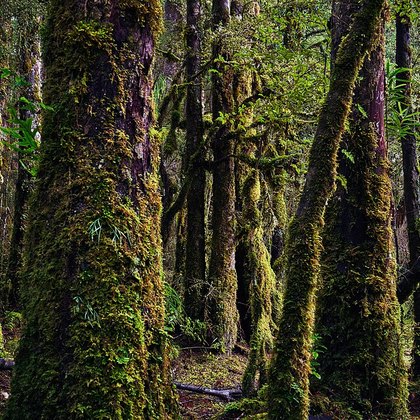
A committed forest bird, tied to extensive native forest: podocarp-broadleaf forest with rimu, matai and totara, southern beech forest, and kauri forest in the north. It nests deep inside hollows in old, large trees, often several metres below the entrance, and forages through the whole height of the forest — nectar from rata and flax flowers, fruit and seed, honeydew from the scale insect on beech trunks, and grubs chiselled out of dead wood. In Wellington and on Waiheke it has also moved into town parks and gardens.
Where the bird is most often found, arranged by main group and formation.


Range and movements
All three main islands, but very unevenly. The strongest populations are on predator-free islands: Little Barrier, Great Barrier, Kapiti, Whenua Hou (Codfish), Ulva and Tuhua (Mayor Island). On the mainland, cores remain in large forest tracts under intensive predator control — Wangapeka in Kahurangi National Park, the Eglinton Valley and Waitutu in Fiordland, Pureora and Whirinaki on the North Island — and on Stewart Island. A reintroduction at Zealandia in Wellington, begun in 2002, has produced more than eight hundred banded birds and returned Kaka to the capital's green belt; Pukaha Mount Bruce and Waiheke hold populations again as well. It occurs nowhere outside New Zealand.
- Resident
- dark = core range, pale = thinly spread
Where and when to look
The surest places are Zealandia in Wellington, where the birds circle noisily over the sanctuary in the late afternoon and at dusk, and Ulva Island off Stewart Island, where they sit at eye level from the tracks. In the forest, listen for tearing bark and falling splinters of wood: that gives away a Kaka opening up a trunk even when the bird itself stays hidden. Check the underwing of every bird that passes. Do not feed it — supplementary bread and nuts in Wellington have caused bone disease in chicks.
Conservation
Vulnerable (VU), with fewer than ten thousand birds and a distribution that tells the story: the species holds on where there are no predators and disappears where there are. The breeding female sits for weeks deep in a tree hollow and is easy prey there for a stoat, along with her eggs and young; rats and brushtail possums do the rest. The possum also eats the same fruit and flowers, and introduced wasps strip the beech forests of the honeydew Kaka live on in winter. Large-scale control with 1080 in mast years produces demonstrable recovery: on treated ground almost all nests survive, on untreated ground almost none. New Zealand now counts the northern form among its recovering species, while the southern one remains nationally vulnerable.
Scientific name
Nestor meridionalis | (Gmelin, 1788)
Gmelin described the species in 1788 as Psittacus meridionalis, after the 'southern brown parrot' Latham had described in 1781; because it was later placed in another genus, author and year are bracketed. Lesson introduced the genus Nestor in 1830, after Nestor, the old king of Pylos in the tales of Homer. meridionalis means 'southern'. The type locality is Dusky Sound on the South Island. The name kaka is Maori and simply means 'parrot'; it probably goes back to ka, 'to screech'.