All species › Parrots › New Zealand parrots › Kea
Kea | Nestor notabilis
Kea | Kea
The Kea is the only parrot in the world that lives above the treeline: a solid olive-green bird of the Southern Alps, with a long curved bill and an orange underwing that shows only in flight. It is investigative by nature, and that is exactly what brings it into conflict with people.

Voice
The call is a loud, drawn-out descending cry that carries across whole valleys: kee-ee-aa-aa, often given in flight and usually the first sign that Kea are about. Between birds come soft, clipped contact notes. Young birds add an uncontrolled whooping squeal, and in play there is a rolling warble.
Recording: Romuald Mikusek — CC BY-NC-SA 4.0 · Arthur's Pass, Selwyn District, Canterbury, New Zealand · xeno-canto
Identification
A large parrot of about half a metre, olive-green with black feather edges that give the plumage a scaled look, and with blue-green gloss on the primaries. In flight the orange-red underwing and the orange rump and flanks light up, which fixes the species at a distance. The bill is slender, grey-black and strongly hooked, longer and more curved in the male; the female weighs about a fifth less. Young birds have a yellow cere and yellow eyelids, both fading to grey with age.
Confusion species
New Zealand Kaka (Nestor meridionalis) is the only close relative and overlaps in forest below the treeline: browner, with a grey crown and a crimson rather than orange underwing, and rarely out in open alpine country. Kakapo (Strigops habroptilus) is mottled moss-green, flightless, nocturnal and now confined to predator-free islands. At range a passing Kea can suggest a New Zealand Falcon, but the broad wings and slow beat rule that out.
Habitat
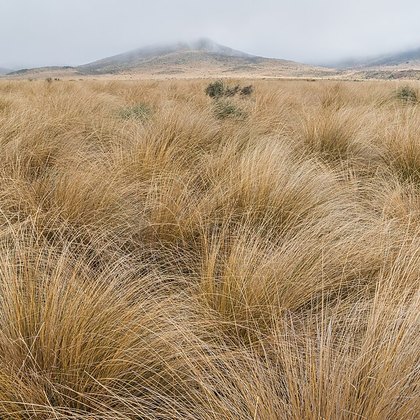
Alpine herbfield, scree and rock faces above the treeline make the picture the bird is known for, but it nests in the southern beech forest below, in cavities under boulders and tree roots. It also uses tussock (grassland of loose, tall clump-forming grasses, especially in New Zealand) grassland and subalpine scrub, and in Westland its ground runs down to the coast. With the season it moves up and down the mountainside.
Where the bird is most often found, arranged by main group and formation.



Range and movements
The mountains of the South Island only, from Farewell Spit to Waitutu and east into the Kaikoura Ranges, some four million hectares in all. It does not occur on the North Island, nor anywhere outside New Zealand. Within that area it is unevenly spread: densities are highest in the beech forests of Westland and Fiordland and have fallen in many places since the 1990s.
- Resident
- dark = core range, pale = thinly spread
Where and when to look
Walk a pass or a ridge above the treeline in summer and listen; the call travels the length of a valley and places the birds before you see them. Check the underwing of every bird that flies over, because the orange survives even against the light. Do not feed it, and leave no gear unattended at a hut or car park.
Conservation
Endangered (EN), with an estimate of some four to six thousand birds and densities clearly reduced since 1998. Lead poisoning is a leading cause: the bird chews at nails, lead flashing and roof trim on older mountain buildings, and tested Kea carry lead in the blood on a wide scale. Beyond that weigh a century of bounty hunting — roughly a hundred and fifty thousand killed before full protection in 1986, on suspicion of harming sheep — and losses to stoats, vehicles and human food.
Scientific name
Nestor notabilis | Gould, 1856
Gould described the species in 1856 as Nestor notabilis, and it has stayed in that genus, so author and year carry no parentheses. The genus Nestor was introduced by Lesson in 1830 and refers to Nestor, the old king of Pylos in the tales of Homer. notabilis means 'noteworthy'. The type locality is the Murihiku district of the South Island; the name Kea itself is Maori and is formed after the call.