All species › Waders, gulls and terns › Skimmers, noddies, terns and gulls › Black-fronted Tern
Black-fronted Tern | Chlidonias albostriatus
Nieuw-zeelandse stern | Charrán fumarel
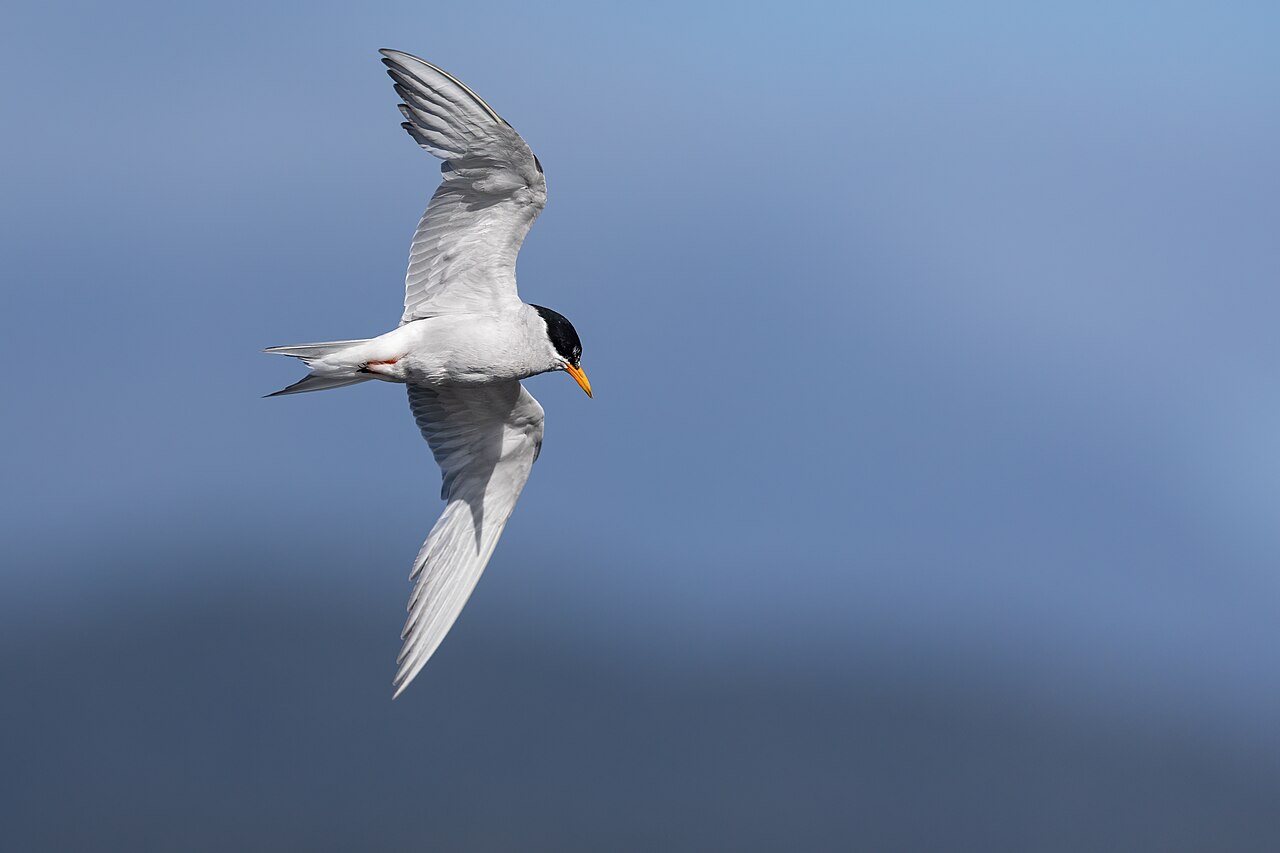
The Black-fronted Tern is the only tern in the world that breeds exclusively inland, on the bare shingle banks of the braided rivers of the South Island. It is dark grey above and pale below, with a black cap, a bright orange bill and orange legs, and a white rump that lights up as a pale wedge in flight. It is endemic to New Zealand and declining sharply: both the IUCN and New Zealand's own list place it in the highest categories of concern.
Voice
The call is a high, sharp, rapidly repeated kit-kit-kit, which above a shingle bank seems to come from all sides as soon as a colony takes to the air. Anyone who comes too close to the nests earns a rasping, sustained krek while the birds swoop overhead. Birds feeding over a river or a paddock, by contrast, are notably silent.
No freely licensed recording has been found for this species yet; what to listen for is described below.
Identification
A tern of twenty-eight to thirty centimetres, the largest of the three marsh terns, with a short, bright orange bill and short orange legs. The upperparts are mid-grey, the underparts paler grey, and the cap is black to the nape; between that black cap and the base of the bill runs a narrow white band across the forehead, from which the English name derives. The rump and the shallowly forked tail are white and stand out clearly against the grey back — in flight that is the best mark. Outside the breeding season the cap draws back to a black-flecked hindcrown and the forehead turns white. Young birds have a brown-scaled mantle and a dull, dark bill.
Confusion species
Whiskered Tern (Chlidonias hybrida) and White-winged Tern (Chlidonias leucopterus) are the guide's two other marsh terns, but both are smaller, have a black or deep-red rather than orange bill, and occur in New Zealand only as vagrants or in small numbers — White-winged annually, Whiskered rarely. The real confusion in New Zealand is White-fronted Tern (Sterna striata): whiter, longer in wing and tail, with a black bill and black legs, and breeding on the coast and on rock stacks rather than on riverbeds. On a winter estuary the two often mix, and then bill colour settles it at once: orange against black. Black-billed Gull (Chroicocephalus bulleri) shares the shingle banks and the threatened status but is a gull: bulkier, whiter, with broader wings and a slower beat.
Habitat
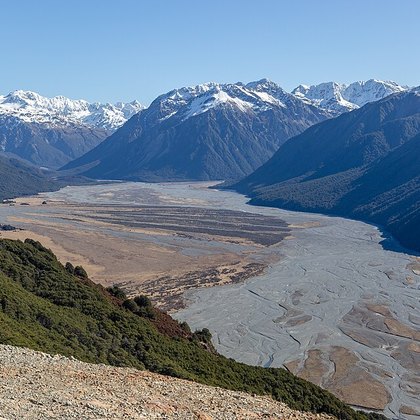
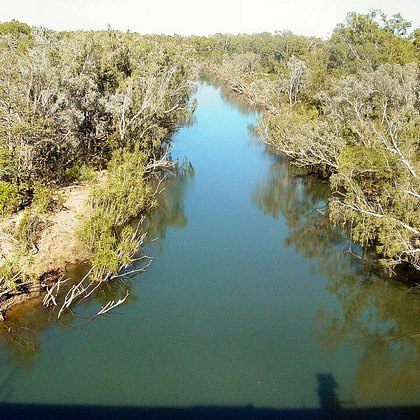
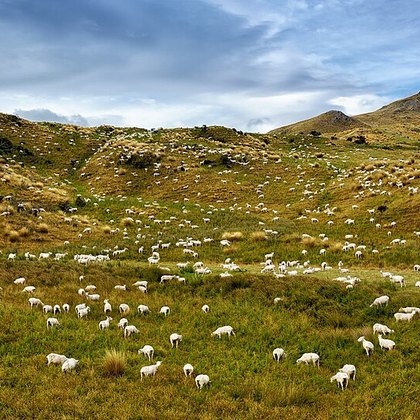
In the breeding season the open, unvegetated shingle islands and sand banks of braided rivers, where the nest is a simple scrape among the stones. Feeding takes place over the river itself, over neighbouring paddocks and cropland up to several kilometres from the water, and over creeks and stock ponds. Outside the breeding season the picture shifts to estuaries, harbours, sandy beaches and the coastal zone, where birds forage up to some ten kilometres offshore.
Where the bird is most often found, arranged by main group and formation.


Range and movements
Endemic to New Zealand. The breeding range lies almost entirely on the braided rivers of the eastern South Island — the Waimakariri, Rakaia, Rangitata, Ashburton, Waitaki and the rivers of the Mackenzie basin, with outliers in Marlborough, Otago and Southland. After breeding the birds spread to the coasts of the whole South Island, to Stewart Island and along the southern coast of the North Island as far as the Manawatu and Hawke's Bay. In Australia the species has turned up only a handful of times.
- Resident
- Winter
- dark = core range, pale = thinly spread
Where and when to look
In November or December drive to a bridge over the Rakaia, the Rangitata or the Waitaki and look upstream across the shingle flat: the birds hunt low over the channels and over the neighbouring farmland, and give themselves away with their high kit call. Stay on the bridges and the banks and do not walk out onto the shingle, because the nests are invisible until you are standing on them. In winter the easiest place is an estuary such as the Avon-Heathcote at Christchurch, among the White-fronted Terns; look there for the orange bill.
Conservation
Endangered (EN) on the IUCN list and Nationally Endangered on the New Zealand list, with a population estimated at a few thousand mature birds and still falling. The heaviest burden is introduced predators on the shingle banks: stoats, ferrets, feral cats, rats and hedgehogs work the open nests, with Southern Black-backed Gulls and harriers on top of that. Just as decisive is the loss of the breeding habitat itself: lupin, broom, gorse and willow close over the bare shingle flats, cutting nesting room and giving predators cover, while water abstraction and hydro schemes remove the natural floods that used to scour the banks clean. Gravel extraction, quad bikes and four-wheel drives and recreation in the breeding season come on top. The counterweight is river-recovery work in the Waitaki and Mackenzie country, weed control on the Tasman and Ohau rivers, extensive trap lines along the breeding rivers, and advocacy by braided-river groups to keep people and vehicles off the shingle in the nesting months.
Scientific name
Chlidonias albostriatus | (Gray, 1845)
George Robert Gray described the bird in 1845 as Hydrochelidon albostriata; because it was later placed in another genus, author and year stand in parentheses. albostriatus is formed from Latin albus, 'white', and striatus, 'striped'. The placing of the species was long disputed: on build and bearing it was put in Sterna, while its plumage and inland breeding migration pointed to the marsh terns, and only a molecular study by Bridge and co-workers in 2005 settled it as the most basal species of Chlidonias. The type locality is New Zealand; the Maori name is tarapirohe, also spelled tarapiroe.