All species › Waders, gulls and terns › Skimmers, noddies, terns and gulls › Lesser Noddy
Lesser Noddy | Anous tenuirostris
Kleine noddy | Tiñosa picofina
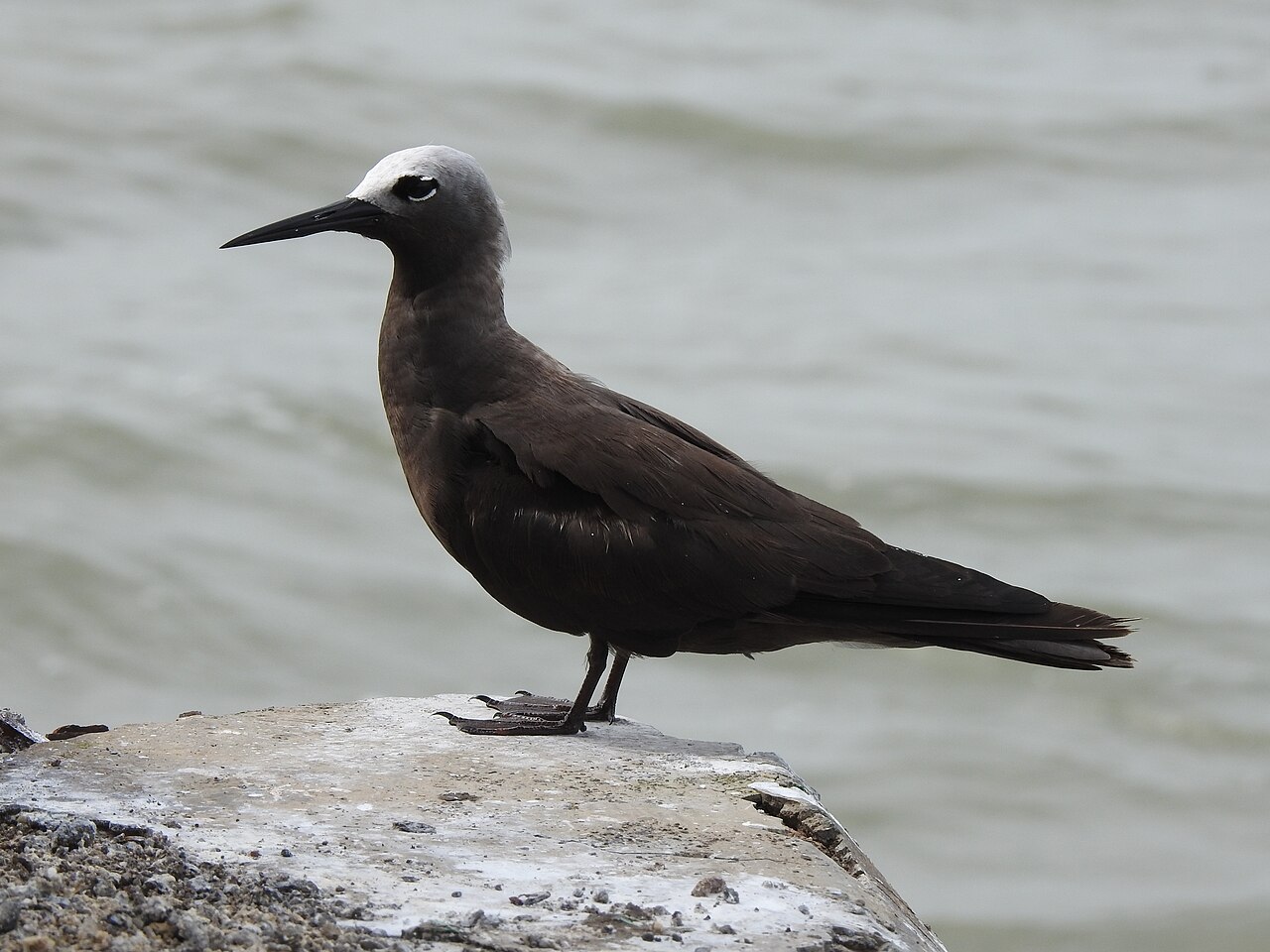
The Lesser Noddy is the smallest and finest-built of the three dark noddies: greyish to blackish brown, with a pale grey cap that runs down below the eye without a sharp border, and with a thread-fine, strikingly long bill. In Australia it breeds in one place only — the Houtman Abrolhos off Geraldton — and there it nests in the white mangroves, a breeding site no other Australian seabird uses.
Voice
The call is a short, nasal, rattling kerr, higher and thinner than the crow-like rasp of the Brown Noddy but fuller than the dry ticking of the Black Noddy. In the mangrove colony a soft, continuous chatter of thousands of birds runs all day, with sharper cries over it from birds disputing a nest branch. Over the sea it is rarely heard.
No freely licensed recording has been found for this species yet; what to listen for is described below.
Identification
A small, slender noddy of thirty to thirty-four centimetres, with narrow wings, a fairly short, slightly forked to square-cut tail and a very long, thin, dead-straight black bill almost as long as the head. The body is blackish brown with a greyish cast, less deeply black than the Black Noddy. The cap is pale lavender-grey, palest on the forehead, and on the side of the head extends below the eye, so the black lores of Black Noddy are absent here and the boundary towards the nape stays diffuse. Legs black, sexes alike; young birds are slightly browner with paler feather fringes. The flight is light and fluttering, low over the water, with much turning.
Confusion species
Black Noddy (Anous minutus) is the one real pitfall: slightly larger, deeper black, with a snow-white cap breaking off sharply on the nape and black lores between eye and bill, where the grey of Lesser Noddy runs below the eye and fades away. In practice range almost always settles it, since in Australia Lesser Noddy breeds only at the Houtman Abrolhos in the west while Black Noddy holds the eastern cays, Norfolk and Lord Howe. Brown Noddy (Anous stolidus) is much larger and warmer brown, with a heavy bill and a long wedge-shaped tail. Grey Noddy (Anous albivitta) is pale blue-grey rather than dark. From juvenile Sooty Terns (Onychoprion fuscatus) it is separated by the wedge tail and the pale cap.
Habitat
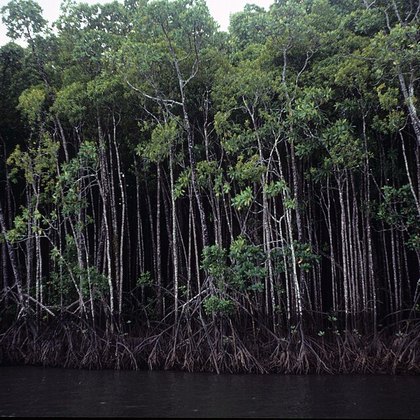
It fishes in the warm clear sea around its island group, usually within a few tens of kilometres of the colony, taking small fish and squid from the surface without diving. It breeds in the white mangrove (Avicennia marina) of the lagoons: the nest is a flat mat of leaves and seaweed fixed with droppings to a horizontal branch, often just above the water. Where mangrove is lacking it uses low shrubs. It does not visit mainland Australia.
Where the bird is most often found, arranged by main group and formation.

Range and movements
Within the map window of this guide it occurs in Western Australia only, and there effectively only at the Houtman Abrolhos: the colonies lie in the Pelsaert Group, on Pelsaert, Wooded and Morley Islands, where tens of thousands of pairs nest in the mangroves — the sole Australian breeding ground of the species. Outside the breeding season it ranges over the sea between the Abrolhos and the coast near Geraldton; it is absent further north and along the east coast, and has never been recorded in New Zealand. The rest of the world population sits in the tropical Indian Ocean, outside this window.
- Resident
- dark = core range, pale = thinly spread
Where and when to look
Seeing the bird takes a boat or a flight: day trips run from Geraldton to the Abrolhos, and the birds are most numerous from the water over the mangrove lagoons of the Pelsaert Group, above all between August and February. Watch the bill — thread-fine, almost as long as the head — and the point where the grey of the cap ends: below the eye means Lesser Noddy, above the eye Black Noddy. From the coast at Geraldton it is sometimes visible from a headland after onshore winds.
Conservation
Least Concern (LC) worldwide, but the Australian position is more fragile than that category suggests: the whole Australian population, the endemic subspecies melanops, breeds on a handful of islets in a single archipelago and is listed as a threatened subspecies in Australia. One successful introduction of rats, one oil spill in the lagoon, or a large-scale dieback of the mangroves could erase the species from Australia in short order. Disturbance by visitors in the colony and the effect of hot sea summers on the fish supply count as well.
Scientific name
Anous tenuirostris | (Temminck, 1823)
Temminck described the species in 1823 as Sterna tenuirostris; because it later moved to Anous, author and year take parentheses. The genus Anous was introduced by Stephens in 1826 and is Ancient Greek for 'mindless'; tenuirostris is Latin for 'slender-billed' and names exactly the feature by which the species is identified. Temminck gave Senegal as the origin, which was an error: Mathews replaced that type locality with the Seychelles in 1912. The Australian birds form the subspecies melanops, 'black-faced'.