All species › Waders, gulls and terns › Skimmers, noddies, terns and gulls › Brown Noddy
Brown Noddy | Anous stolidus
Noddy | Bubí
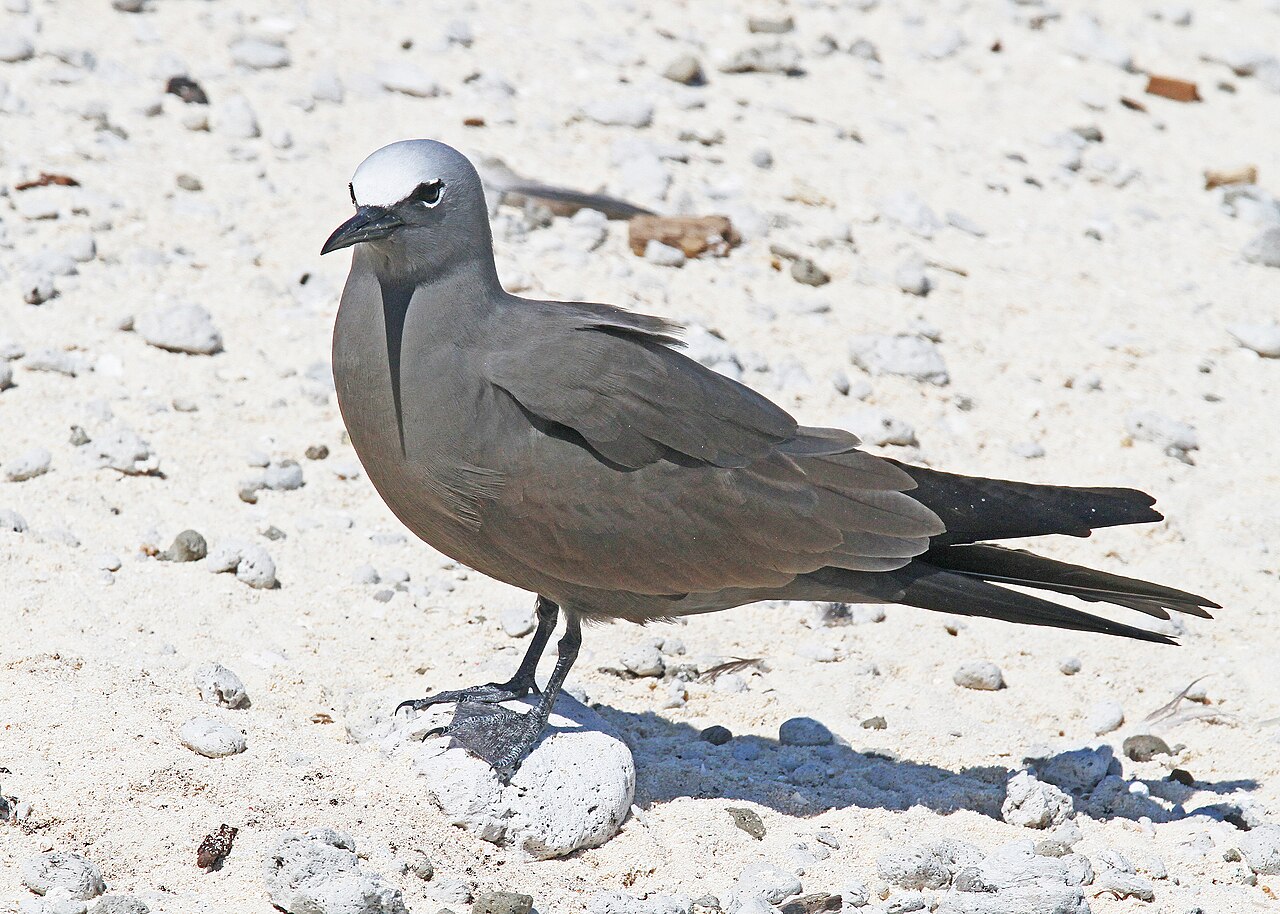
The Brown Noddy is the largest and darkest of the four noddies: a chocolate-brown seabird with a pale greyish-white cap that fades gradually into the brown of the nape. For a tern it is coloured the wrong way round — dark body, pale head — and it does not plunge-dive but picks small fish from the surface in flight, often over hunting tuna. It breeds in large colonies on the coral cays of the Barrier Reef and on Norfolk and Lord Howe.
Voice
The voice is low and hoarse, far darker than a true tern's: a raw, crow-like kaah or karrk, turning at the nest into a soft rattling krrr between partners. In a colony of thousands it merges into a steady low growl without a single high note, more like a crow roost than a tern colony. At sea the bird is almost always silent.
No freely licensed recording has been found for this species yet; what to listen for is described below.
Identification
A solid tern of thirty-eight to forty-five centimetres, with long narrow wings and — the decisive mark — a long wedge-shaped tail notched in the middle, not the deeply forked tail of a true tern. The plumage is warm chocolate brown, a shade paler on the forewing and blacker towards the wingtip. The cap is dirty white on the forehead and fades back over the crown through grey into the brown of the nape, with no sharp border. The bill is long, straight and heavily black, with a small white crescent below the eye; the legs are blackish brown. Sexes alike; young birds show a smaller, whiter, more sharply cut forehead patch. The flight is slow and heavy, low over the swell, with deep beats.
Confusion species
Black Noddy (Anous minutus) is clearly smaller and blacker, with a thinner bill, a shorter tail and above all a snow-white cap that breaks off sharply on the nape instead of grading away — that cap difference is the best key at range. Lesser Noddy (Anous tenuirostris) is smaller again and greyer brown, with a fine long bill and a pale grey cap that runs down below the eye; it occurs only at the Houtman Abrolhos, so geography usually settles it. Grey Noddy (Anous albivitta) is pale blue-grey and less than half the weight. Juvenile Sooty Terns (Onychoprion fuscatus) are wholly dark but carry white drop-shaped spots on the back and a deeply forked tail, and Bridled Tern (Onychoprion anaethetus) has a white forehead drawn back as a brow behind the eye. Rule of thumb: wedge tail plus pale cap is a noddy, forked tail plus dark cap is a tern.
Habitat
Warm sea over and beyond the continental shelf is its hunting ground; it works over hunting tuna, which drive small fish and squid to the surface, and rarely settles on the water. It breeds on coral cays and rocky islands: on the bare sand floor of a cay, among Argusia and Pisonia shrubs, or on the ledges of sea cliffs. It makes no use of the mainland and appears there only after a cyclone, often exhausted on the beach.
Where the bird is most often found, arranged by main group and formation.


Range and movements
Within this region it breeds on tropical and subtropical islands around almost the whole of Australia: from the Houtman Abrolhos north along the Western Australian coast by way of the Lacepede Islands and the Rowley Shoals to Ashmore Reef, and on the eastern side on the cays of the Great Barrier Reef — Michaelmas Cay off Cairns and Raine Island are the best known — and in the Coral Sea. It breeds too on Lord Howe and Norfolk, where it is common, and on the Kermadec Islands, the only New Zealand breeding ground. Around the New Zealand main islands it is a rare vagrant, nearly always after tropical storms.
- Resident
- dark = core range, pale = thinly spread
Where and when to look
No multi-day pelagic is needed: the day boat from Cairns to Michaelmas Cay puts you a hundred metres from thousands of breeding noddies and Sooty Terns. On every dark seabird that passes, check the tail first — wedge or fork — and only then the head, because tail shape survives even against the light. At sea it gives itself away by its slow, low, shearing flight, quite unlike the light springing beat of the true terns.
Conservation
Least Concern (LC): the world population runs into the millions and is spread across all tropical oceans. The risk is colony by colony: introduced rats and cats can empty an island colony within a few years, cyclones wash low cays clean, and disturbance at a breeding cay costs eggs to the Silver Gulls (Chroicocephalus novaehollandiae) that come in on the commotion. Visits to the Australian colonies are regulated accordingly: on Michaelmas Cay you may use only a fenced strip of beach.
Scientific name
Anous stolidus | (Linnaeus, 1758)
Linnaeus described the species in 1758 as Sterna stolida, among the terns; because it was later placed in Anous, author and year take parentheses. Stephens introduced that genus in 1826: anous is Ancient Greek for 'mindless', and stolidus is Latin for the same thing, 'stupid'. Both names come from seafaring, since breeding birds let themselves be lifted off the nest and were taken for fools; the English and Dutch 'noddy' is the same idea — an old word for a simpleton, and at once a reference to the nodding with which the birds greet each other. Linnaeus gave the type locality as 'Americae pelago', the sea of America, later read as the West Indies.