All species › Birds of prey › Kites, Old World vultures, eagles and hawks › Black-shouldered Kite
Black-shouldered Kite | Elanus axillaris
Australische grijze wouw | Elanio australiano
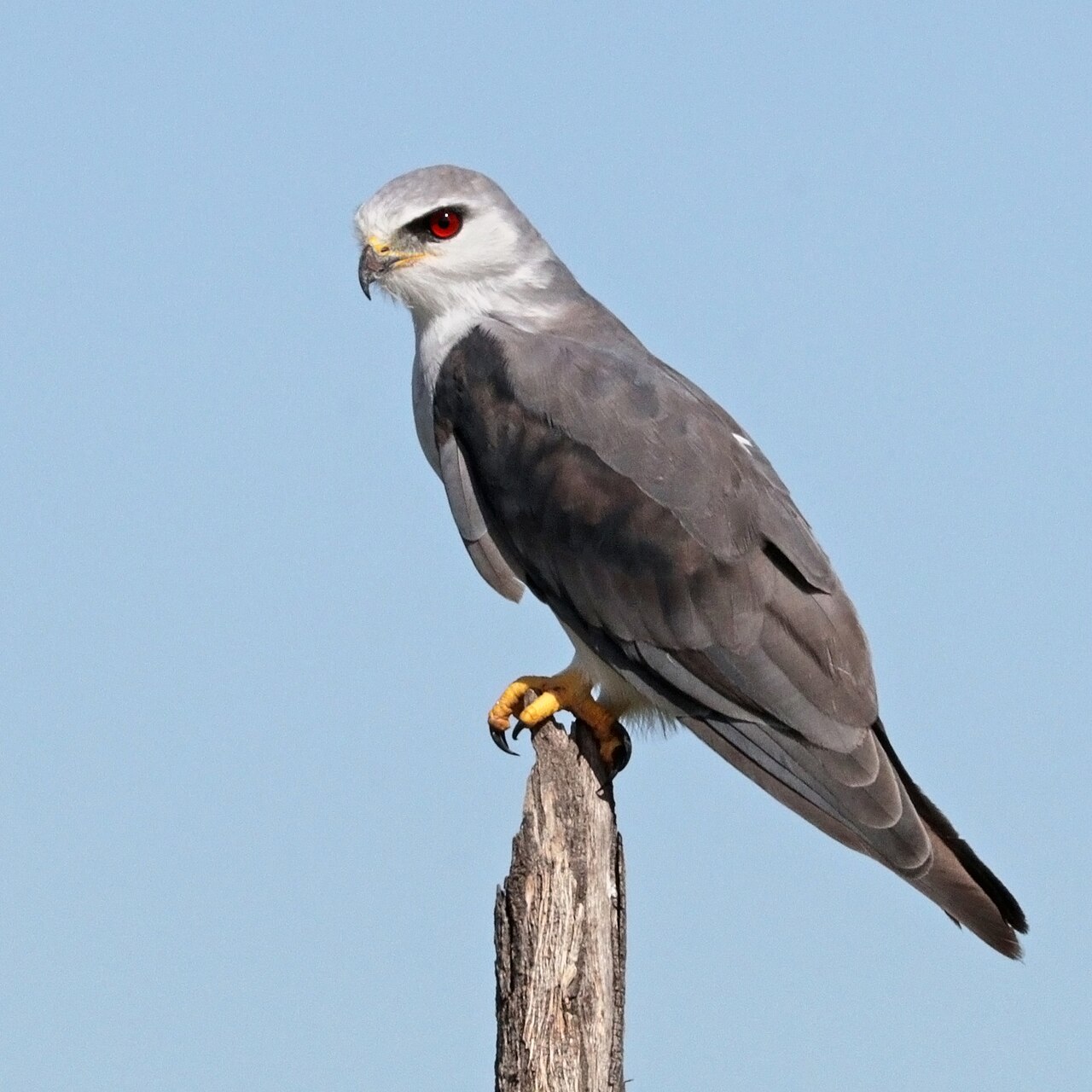
The Black-shouldered Kite is a small pale grey and white raptor of open farmland that can hang on one spot above the grass for minutes on end, legs dangling, before dropping with wings raised. The red eye with its black comma behind it, and the black shoulder patch, fix it at close range. It lives almost entirely on mice.
Voice
For a raptor it is fairly quiet. At the nest and between partners comes a high, thin whistled chee-chee, often given while hovering, and in alarm a rasping, slightly plaintive skree-ah. Young birds beg with a persistent hoarse piping that carries well from the nest tree.
No freely licensed recording has been found for this species yet; what to listen for is described below.
Identification
A raptor of thirty-three to thirty-eight centimetres with a wingspan of eighty to a hundred centimetres. Head, underparts and tail are white, the upperparts pale blue-grey, and a sharply cut black patch sits on the shoulder, worn like an epaulette by the perched bird. The iris is red, with a black comma running over and behind the eye; cere, legs and feet are yellow. In flight the underwing shows a small black carpal patch and a dark primary tip, and is otherwise white. Young birds are washed rusty brown with dark streaking on breast and back and have a brown iris.
Confusion species
Letter-winged Kite (Elanus scriptus) is the only real trap: it carries a broad black band across the whole underwing that spreads into the shape of an M or a W, where Black-shouldered Kite has only the small black carpal patch. Letter-winged Kite also has a grey rather than white crown, lacks the black comma behind the eye, beats more slowly and deeply, hunts at night and keeps to the dry interior. Nankeen Kestrel (Falco cenchroides) hovers over grass in the same way but is rufous-backed with a barred tail and has pointed falcon wings.
Habitat
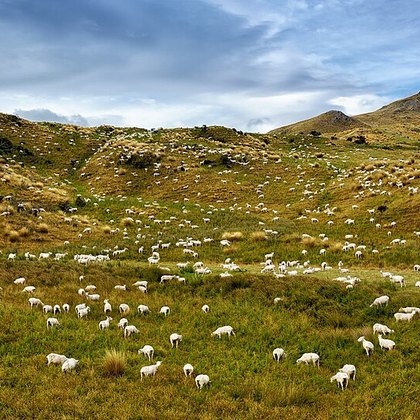
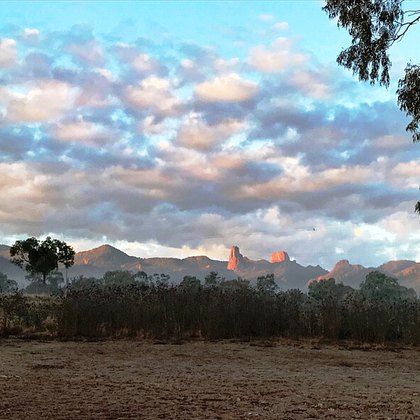
Open grassland with scattered trees, grazed farmland, crop margins, roadsides and waste ground at the edge of towns and along the coast. It needs a lookout — a dead branch, a fence post, a wire — and a sward thick enough to hold mice. Closed forest and the bare heart of the desert are avoided.
Where the bird is most often found, arranged by main group and formation.


Range and movements
Across almost all of mainland Australia, at its densest in the southeast and southwest, where cropping and grazing yield the most mouse food. It is absent from Tasmania and does not occur in New Zealand. It is nomadic: in a mouse plague birds pour in and raise two broods in quick succession, then move on again.
- Resident
- dark = core range, pale = thinly spread
Where and when to look
Drive a country road early or late in the day and watch the wires and fence posts: a white raptor sitting there with the tail hanging is almost always this bird. Then look for the hovering bird over the grass — the stiff, slightly raised wings and the dangling yellow legs place it before you can see the shoulder patch.
Conservation
Least Concern (LC), and one of the few Australian raptors that has gained rather than lost from agriculture: the introduced house mouse handed it a food supply that did not exist before European settlement, and one bird eats about a thousand a year. Where mouse plagues are fought with modern rodenticides, hovering and perch-hunting raptors die of secondary poisoning; birds are also lost along roads, where they hunt low over the verge.
Scientific name
Elanus axillaris | (Latham, 1801)
Latham described the species in 1801 as Falco axillaris, among the falcons; because it was later moved to another genus, author and year stand in parentheses. The genus Elanus was introduced by Savigny in 1809 and goes back to Greek elanos, a kite. axillaris is from Latin axilla, 'armpit', and points to the black patch under the bend of the wing. AviList fixes no type locality; Latham worked from material out of New Holland, the old name for Australia.