All species › Birds of prey › Kites, Old World vultures, eagles and hawks › Spotted Harrier
Spotted Harrier | Circus assimilis
Gevlekte kiekendief | Aguilucho moteado
The Spotted Harrier is the only harrier in the world that nests in a tree rather than on the ground, and with its blue-grey upperparts and chestnut, white-spotted underside also the handsomest in the region. It belongs to the dry interior, where it quarters slowly and rockingly over Mitchell grass and mulga with the wings in a high V.

Voice
As a rule it is wholly silent. Only in the breeding season and at the nest do you hear sharp, piercing squeaks and a rapid rattling chatter, chek-chek-chek, usually as one of the pair arrives with prey. Outside those weeks it is among the quietest raptors of the inland.
No freely licensed recording has been found for this species yet; what to listen for is described below.
Identification
Fifty to sixty-two centimetres, the female at fifty-eight to sixty-one noticeably larger than the male. The adult is blue-grey above, with a chestnut face and chestnut underparts finely spotted white, and has a yellow iris set in an owl-like facial ruff that makes the head look broad. The wings are broad with rounded, solidly black tips, the tail grey with wide dark bars, the legs long, slender and yellow. Young birds look quite different: dark brown and ochre above, pale ochre below, with a pale nape collar. Soaring, it holds the wings in a clear V and rocks slowly from side to side.
Confusion species
Swamp Harrier (Circus approximans) is the species it is forever confused with, above all in immature plumage. The rump decides it: creamy white in Swamp Harrier, never so in Spotted Harrier. Spotted Harrier further shows solidly black wingtips where Swamp Harrier has streaked points, a more finely barred tail, and no white marking at all on the uppertail. Adults cannot be confused: chestnut and spotted against dull brown and streaked. Young Whistling Kite (Haliastur sphenurus) is brown too, but lacks the facial disc and the long slender legs.
Habitat
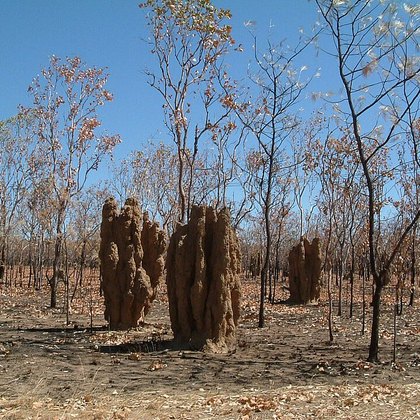
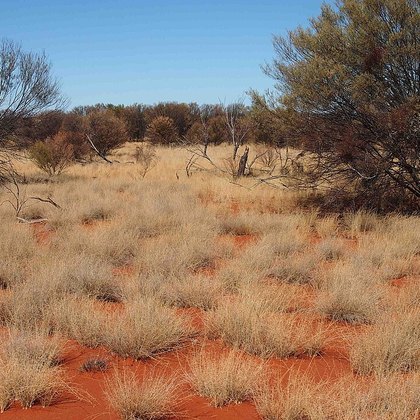
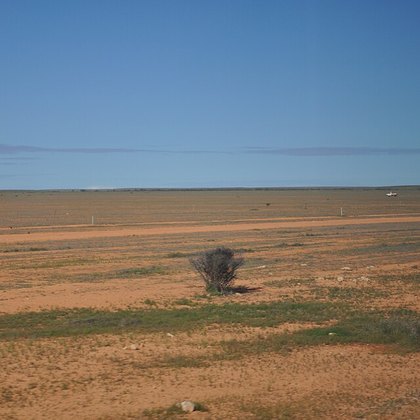
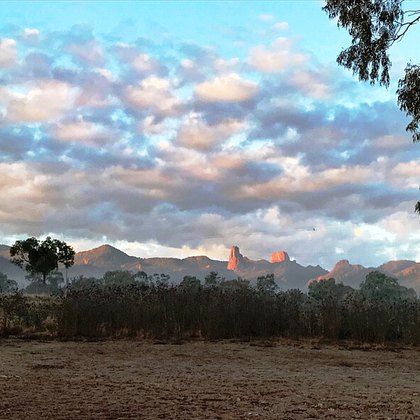
Open eucalypt savanna, Mitchell grassland, mulga and acacia scrub, saltbush plain and cropland in the dry and semi-dry interior; it hunts over grassland and nests on a loose stick platform high in a single tree or in a strip of remnant timber. Dense forest and the wet coastal belt are avoided.
Where the bird is most often found, arranged by main group and formation.

Range and movements
Across almost all of mainland Australia except the densely timbered coastal belt, and absent from Tasmania and New Zealand. Its stronghold is the dry interior of Queensland, the Northern Territory and Western Australia; it is nomadic and appears in the southeast and out to the coast after good rainfall years or in a mouse plague. Beyond this guide's window it occurs on Sulawesi, the Sula Islands and the eastern Lesser Sundas.
- Resident
- dark = core range, pale = thinly spread
Where and when to look
Work the inland highways and watch at knee height above the grass: it quarters so low that it keeps vanishing behind a bush and reappearing. Against the light the chestnut belly does not always help — then check the rump, which stays grey, and the black wingtips. Find a large loosely built stick nest high in a lone tree out in grassland and the odds are good that it belongs to this bird.
Conservation
Least Concern (LC) on the strength of its range, but thinly spread everywhere and clearly down in places; in New South Wales it is listed as vulnerable. Overgrazing and the conversion of grassland to crop reduce its prey, the felling of old trees in open country costs it nest sites, and because it takes many mammals it picks up secondary rodenticide.
Scientific name
Circus assimilis | Jardine & Selby, 1828
Jardine and Selby described the species in 1828 as Circus assimilis, and it has stayed in that genus, so author and year carry no parentheses. The genus Circus was introduced by Lacepede in 1799 and goes back to Greek kirkos, a bird of prey that flies in circles. assimilis is Latin for 'similar' and points to its likeness to the already known harriers of the Old World. The type locality is near Sydney.