All species › Birds of prey › Kites, Old World vultures, eagles and hawks › Swamp Harrier
Swamp Harrier | Circus approximans
Australische bruine kiekendief | Aguilucho lagunero del pacífico
The Swamp Harrier is the largest harrier in the region and, in New Zealand where it is the kahu, by far the commonest raptor. You almost always see it the same way: low and rocking over reeds, long grass or a road verge, wings held in a shallow V and the long yellow legs half buried in feathering. The creamy white rump is its signature.

Voice
Outside the breeding season it is nearly always silent. Over the nesting territory and in the display flight comes a run of short, high, sharp notes on one pitch, kee-o kee-o kee-o, and at the nest a plaintive, slightly whining whistle. Young birds beg with a hoarse, shrill piping that rises out of the reeds.
No freely licensed recording has been found for this species yet; what to listen for is described below.
Identification
Fifty to sixty centimetres, with a wingspan approaching a metre and a half; the female weighs about eight hundred and fifty grams against six hundred and fifty for the male and is clearly the larger. Adults are brown above — growing paler and greyer on wing and tail with the years — and creamy and streaked below, with a yellow iris and cere, a clear facial disc and long yellow legs. On every flight the creamy white rump catches the eye. Young birds are uniform chocolate brown with a dark iris, but they too carry that pale rump. The wings are long and fairly pointed and are held in a marked V when soaring.
Confusion species
Spotted Harrier (Circus assimilis) is its counterpart in the dry interior: adults are blue-grey above with a chestnut, white-spotted underside and solidly black wingtips, and lack the white rump altogether. Young Spotted Harriers are brown as well, but a warmer ochre, with a pale nape collar and again no pale rump — which stays the quickest separation. Whistling Kite (Haliastur sphenurus) is about the same size and brown, but lacks the facial disc, holds the wings flatter and has a pale rounded tail. In New Zealand the New Zealand Falcon (Falco novaeseelandiae) is far smaller and flies on fast, stiff beats.
Habitat
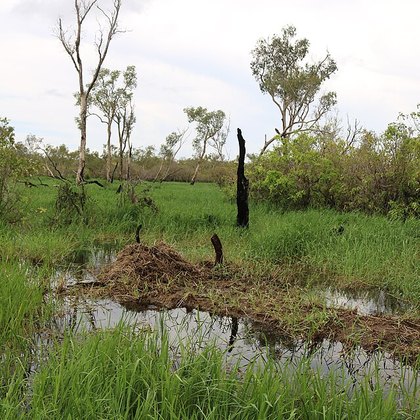
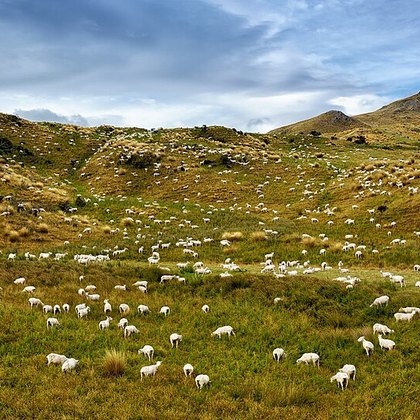
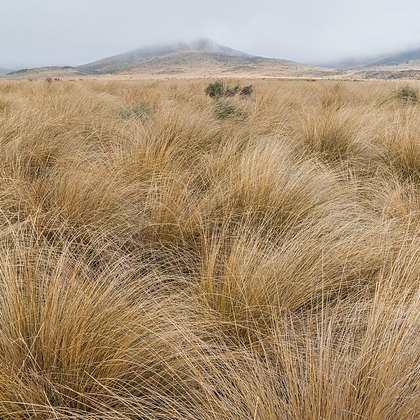
Swamp, reedbed, lake and lagoon margins, estuaries and saltmarsh, and besides that anything carrying long grass: pasture, rough ground, road verges, young pine plantations and the tussock grassland high into the New Zealand back country. To breed it needs dense, wet or rank vegetation in which to build a platform on the ground.
Where the bird is most often found, arranged by main group and formation.



Range and movements
On mainland Australia across nearly the whole country except the driest interior, and in New Zealand on the North and South Islands, Stewart Island and the Chathams, up into the subalpine zone. It also moves or wanders to the Kermadecs and Norfolk Island, and beyond this guide's window to Vanuatu, New Caledonia and Fiji. It reached New Zealand only after human settlement — all bone material examined is a thousand years old at most — taking the place of the extinct Eyles's Harrier.
- Resident
- dark = core range, pale = thinly spread
Where and when to look
Drive past a swamp or a paddock early in the day and look for the low quartering bird: the shallow V and the rocking, undecided-looking glide carry at range. Then watch the moment it turns and check the rump — white means this species. In New Zealand it also pays to watch every raptor that lifts off roadside carrion.
Conservation
Least Concern (LC), rated Not Threatened in New Zealand and decidedly numerous there: forest clearance and the making of pasture handed it a country wider than the original one. It is regularly killed at roadside carrion, and in New Zealand it holds only partial protection, so it may still be controlled there under conditions; drainage of wetland costs it breeding ground.
Scientific name
Circus approximans | Peale, 1849
Peale described the species in 1849 as Circus approximans, and it has stayed in that genus, so author and year carry no parentheses. The genus Circus was introduced by Lacepede in 1799 and goes back to Greek kirkos, a bird of prey that flies in circles. approximans is Latin for 'approaching, coming near' and states how close Peale found the bird to the marsh harrier of the Old World. The type locality is Vanua Levu in Fiji, where Peale collected it on the United States Exploring Expedition. The Maori name kahu is still in daily use in New Zealand.