All species › Birds of prey › Kites, Old World vultures, eagles and hawks › Pacific Baza
Pacific Baza | Aviceda subcristata
Australische koekoekswouw | Baza australiana
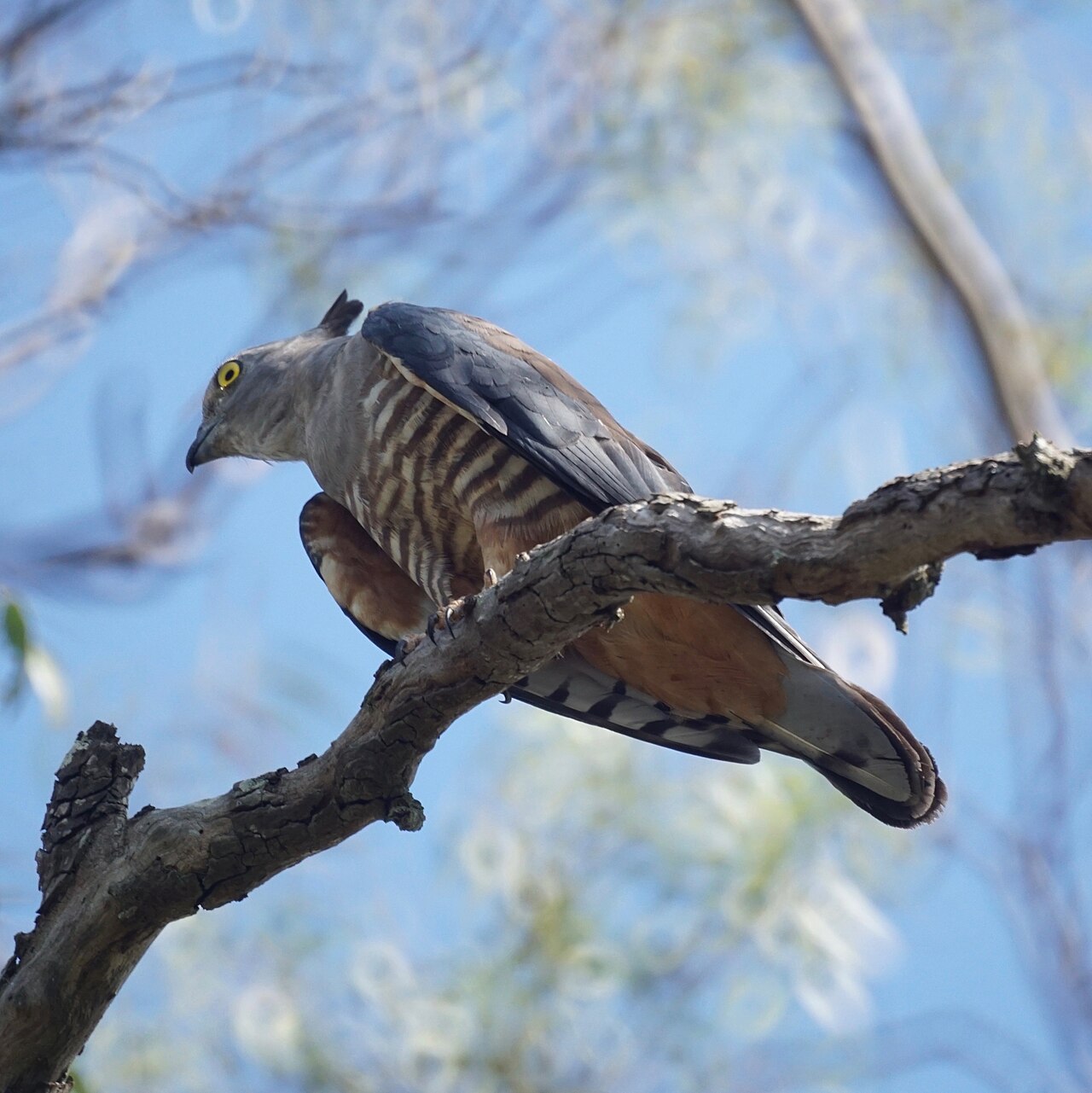
The Pacific Baza is the only Australian raptor with a crest: a slim, long-tailed bird with a grey head, bright golden eyes set well to the side of the head and a white belly crossed by broad black bars. It clambers slowly through the canopy after stick insects and mantids, and its broad paddle-shaped wings make it unlike any goshawk the moment it flies.
Voice
A clear, far-carrying two-note whistle, whee-choo, whee-choo, the second note lower and tipping downward; it is also written ee-tui. It calls often and persistently, over the canopy in display flight and sometimes well into the evening, and the sound nearly always gives it away before the eye finds it.
No freely licensed recording has been found for this species yet; what to listen for is described below.
Identification
Thirty-five to forty-five centimetres, with a wingspan of eighty to a hundred and five. Head and breast are grey, the belly white with broad black bars, the upperparts brownish grey and the tail long and clearly banded. On the nape sits a short stiff crest, often held half raised. The iris is golden yellow and the eyes are set strikingly far to the side of the head. In flight the broad, rounded, almost paddle-shaped wings stand out, with deeply fingered primaries and a rufous underwing; in display it climbs high and tumbles down with the wings in a V.
Confusion species
Brown Goshawk (Tachyspiza fasciata) and Collared Sparrowhawk (Tachyspiza cirrocephala) also have barred underparts, but that barring is far finer and rufous rather than broad and black; they also lack the crest, their yellow eyes sit forward in the head under a heavy brow, and their wings are narrower and less paddle-shaped. Crested Honey Buzzard (Pernis ptilorhynchus), which appears here only as a northern visitor, is larger, has a strikingly small crestless pigeon head and a longer tail with two broad dark bands.
Habitat
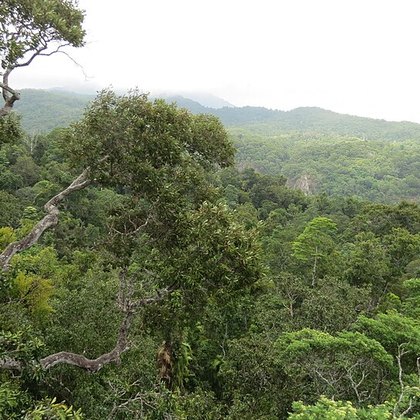
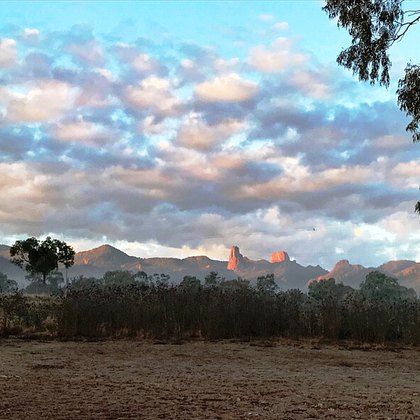
Tropical and subtropical forest and woodland, rainforest edge, monsoon forest and vine thicket, riverine woodland along creeks, and in the east also orchards, parks and well-grown suburbs with large figs and other fruiting trees. It likes well-watered country and hunts in the canopy layer, not over open ground.
Where the bird is most often found, arranged by main group and formation.



Range and movements
Northern and eastern Australia, nearly always within some four hundred kilometres of the coast, from the Kimberley across the Top End and Cape York down to about the latitude of Sydney; further south it is scarce. It is absent from Tasmania and New Zealand. Beyond this guide's window it lives in New Guinea and the surrounding islands out to the Solomons. In the south of its Australian range part of the population shifts with the seasons.
- Resident
- dark = core range, pale = thinly spread
Where and when to look
Let your ears do the work: the two-note whistle carries far and in Australia can be confused with nothing else. Then search the crown of a large fig or a riverside tree for a raptor clambering slowly and awkwardly through the foliage — no goshawk hunts like that. In the suburbs of Brisbane and Cairns it has become an ordinary garden bird.
Conservation
Least Concern (LC). The species copes strikingly well with a landscape people have reshaped: where suburbs with old trees and fruiting exotics have grown up it has stayed or even increased, and in the southeast its range has edged forward over recent decades. The pressure lies in the north, where rainforest, monsoon forest and vine thicket keep giving way to agriculture and mining.
Scientific name
Aviceda subcristata | (Gould, 1838)
Gould described the species in 1838 as Lepidogenys subcristatus; because it was later moved to another genus, author and year stand in parentheses. The genus Aviceda was introduced by Swainson in 1836 and is built from Latin avis, 'bird', and the verb caedere, 'to kill'. subcristata means 'somewhat crested', for the short crest on the nape. The type locality is New South Wales. The Dutch and Spanish names of the group point to the slim build, the long banded tail and the barred underside, which together recall a cuckoo.