All species › Birds of prey › Kites, Old World vultures, eagles and hawks › Wedge-tailed Eagle
Wedge-tailed Eagle | Aquila audax
Wigstaartarend | Águila audaz
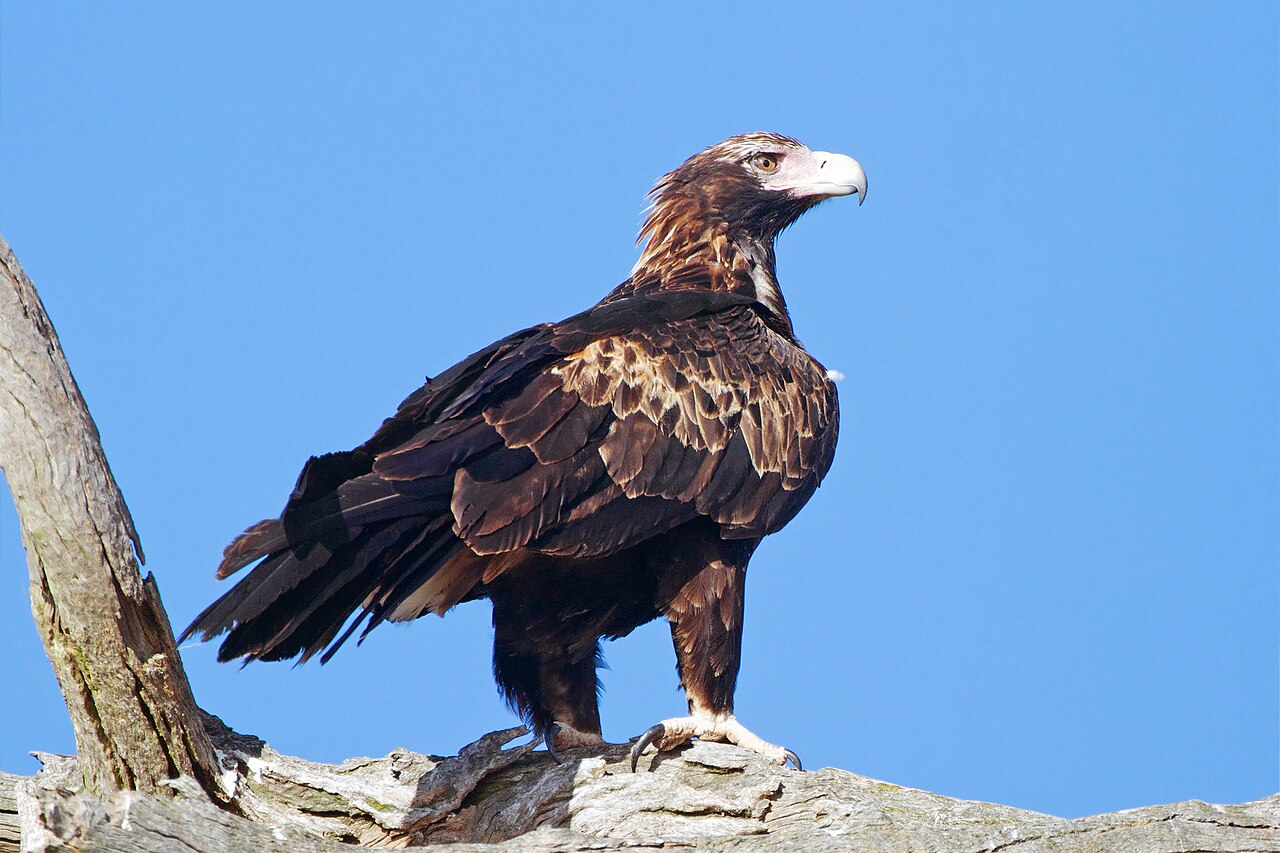
The Wedge-tailed Eagle is Australia's largest raptor and one of the largest eagles in the world, with a wingspan of over two metres and a long tapering tail that stands out as a wedge in flight. It occurs across almost the whole continent, from the coastal hills to above the ranges, usually high on a soar and rarely flapping.
Voice
For its size it is remarkably silent. At the nest and between partners come a thin, rather plaintive whistled psee-yoo and a series of short yelping kek-kek notes, sounds that seem to belong to a smaller bird. Away from the breeding territory it is hardly ever heard; young birds, though, beg loudly and persistently from their parents.
No freely licensed recording has been found for this species yet; what to listen for is described below.
Identification
A very large dark eagle with long fingered wings held in a shallow V when soaring, and the characteristic long wedge-shaped tail. Adults are blackish-brown with rufous hackles and a pale shoulder bar; the female is larger and a shade duller. Young birds are mid-brown with a golden-brown nape and pale wing patches, and only darken fully after some ten years. The legs are feathered right down to the toes.
Confusion species
White-bellied Sea-Eagle (Haliaeetus leucogaster) also has a wedge-shaped tail, but it is short and white, the underparts are white and the legs bare; it stays near water. Little Eagle (Hieraaetus morphnoides) is the same shape in miniature, with a short square tail and a much faster wingbeat. Black-breasted Buzzard (Hamirostra melanosternon) of the interior is short and broad in the tail and shows large white patches in the primaries, a pattern the Wedge-tailed Eagle never has.
Habitat
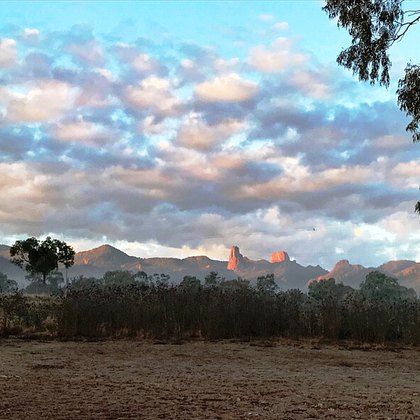
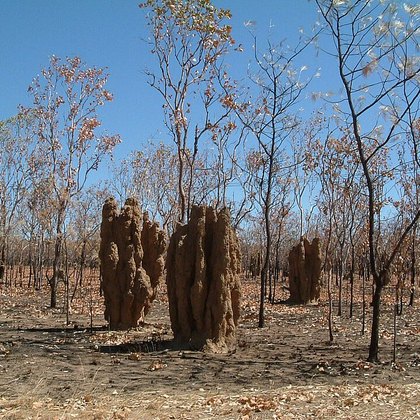
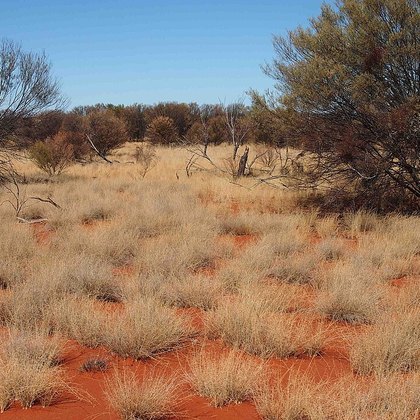
From sea level to above the treeline in the Australian Alps, preferring dry eucalypt woodland, savanna, mulga and grazed rangeland where it can see out over distance. Closed rainforest and dense coastal heath are avoided, but cliffs, gorges and scree are used for lift and sometimes for nesting. For the nest it needs a tall tree with a solid fork, and the same nest is built up further year after year.
Where the bird is most often found, arranged by main group and formation.


Range and movements
Across the whole Australian mainland and Tasmania, and on into southern New Guinea; it is absent from New Zealand. Adults hold a territory the year round, while immatures wander hundreds of kilometres and gather where carrion is plentiful. Through much of the twentieth century it was shot for bounty on the charge of taking lambs; since legal protection in the 1970s numbers have been stable again in most states.
- Resident
- dark = core range, pale = thinly spread
Where and when to look
Look for it in the middle of the day when the thermals are working: it comes up high over a ridge or a gorge, and the shallow V with the long wedge tail can be read from kilometres away. Drive a road with kangaroo roadkill and watch the birds that lift from the carcasses; young and adult often stand there together.
Conservation
Not threatened (LC), with a range spanning the continent and numbers that recovered once the bounties ended. The Tasmanian subspecies Aquila audax fleayi stands differently: fewer than a thousand birds, sensitive to disturbance at the nest and to the loss of old nest trees. Everywhere, collisions at roadside carrion, strikes on powerlines and turbines, and illegal shooting take a steady toll.
Scientific name
Aquila audax | (Latham, 1801)
Latham described the bird in 1801 as Vultur audax, among the vultures; because it was later moved to another genus, author and year stand in parentheses. The genus Aquila was introduced by Brisson in 1760 and is the ordinary Latin word for eagle. audax means 'bold, daring'. The type locality is New South Wales; the English and Dutch names both point at the tail, which separates the species from every other Australian raptor.