All species › Passerines › Australasian treecreepers › Black-tailed Treecreeper
Black-tailed Treecreeper | Climacteris melanurus
Zwartstaartkruiper | Corretroncos colinegro
The Black-tailed Treecreeper is the treecreeper of the tropical savanna of northern Australia and the largest and darkest of the genus: an almost chocolate-brown bird with a black tail, moving through savanna woodland and creek-line forest in noisy family parties. It is the most conspicuous of the five, not by colour but by voice — where it occurs, it is heard before it is seen.

Voice
Loud, clear and penetrating, and the most powerful voice of all the Australian treecreepers. The usual call is a sharp chip given in long accelerating series that run into a ringing rattle, carrying hundreds of metres in the open savanna woodland. Members of a party take the series up from one another, so that the sound seems to roll through the trees. In the early morning this is one of the standing voices of the northern woodland.
No freely licensed recording has been found for this species yet; what to listen for is described below.
Identification
Eighteen to twenty centimetres, by a clear margin the largest treecreeper. The whole plumage is dark sooty to chocolate brown, with a distinctly black tail that stands out against the back; there is no pale brow. The male has a white throat and upper breast, below which heavy black-and-white streaking begins on breast and belly. The female has rufous streaks on the sides of the throat. In flight the broad buff wing-bar appears that all treecreepers of the genus Climacteris share. The bird climbs trunk and heavy branches in firm spirals, regularly forages on the ground and on fallen timber as well, and nests in tree hollows. An isolated, paler-plumaged race lives in the Pilbara.
Confusion species
Within the northern range this is usually the only treecreeper. Where it meets Brown Treecreeper (Climacteris picumnus), in the Gulf country of north-western Queensland, the distinction is plain as soon as the underparts are seen: Brown Treecreeper is pale buff below, has a pale brow and a brown tail, while this species is dark, browless and black-tailed. Note that the northern race of Brown Treecreeper on Cape York is itself dark-backed, so there the tail colour is more reliable than the colour of the back. Varied Sittella (Daphoenositta chrysoptera) shares the same savanna woodland, but is far smaller, also climbs head-downward and has an upturned bill.
Habitat
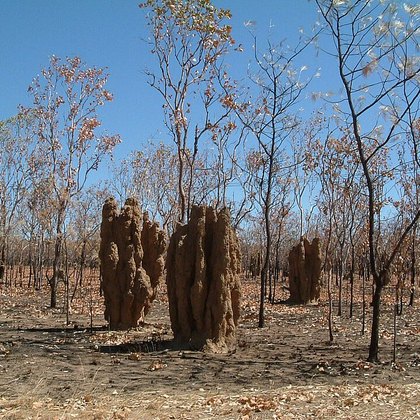
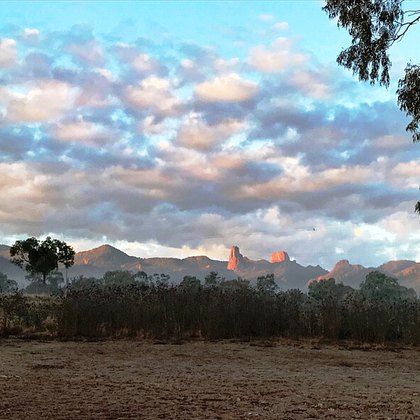
Eucalypt savanna of the monsoon belt, with open crowns over a grass floor, and above all the heavier tree belts along creeks and river flats carrying river red gum, coolibah and paperbark. Dry eucalypt forest and woodland on the sandstone plateaus also count. The species needs old, rough-barked trees for hollows and for food; in the savanna these are often the trees along water, and that is where densities are highest. The annual fires that run over most of this savanna affect the grass layer more than the trees, but hot late-dry-season fires kill old hollow-bearing trees as well.
Where the bird is most often found, arranged by main group and formation.

Range and movements
Northern Australia, from the Kimberley in Western Australia east through the Top End of the Northern Territory into north-western Queensland. A separate, isolated race persists in the Pilbara, far to the south-west of the continuous range, along the tree belts of the gorges. The species is sedentary and does not move with the season, though parties may shift towards the remaining watercourses late in the dry. To the south the range ends where savanna woodland gives way to drier acacia scrub.
- Resident
- dark = core range, pale = thinly spread
Where and when to look
Walk a creek-line stand of old river red gums or coolibahs and listen for the accelerating rattle; in the north that is almost always this species. Once the bird is in view, look at the tail: black and contrasting even in poor light. The parties are little shy and allow a close approach, so the sex can be read from the throat pattern. Late in the dry season the birds concentrate at the last waterholes, and those are the best hours of the day to see them.
Conservation
Least Concern (LC). The species is widespread and locally common across the northern savanna, and there is no sign of a rapid decline. The bird community of the northern savanna as a whole is nevertheless under pressure: altered fire regimes with hot late-dry-season burns, grazing by stock and by feral donkeys and horses, and the loss of old hollow-bearing trees all work against hollow-nesters. The isolated Pilbara population is small and cut off from the rest, and for that reason deserves separate attention.
Scientific name
Climacteris melanurus | Gould, 1843
John Gould described the species in 1843 as Climacteris melanura, from north-west coast material later attributed to Derby; the ending shifted with the grammatical gender assigned to the genus name. Climacteris goes back to Ancient Greek klimax ('ladder'). The epithet is formed from melas ('black') and oura ('tail'). The English Black-tailed Treecreeper, the Spanish corretroncos colinegro and the Dutch zwartstaartkruiper all say the same thing and name the character that works fastest in the field.