All species › Passerines › Australasian treecreepers › Red-browed Treecreeper
Red-browed Treecreeper | Climacteris erythrops
Roodbrauwkruiper | Corretroncos cejirrojo
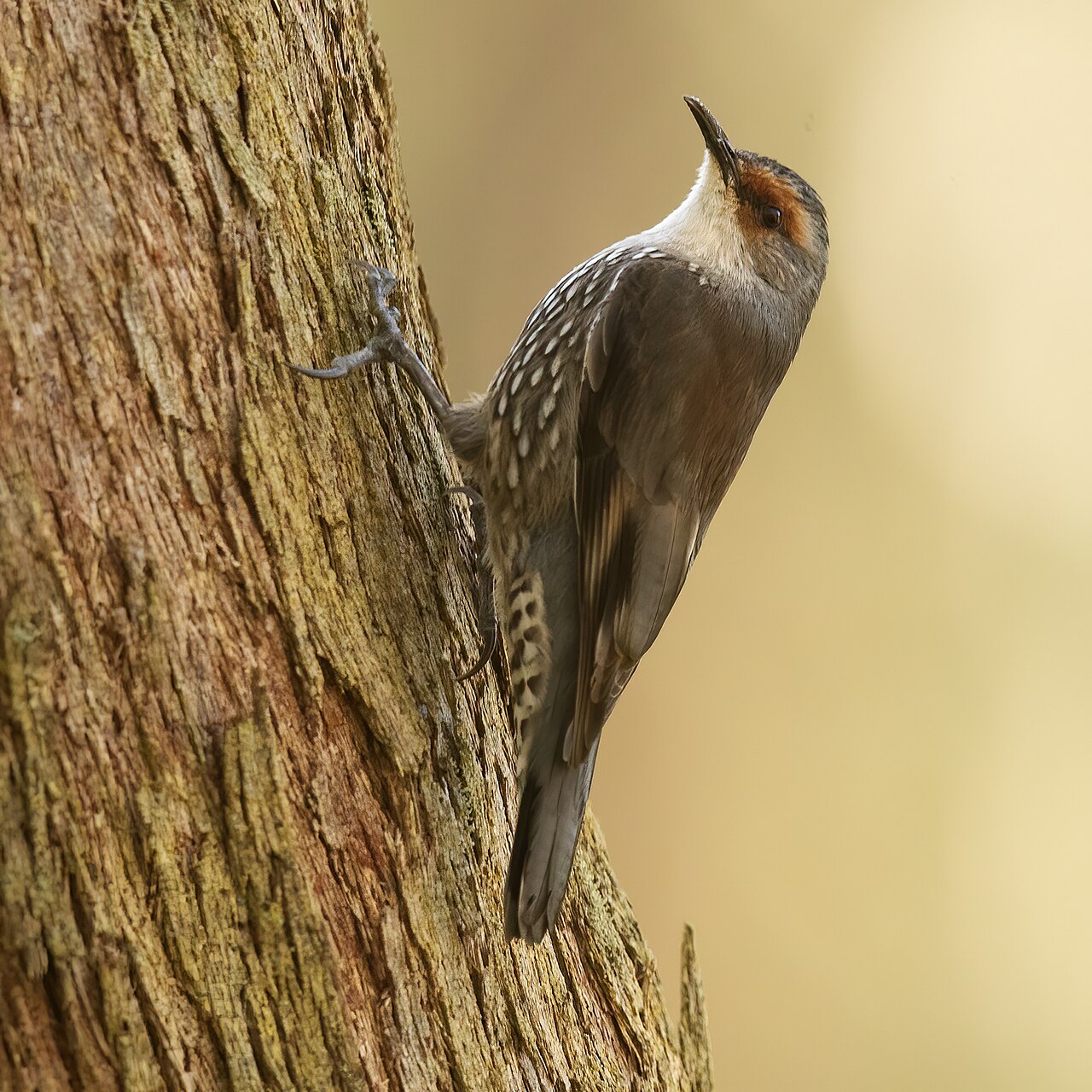
The Red-browed Treecreeper is the treecreeper of the wet, high-lying eucalypt forests of south-eastern Australia, and the only member of the genus with a rufous brow. It is also the most thoroughly arboreal of the five: where its relatives regularly forage on the ground, this species stays almost entirely on trunk and branch, usually high in the forest. That makes it harder to see than its voice suggests.
Voice
A high, thin, rapidly repeated series of sharp squeaks, best rendered as a hurried sit-sit-sit-sit. The pitch is noticeably higher and the delivery faster than in Brown Treecreeper, and the sound carries much less far. There is also a dry rattling churr with which the members of a family party hold neighbours at a distance. Once the difference from Brown Treecreeper is in the ear it becomes the first thing to go on, because the two can meet on the slopes of the Great Dividing Range.
No freely licensed recording has been found for this species yet; what to listen for is described below.
Identification
Fourteen to sixteen centimetres, darker and more compact than Brown Treecreeper. The upperparts are dark grey-brown and the crown grey. The decisive character is a broad rufous brow that begins above the eye and runs back behind it; in good light the ear-coverts are warm rufous too. Throat and upper breast are plain grey, while belly and flanks carry heavy black-and-white streaking. The buff wing-bar shows only in flight. The female has rufous streaks on the sides of the throat and upper breast, which the male lacks. The bird climbs trunk and heavy branches in short jerky spirals, often high in the canopy, and rarely comes to the ground.
Confusion species
Brown Treecreeper (Climacteris picumnus) is paler, has a faint buff rather than rufous brow and forages a great deal on the ground; it also keeps to drier, more open woodland, while this species chooses the wet slope forests. White-throated Treecreeper (Cormobates leucophaea) shares the same forest but has a clean white throat, no brow, and climbs in one unbroken run from the foot of the trunk to the canopy. Against the light high in the canopy the colour of the brow is lost; the voice and the manner of climbing then help more than the plumage. Confusion with Rufous Treecreeper (Climacteris rufus) is impossible: that species occurs two thousand kilometres to the west.
Habitat
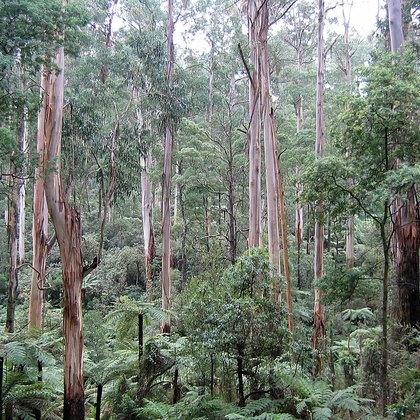
Wet eucalypt forest and tall open forest on the moist slopes and uplands of the Great Dividing Range, with tree ferns and a soft understorey; locally also the adjoining drier eucalypt forest, but there mainly in damp gullies. The species needs old trees: it nests in hollows and prefers to forage on the rough, deeply furrowed bark of heavy trunks, where spiders and insects sit in the fissures. Clear-felling and the removal of hollow-bearing trees empty the habitat even where the forest itself grows back.
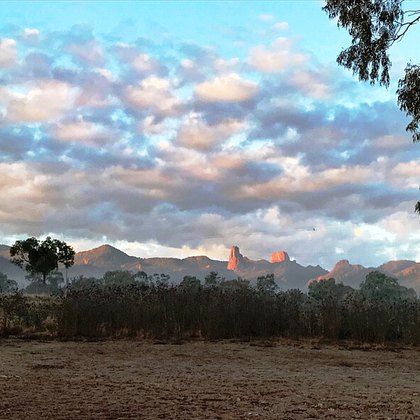
Where the bird is most often found, arranged by main group and formation.
Range and movements
South-eastern Australia, from south-eastern Queensland south across the tablelands and escarpment of New South Wales into central Victoria, where the species reaches its south-western limit in the Wombat Ranges. The range is tied to the higher, wetter country and is therefore narrow and broken into blocks. There is no migration, though birds sometimes move a little downhill in winter. Family parties of three to six hold the same territory year-round.
- Resident
- dark = core range, pale = thinly spread
Where and when to look
Look in damp gullies and slope forest above roughly five hundred metres and put the binoculars first on the heavy, rough-barked trunks from mid-height upwards. Go by sound: the hurried, high sit-sit-sit is the quickest separation from Brown Treecreeper. Once the bird is in view, check the brow before it swings round behind the trunk — that is often the only second in which the character shows. Winter mixed flocks are a good opportunity, since the treecreepers regularly attach themselves to them.
Conservation
Least Concern (LC). The species is locally numerous across its narrow range and there is no sign of a rapid decline. Even so it is more exposed than that status suggests: the habitat is a thin band along the escarpment, the birds are sedentary and nest only in hollows, and logging that takes out the old hollow-bearing trees renders a forest unusable for decades. Severe bushfire, of the kind that has run over large stretches of the escarpment in recent years, is a further risk that grows with the scale of the fires.
Scientific name
Climacteris erythrops | Gould, 1841
John Gould described the species in 1841 from a specimen taken in New South Wales. The genus Climacteris goes back to Ancient Greek klimax ('ladder'), after the manner of climbing. The epithet erythrops combines eruthros ('red') with ops ('face, eye') and names exactly the character by which the species is known. The English Red-browed Treecreeper, the Spanish corretroncos cejirrojo and the Dutch roodbrauwkruiper all say the same thing, and for once there is nothing to choose between the languages.