All species › Passerines › Australasian treecreepers › White-browed Treecreeper
White-browed Treecreeper | Climacteris affinis
Witbrauwkruiper | Corretroncos cejiblanco
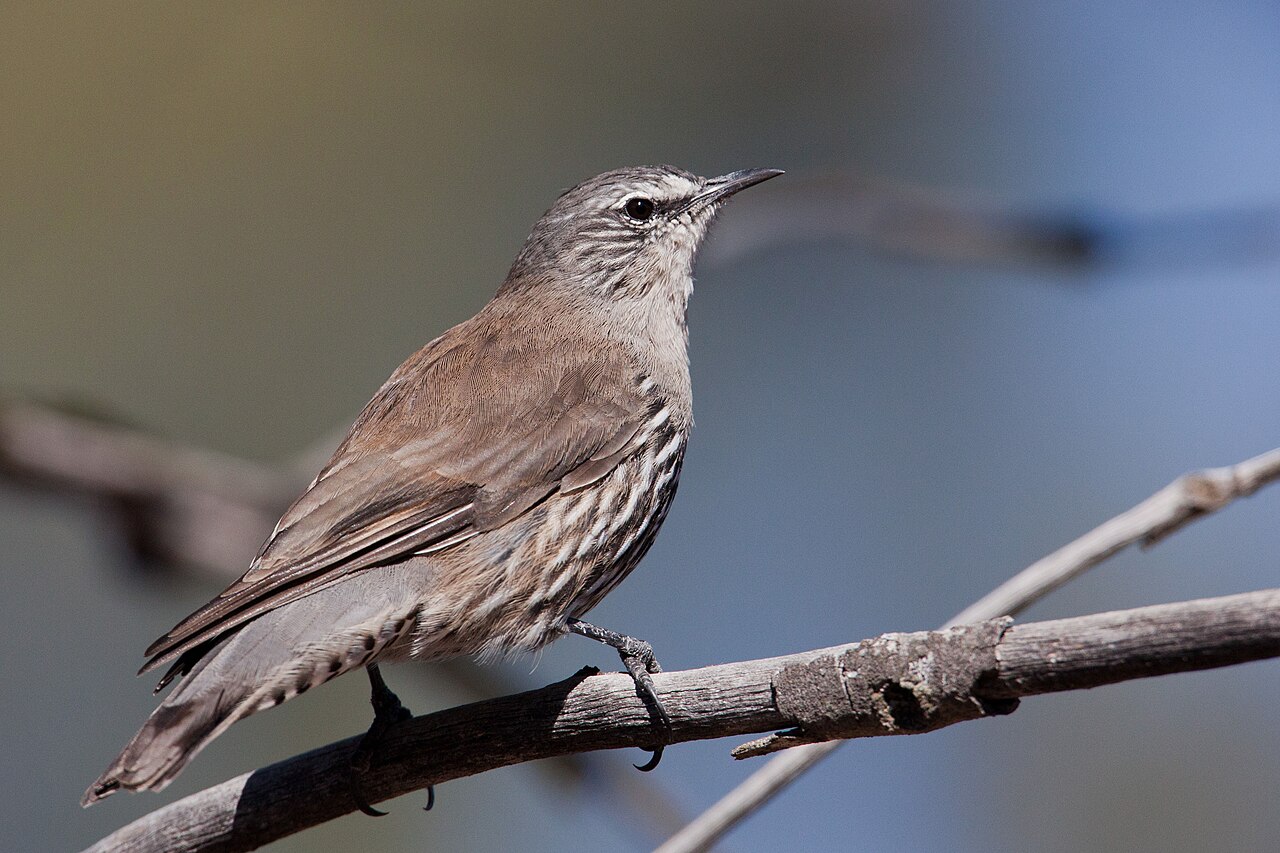
The White-browed Treecreeper is the smallest of the Australian treecreepers and the only one to have taken on the arid interior. It lives in mulga, belah and cypress-pine woodland far beyond the eucalypt forests in which its relatives belong, in country where the trees are low and widely spaced. The crisp white brow that gives it its name settles the identification at once; the harder part is finding the bird at all, for it is scarce, thinly spread and much quieter than the other treecreepers.
Voice
Soft and high, and therefore easy to miss. The ordinary contact note is a thin chip delivered in quick series, followed by a reedy, slightly descending trill. There is no loud far-carrying call of the kind Brown Treecreeper has; in the silence of mulga country the sound travels a few tens of metres at most. Anyone after this species in the dry interior must stay close to the trees and listen at short range.
No freely licensed recording has been found for this species yet; what to listen for is described below.
Identification
Fourteen to fifteen centimetres, the smallest and most finely built treecreeper. The upperparts are dark grey-brown and the ear-coverts dark. Above them runs a narrow but sharply drawn, pure white brow reaching from the base of the bill well behind the eye — the decisive character, and the only one needed. The throat is white, the breast grey, and flanks and belly carry fine black-and-white streaking. The female has orange-rufous streaks on the sides of the throat and upper breast; in the male those streaks are white. The wing-bar is pale and shows only in flight. The bird climbs the often slender stems of mulga and works the horizontal branches as well, and forages besides on the bare ground beneath.
Confusion species
Brown Treecreeper (Climacteris picumnus) meets this species along the eastern edge of the dry interior; it is distinctly larger, warmer buff below, and has a faint buff rather than a crisp white brow, and it keeps to eucalypt woodland while this bird sits in the acacia. Rufous Treecreeper (Climacteris rufus) is the neighbour to the west: rufous below and without a white brow. Varied Sittella (Daphoenositta chrysoptera) occurs in the same mulga country and also climbs along branches, but moves head-downward, has an upturned bill and shows an orange-buff wing-flash in flight. If the brow cannot be judged against the light, small size combined with the acacia setting is the practical alternative.
Habitat
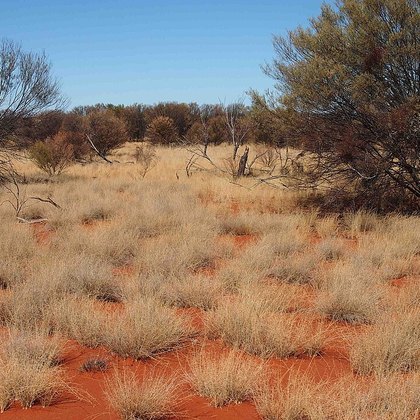
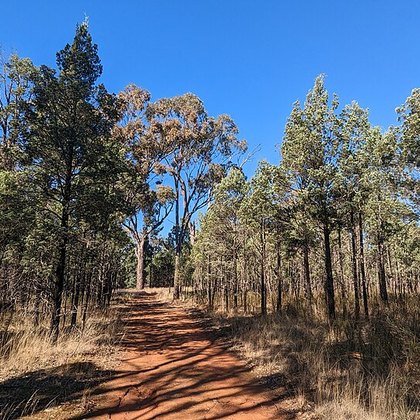
Mulga and other acacia scrub of the dry interior, and besides that the woodland of belah, black oak and white cypress-pine on heavier or sandier ground. What these share is an open canopy of low trees with rough bark and hollows of small size, over an almost bare floor. The species avoids pure treeless spinifex country and open saltbush plain, and does not enter the eucalypt woodland of the moister margins. Where mulga bands thicken and age along a drainage line, the densest parties are found.
Where the bird is most often found, arranged by main group and formation.
Range and movements
The arid interior of Australia, in a broad but very irregular band from inland Western Australia east through South Australia to far north-western Victoria and western New South Wales. The distribution is everywhere thin and patchy: whole mulga landscapes hold none, and then a run of occupied territories follows. The south-eastern outpost in the Murray mallee is small and isolated. There is no migration; the birds stay in the same territory all year, even in the driest seasons.
- Resident
- Winter
- dark = core range, pale = thinly spread
Where and when to look
Search old mulga bands and belah groves, and run the eye along the stems and the thicker horizontal branches rather than looking up into the canopy. Because the calls are so soft, walking slowly with frequent stops works better than covering a lot of ground. A single bird usually has a mate or a helper nearby, so finding one generally produces the whole party. In side light the white brow can be judged with certainty at fifteen metres.
Conservation
Least Concern (LC). Across the range as a whole the species is widespread and not rare, though nowhere numerous. The south-eastern edge is another matter: the population in north-western Victoria is small, fragmented and cut off from the rest of the range, and is regarded as threatened at state level. The risks in the interior are grazing by stock and feral goats, which removes the young acacias so that there is no succession, and extensive fire that kills a mulga band outright — mulga does not resprout after fire and must return from seed, which takes decades.
Scientific name
Climacteris affinis | Blyth, 1863
Edward Blyth described the species in 1863; no type locality was given, and one was later fixed at Broken Hill in New South Wales. The genus Climacteris goes back to Ancient Greek klimax ('ladder'), after the manner of climbing. The epithet affinis is Latin for 'related': Blyth placed the bird expressly alongside the already known Brown Treecreeper. The English White-browed Treecreeper, the Spanish corretroncos cejiblanco and the Dutch witbrauwkruiper all take the brow, which in the field is the right choice.