All species › Passerines › Fairywrens, grasswrens and emu-wrens › Blue-breasted Fairywren
Blue-breasted Fairywren | Malurus pulcherrimus
Blauwborstelfje | Maluro pechiazul
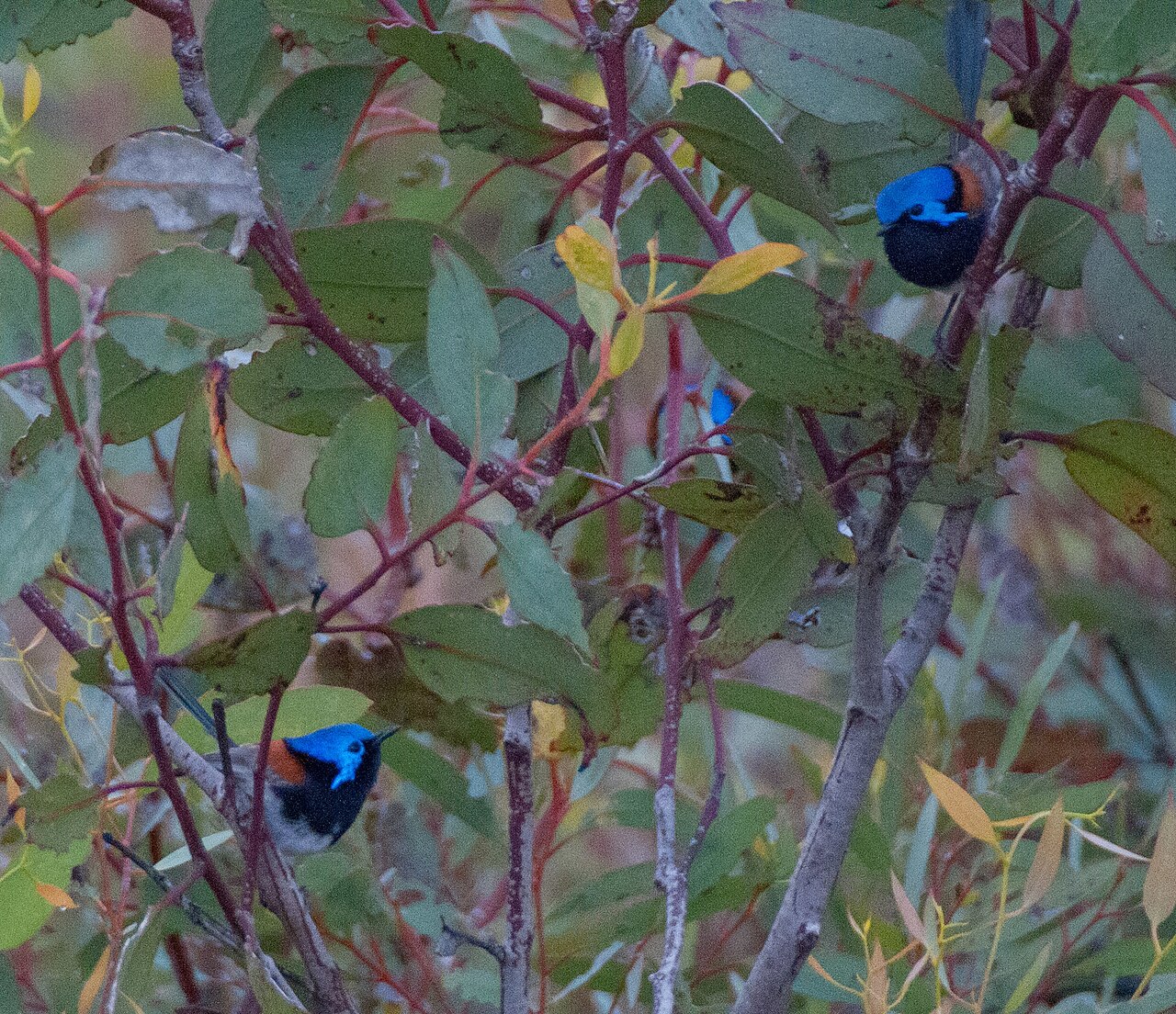
The Blue-breasted Fairywren is the fairywren of the dry heath and mallee of Western and South Australia: a small, long-tailed bird whose breeding male has a deep violet-blue throat and breast and chestnut shoulders. It belongs to the complex of 'blue fairywrens' whose males are spectacular and whose females are all but unidentifiable.
Voice
A high, fast, sustained reeling song of a few seconds, opening with a couple of sharp notes and running into an even trill — in pitch and tempo barely separable from that of the related blue fairywrens. The contact call is a thin tsit; in danger there is a fine, very high alarm call. The birds call constantly to one another as they work through the lowest layer of shrubs.
No freely licensed recording has been found for this species yet; what to listen for is described below.
Identification
Fourteen to fifteen centimetres, nearly half of it the usually cocked tail. The breeding male has a silvery violet-blue crown and blue ear-coverts, black lores and nape band, chestnut shoulders and — the decisive feature — a deep violet-blue throat and breast, not black. The belly is off-white, the tail blue. The female is grey-brown above and off-white below, with dull rufous lores and eye-ring and a blue-grey tail. Outside the breeding season the male moults into an eclipse plumage resembling the female; the blue tail and the dark bill then remain as clues.
Confusion species
For breeding males everything turns on throat and breast. The Purple-backed Fairywren (Malurus assimilis) has the same chestnut shoulders but a black throat and breast; the two occur side by side in the Western Australian wheatbelt and on the Eyre Peninsula, and there this is the only reliable distinction. The Red-winged Fairywren (Malurus elegans) likewise has a black throat and breast, is larger, and lives in the moist karri and jarrah forests of the far south-west. The Splendid Fairywren (Malurus splendens) has no chestnut shoulders and as a male is blue from head to belly. The Superb Fairywren (Malurus cyaneus) lacks the chestnut shoulders and shows a black nape band with an off-white belly; it meets this species only on the Eyre Peninsula. Females and eclipse males are another matter: they are mostly brown with dull rufous lores and cannot be separated reliably in the field from those of the Purple-backed Fairywren. Seeing such a brown bird, it is best to note 'Blue-breasted or Purple-backed Fairywren' and leave it there, unless a coloured male in the party settles it.
Habitat
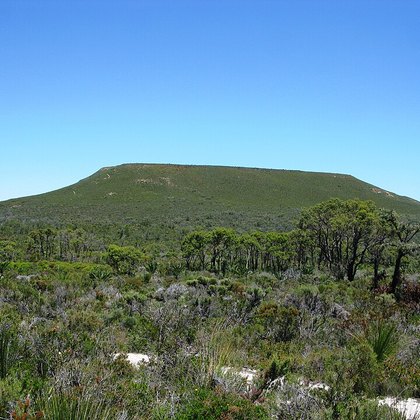
Dry shrublands with a dense, closed understorey: mallee with shrubby ground cover, kwongan heath on sandplain, and acacia thicket, often rich in Banksia, Hakea and prickly dwarf shrubs. What matters is that the lowest metre is dense and has gone unburnt for years; after fire a site takes several years to be reoccupied. Open woodland over bare ground is avoided and, unlike the Superb Fairywren, this is not a garden bird.
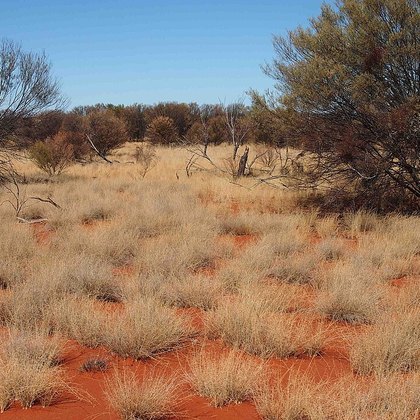
Where the bird is most often found, arranged by main group and formation.

Range and movements
Two separate areas. The larger lies in south-western Western Australia, from the Shark Bay region and the Murchison south through the wheatbelt to the south coast and east along it. The second lies in South Australia, on and around the Eyre Peninsula. Between them lies the gap of the Nullarbor. Resident in the strictest sense: a party holds the same ground year-round and the birds rarely cross more than a few tens of metres of open ground.
- Resident
- dark = core range, pale = thinly spread
Where and when to look
Walk the edge of a belt of dense heath or mallee and listen for the reeling song; the party works through the lowest metre and now and then perches on top of a shrub. At every coloured male, look deliberately at the throat: violet-blue belongs to this species, black to the Purple-backed Fairywren. In the winter months of June and July the males too are mostly brown, and a party can only be placed by range and company.
Conservation
Of Least Concern and still widespread across the Western Australian part of the range, but the species has clearly declined in the wheatbelt. The causes are wholesale clearing of heath and mallee for grain growing, which leaves the remaining shrublands as islands in farmland, and fire that is too frequent and too extensive, after which a site stays empty for years. Cats and the introduced fox take birds from low cover. In the smaller South Australian core the species is more vulnerable, because suitable shrubland is naturally limited there.
Scientific name
Malurus pulcherrimus | Gould, 1844
John Gould described the bird in 1844 from Western Australian material; the type locality was later fixed at the Wongan Hills. pulcherrimus is the Latin superlative of pulcher, beautiful, and so means 'most beautiful of all' — Gould was not sparing in his judgement of the fairywrens. The genus Malurus was introduced by Vieillot in 1816, from Greek malos (soft) and oura (tail). The English name names the feature by which the male differs from its closest relatives: a blue rather than a black breast.