All species › Passerines › Fairywrens, grasswrens and emu-wrens › Red-backed Fairywren
Red-backed Fairywren | Malurus melanocephalus
Roodrugelfje | Maluro dorsirrojo
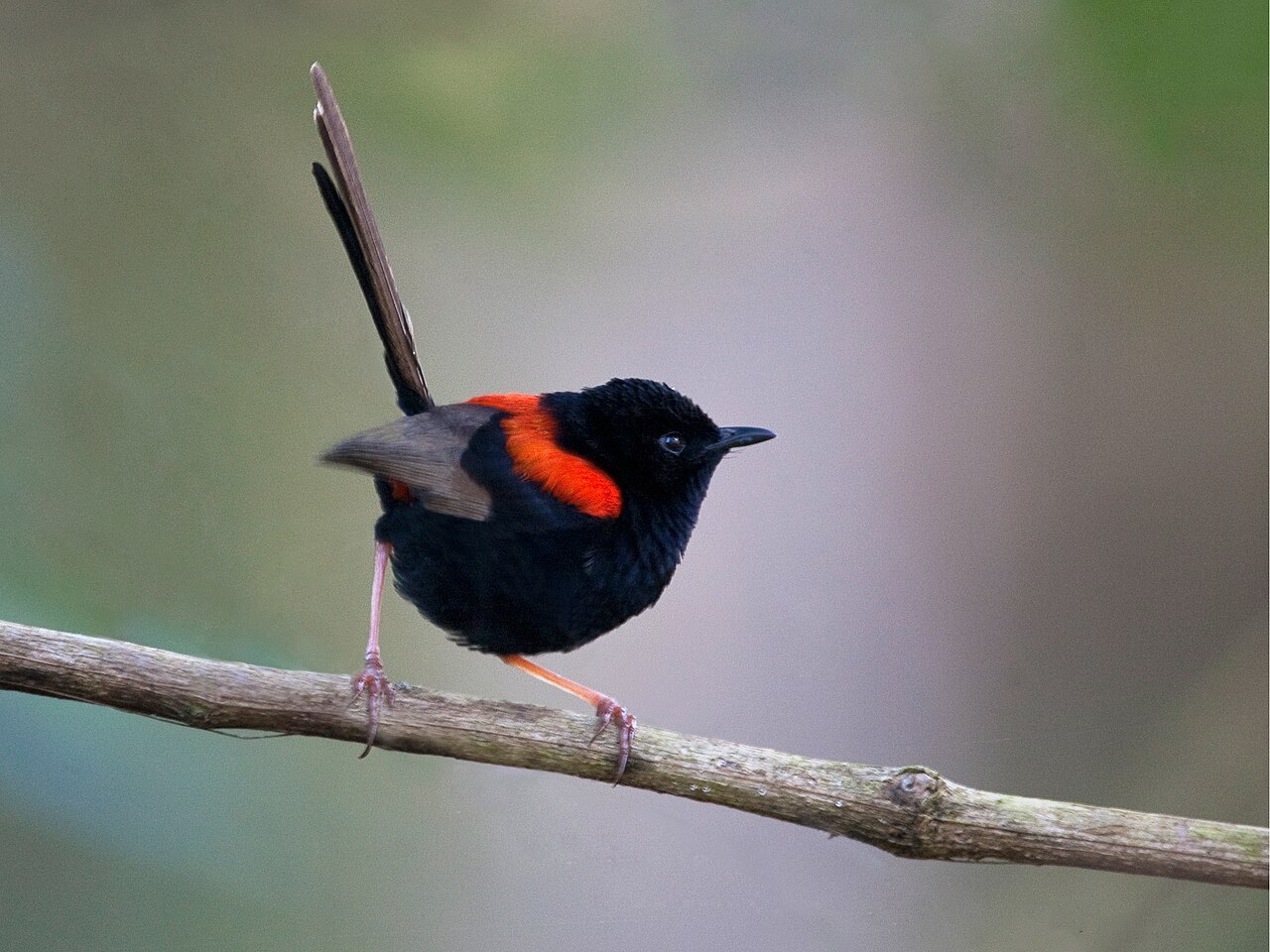
The Red-backed Fairywren is the smallest of the fairywrens and the only one whose breeding male is glossy black with a scarlet or orange back. It is a bird of tall grass in the tropics and subtropics, more often heard than seen.
Voice
A weak, high reeling song: an introductory note followed by short repeated segments that begin soft and end high and shrill. It hardly carries and is often audible only from close by; it is mostly the male that sings, in the breeding season. Foraging birds keep contact with a soft ssst that fades out at ten to fifteen metres, and alarm with a high zit.
No freely licensed recording has been found for this species yet; what to listen for is described below.
Identification
Eleven and a half centimetres, six of them tail — the smallest fairywren of all. The breeding male is glossy black with a scarlet to orange saddle across the back, brown wings and a short, square-tipped tail. Females, young birds and eclipse males are warm light brown with pale underparts, pale lores and eye-ring and a yellowish spot below the eye; the male then has a black bill, the female a pinkish-brown one, and the female's tail is longer and more pointed. There is no blue anywhere in the plumage. Males reach full breeding dress only in their fourth year, and some breed in eclipse plumage.
Confusion species
The breeding male can be confused with nothing. The brown birds are another matter: the Superb Fairywren (Malurus cyaneus) is larger and has orange-red lores, Malurus lamberti and Malurus assimilis are larger and longer-tailed, and the Purple-crowned Fairywren (Malurus coronatus) has a blue tail and keeps strictly to riverside growth. The best mark on the female is a negative one: alone among fairywren females she has no blue tint at all in the tail. With Malurus leucopterus it barely overlaps.
Habitat
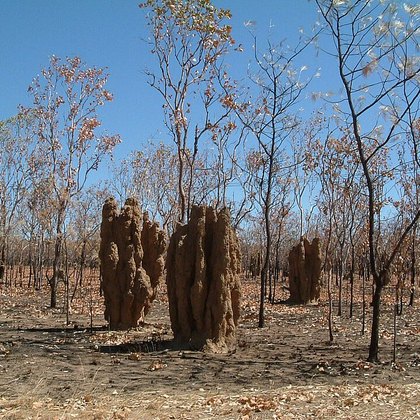
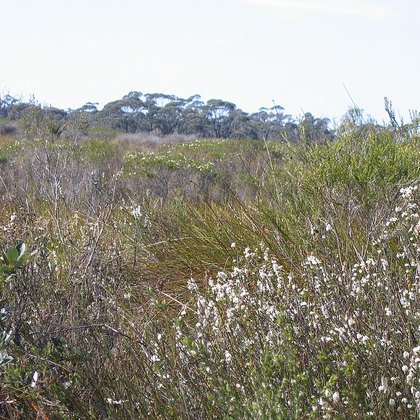
Dense understorey of tall grasses in tropical and subtropical country: heathland and eucalypt savannah, swards of spear grass and blady grass, and rank growth along creeks and coastal plains. It keeps low in the grass and feeds there, sometimes in shrubs and trees.
Where the bird is most often found, arranged by main group and formation.

Range and movements
Endemic to northern and eastern Australia, from Cape Keraudren in northern Western Australia through the Kimberley, Arnhem Land and the Gulf Country to Cape York and down the east coast to the Hunter Region of New South Wales. The northern form is smaller, shorter-tailed and scarlet-backed, the eastern larger, longer-tailed and orange; in northern Queensland, between the Burdekin, Endeavour and Norman Rivers, lies a broad band in which all intermediates occur. Resident, but nomadic in country with frequent fires.
- Resident
- dark = core range, pale = thinly spread
Where and when to look
Walk a grass flat with scattered shrubs and watch for a low, short flight of something black and red: that is usually the whole of the view you get. The voice is so soft that you must almost stand over it. Displaying males carry red petals in the bill — in the other fairywrens they are yellow, pink or purple.
Conservation
Not threatened. Clearing and grazing have locally increased rather than reduced the area of suitable grassland. Breeding work on this species is limited; less is known of its nest, set low and well hidden in a grass tussock, than of those of the southern fairywrens.
Scientific name
Malurus melanocephalus | (Latham, 1801)
John Latham described the bird in 1801 as Muscicapa melanocephala, from a specimen taken near Port Stephens in New South Wales; because the species later moved to Malurus, author and year stand in parentheses. The name means black-headed, from Greek melas (black) and kephale (head) — Latham had a moulting male before him, mixed black and brown, and named it for what he saw. In 1840 Gould described the short-tailed, scarlet-backed northern form as Malurus cruentatus, bloodstained, from material collected by Benjamin Bynoe aboard the Beagle. In 1939 Tom Iredale proposed the name elfin-wren, which never took hold.