All species › Passerines › Fairywrens, grasswrens and emu-wrens › White-winged Fairywren
White-winged Fairywren | Malurus leucopterus
Witvleugelelfje | Maluro aliblanco
The White-winged Fairywren is the fairywren of the open, dry interior: a bird of eleven to thirteen centimetres that runs across bare ground between low shrubs in loose groups. On the mainland the breeding male is deep cobalt blue with snow-white wings; on two islands off the west coast that same male is glossy black with white wings.

Voice
A high, thin series that begins with sharp chip notes and runs into a fast, slender trill: the same plan as in the other fairywrens, but higher and weaker, and in the wind of the plains barely audible at twenty metres. The contact note is a short, dry tset by which the group keeps together as it shuffles through the saltbush.
No freely licensed recording has been found for this species yet; what to listen for is described below.
Identification
Eleven to thirteen centimetres, more than half of it tail, usually carried cocked. On the mainland the breeding male is uniform cobalt blue from crown to belly, with sharply contrasting white shoulders and white secondaries and a black bill; the tail is blue. On Dirk Hartog Island and Barrow Island that male is not blue but glossy black, again with white wings. The female is pale sandy to grey-brown above and white below, with a pale horn-pink bill and a blue-grey tail; there is no red-brown marking around eye or lore. The male out of the breeding season resembles the female but keeps the black bill.
Confusion species
Of the nine fairywrens in this guide this is the only one with white in the wing; a blue male with white shoulders can be confused with nothing else. Splendid Fairywren (Malurus splendens) comes closest, for that male is all blue as well, but has blue rather than white wings and keeps to denser shrubbery; the two share large tracts of the dry interior. Purple-backed Fairywren (Malurus assimilis), spread over much the same interior, has a chestnut shoulder patch and a black breast band. Red-backed Fairywren (Malurus melanocephalus), which takes over to the north, has a red back and black underparts. The difficulty lies with females and with males in eclipse, which in all fairywrens are largely brown. Then look at the pale, blue-grey tail and the absence of red-brown around the eye, which separate this female from those of Superb Fairywren (Malurus cyaneus) and Splendid Fairywren.
Habitat
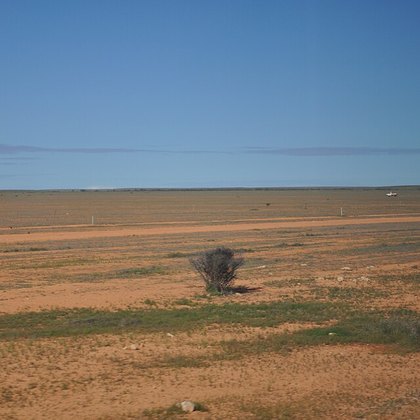
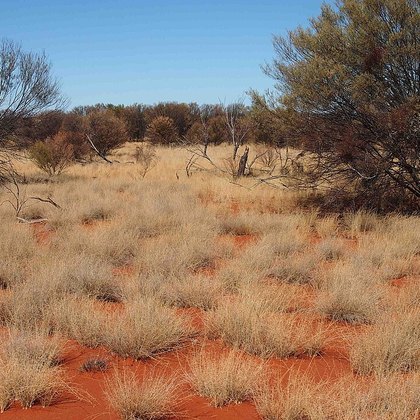
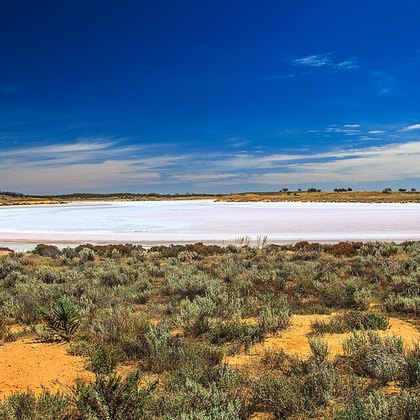
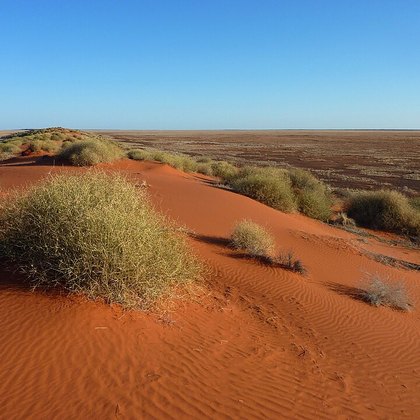
Low, open shrubland of the dry interior: saltbush and bluebush plains, samphire around salt lakes and salt pans, spinifex, mulga with an open understorey, and vegetated dunes. What matters is not the plant species but the structure: scattered low shrubs with bare ground between them, across which the birds run. Dense forest and tall growth are avoided.
Where the bird is most often found, arranged by main group and formation.

Range and movements
Across almost the whole of arid and semi-arid mainland Australia, from the west coast to western Queensland and the interior of New South Wales. It is absent from the wet tropics of the far north, from Tasmania, and from the humid coasts of the south-east and south-west. In addition there are two island populations off Western Australia, on Dirk Hartog Island and Barrow Island. Resident: groups hold the same ground year-round, though densities can fall sharply after a long drought.
- Resident
- dark = core range, pale = thinly spread
Where and when to look
Look for it on a shrub rather than in one: of all the fairywrens this species most often uses an exposed lookout, commonly the topmost twig of a saltbush, and from there the blue and white shows at a hundred metres. Otherwise the group gives itself away by short sprints across open ground. The birds are most active in the first hours after sunrise; in the heat of the day they sit still in the shade beneath the bushes.
Conservation
Not threatened and widespread throughout its range. It is one of the few passerines that depend on vast, meagre shrubland, and that is exactly where it holds on. Locally, overgrazing by stock and burning that is too frequent or too hot depress densities by removing the low shrub layer. The two island forms have small populations and are therefore vulnerable to fire and to introduced cats.
Scientific name
Malurus leucopterus | Quoy & Gaimard, 1824
Quoy and Gaimard described the species in 1824 in the Dictionnaire des sciences naturelles, from a bird taken on Dirk Hartog Island off the west coast of Australia. That matters for the name: on that island the male is black with white wings, so the white in the wing was the feature that stood out. leucopterus is Greek for white-winged, from leukos (white) and pteron (wing). The genus Malurus was introduced by Vieillot in 1816, from Greek malos (soft) and oura (tail). That the blue mainland birds became known only later explains why the most widespread form carries a name that refers to an island bird.