All species › Birds of prey › Kites, Old World vultures, eagles and hawks › Brahminy Kite
Brahminy Kite | Haliastur indus
Brahmaanse wouw | Milano brahmán
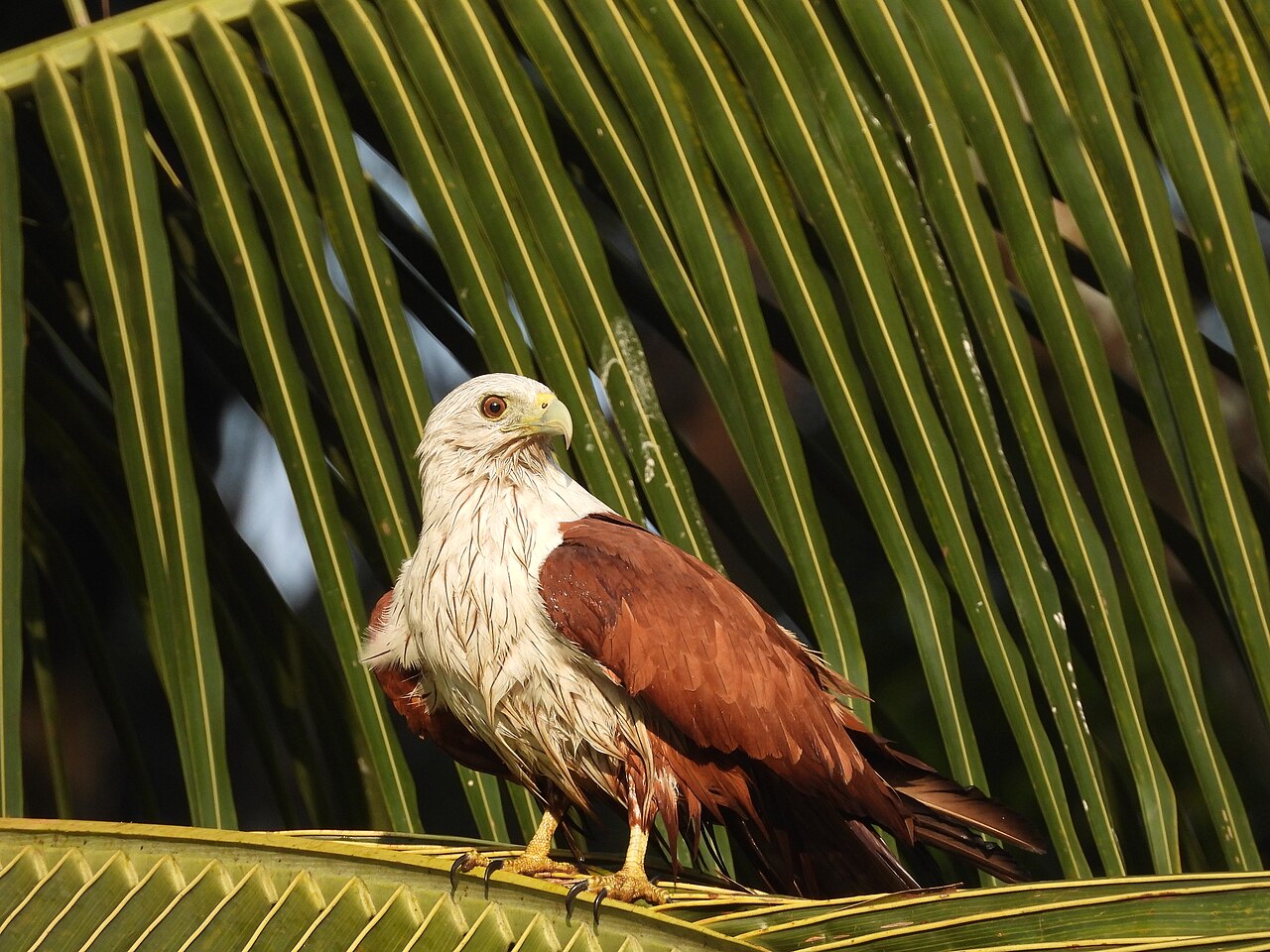
The Brahminy Kite is the raptor of the northern coast: a medium-sized kite with a pure white head and breast against a deep chestnut body, patrolling low over mangrove creeks and harbours and picking dead fish from the water. In adult plumage it cannot be confused with any other Australian raptor.
Voice
Usually silent. Where it does call there is a drawn-out descending wail suggesting a bleating lamb: pee-ah-ah-ah, often from a branch over the water or in flight at the nest. Softer mewing notes pass between partners. It is not a penetrating sound and it does not carry — you are more likely to hear it once you are already under the tree.
Recording: Indra Kusuma — CC BY-NC-SA 4.0 · Danau Siombak, Indonesia · xeno-canto
Identification
A compact kite of half a metre. Head, neck and breast are white, the rest of the plumage chestnut, and the broad wings end in dark fingered tips. The tail is noticeably short and rounded, tipped white. The bill is stoutly hooked and lemon-yellow, the eye dark, the legs short and bare. In flight the short tail makes it look front-heavy, pushed forward into the wing. Young birds lack the white entirely: they are plain brown with pale wing patches and light streaking on the head, and only in the third year is the head fully white.
Confusion species
The risk is with the young bird. Whistling Kite (Haliastur sphenurus) is the direct relative and very like a juvenile Brahminy, but larger and shaggier, with a longer rounded tail and a clear pale M across the underwing that young Brahminy lacks; Brahminy is shorter and stubbier in the tail and keeps strictly to the coast. Black Kite (Milvus migrans) has a clearly forked tail. Osprey (Pandion haliaetus) shares the coastal ground and also shows white below, but is far larger, with long kinked wings and a white head with a dark eye-stripe.
Habitat
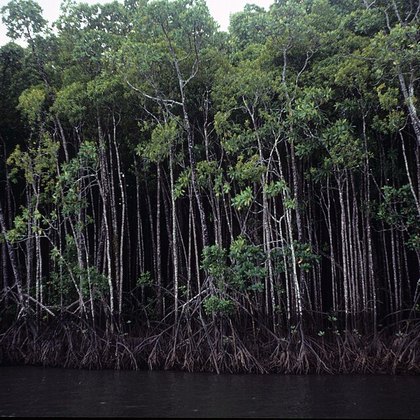
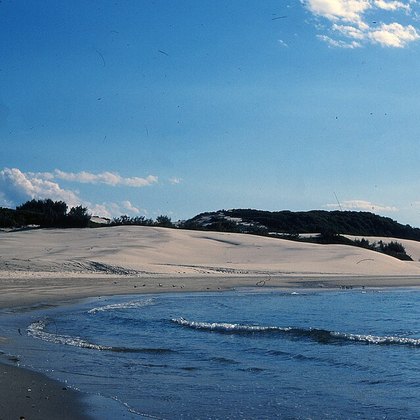
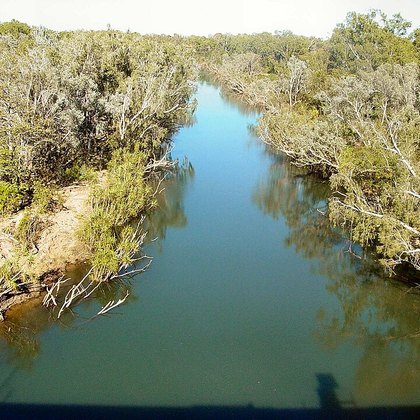
A bird of the coast: mangrove forest, estuaries and mudflats, sandy beaches, rocky shores and river mouths. It is equally at home in harbours, at fishing wharves and over aquaculture ponds, and follows the big northern rivers tens of kilometres inland. The nest is nearly always in a living tree by water, often a mangrove, and is a structure of sticks, seaweed and driftwood finished with lichen, bones and even paper.
Where the bird is most often found, arranged by main group and formation.


Range and movements
The tropical Australian coastline, from the Pilbara and the Kimberley in Western Australia through the Top End and the Gulf of Carpentaria and Cape York to northern New South Wales; the further north, the more numerous. South of Sydney it is a vagrant, and it is absent from Tasmania and New Zealand. Beyond Australia its range covers tropical Asia, but that falls outside this guide's map window.
- Resident
- dark = core range, pale = thinly spread
Where and when to look
Stand at a mangrove creek on a falling tide and watch the water: it patrols low on slow beats and drops to the surface with its feet forward to lift a dead fish or a crab. The harbours and fishing wharves of Darwin, Broome and Cairns are the surest places, and there the white of head and breast lights up even against the sun.
Conservation
Least Concern (LC), with a world range from India to the Solomons and, in Australia, a stable and locally increasing population along the tropical coast. Local pressures are the clearing of mangrove for ports, tourism and aquaculture, and entanglement in discarded fishing line and net that gets worked into the nest. Because it keeps company with people it is also exposed to poisoning through carrion and refuse.
Scientific name
Haliastur indus | (Boddaert, 1783)
Boddaert described the species in 1783 as Falco indus, from an illustrated plate by Daubenton; because the bird was later moved to another genus, author and year stand in parentheses. The genus Haliastur was introduced by Selby in 1840 and combines Greek hals 'sea' with Latin astur 'hawk'. indus simply means 'of India'; the type locality is Pondicherry. The English and Dutch names point to the bird's standing in India, where it is held sacred and identified with Garuda, the mount of Vishnu.